


Wheat imports likely to fall 11% in 2026-27
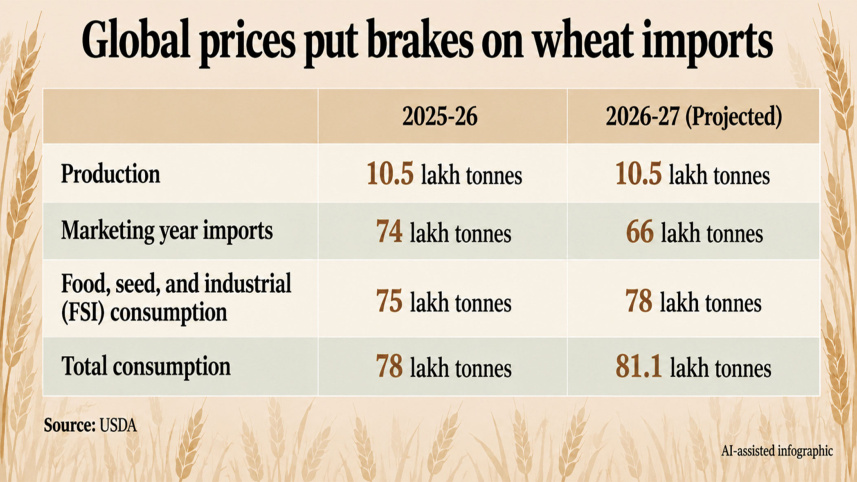
Bangladesh’s wheat imports are expected to fall by 11 percent to 66 lakh tonnes in the 2026-27 marketing year as high global prices, large stocks and uncertainty over global supplies weigh on demand.
The country relies on imports for more than 80 percent of its wheat-based food needs. It imported 74 lakh tonnes of wheat in the previous marketing year, according to a recent United States Department of Agriculture (USDA) report on Bangladesh.

The wheat marketing year runs from July to June.
The USDA said disruptions to grain shipments from Russia and Ukraine had reduced export supplies from the Black Sea, making global supply and trade flows less predictable for countries that depend heavily on imports.
US wheat export prices have increased by $26 per tonne since July. Hard Red Winter (HRW) wheat reached $321, or more than Tk 39,500, per tonne in August, partly because the disruptions increased market volatility.
“Because Bangladesh’s wheat import market is highly price-sensitive, higher global prices are expected to reduce import demand,” the report said.
LARGE STOCKS TO LIMIT FRESH IMPORTS
The private sector imported a large volume of wheat last year, pushing total imports to a record high, the USDA said. Private millers and traders are now holding substantial stocks, which are expected to reduce the need for fresh imports this year, particularly if global prices remain elevated.
Private-sector wheat imports rose 16 percent to nearly 66 lakh tonnes last year, while public-sector imports increased 61 percent to 7.51 lakh tonnes.
The increase in public-sector imports was largely driven by purchases from the United States after the government signed a memorandum of understanding (MoU) with US Wheat Associates.
Under the MoU, Bangladesh procured about 7.45 lakh tonnes of US wheat during the period, according to the USDA.
The government has committed to buying up to 7 lakh tonnes of US wheat annually until 2030. It has already contracted around 2.2 lakh tonnes for this year.
Despite the expected decline in imports, the USDA forecasts wheat consumption at 78 lakh tonnes this year, 4 percent higher than its previous estimate.
Demand for wheat flour remains strong among households and industries producing biscuits, confectionery, pasta, noodles and bakery products.
“As rice prices have remained high for more than a year, many households are now consuming more wheat flour than before,” the USDA said.
LOCAL PRODUCTION REMAINS LARGELY UNCHANGED
The USDA kept its forecast for local wheat production unchanged at 10.5 lakh tonnes.
It said both wheat acreage and production have remained largely stagnant in recent years.
“Despite strong domestic demand for wheat and wheat flour, farmers have shown limited interest in expanding wheat cultivation,” the report said.
Farmers can earn higher returns from other crops, such as vegetables and corn, during the same Rabi season. This reduces their incentive to use more land for wheat, the USDA said.
 For all latest news, follow The Daily Star's Google News channel.
 The agency also identified the limited availability of high-yielding wheat varieties suited to local conditions as a major constraint on production.
These factors are expected to continue limiting any significant increase in wheat acreage and production this year.
Comments