


Salt imports raise concerns among local producers

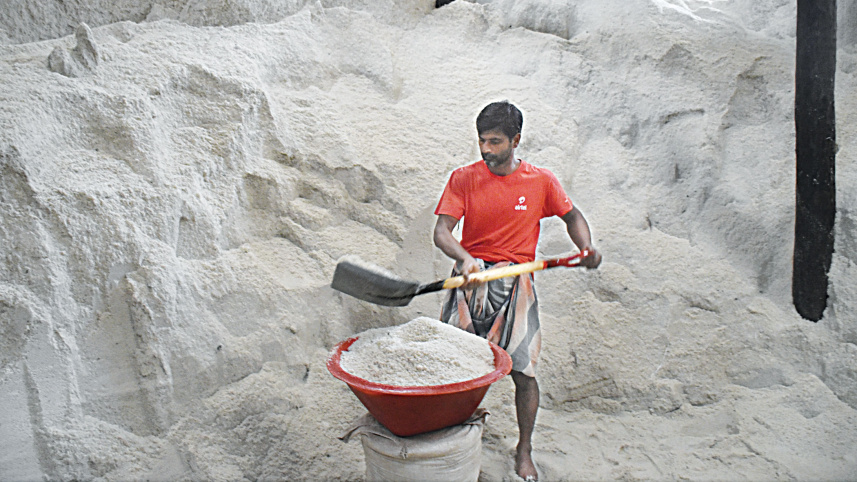
Bangladesh has approved imports of 150,000 tonnes of unrefined salt just weeks before the new domestic production season, raising concerns among farmers and refiners over the need for the purchases and their impact on local producers.
The government says the imports are a precaution against a possible supply shortfall after weather disruptions hit production in Cox’s Bazar, the country’s main salt-producing region. But farmer representatives and industry executives say existing stocks are sufficient and cheaper imports could depress local prices.

The Office of the Chief Controller of Imports and Exports issued the approval on September 23 following recommendations from the ministries of commerce and industries. The allocation covers 251 registered and operational salt mills identified by the Bangladesh Small and Cottage Industries Corporation (BSCIC).
The selected mills must apply for import permits by October 1 and submit renewed import registration certificates, trade licences and membership certificates of the Bangladesh Salt Mill Owners Association, along with a Tk 5,000 fee.
Gias Uddin, general secretary of the Salt Farmer Welfare Association, said existing stocks could meet domestic demand for at least two months.
“Even without imports, the existing stock can easily meet demand for four months,” Gias told The Daily Star.
He estimated that farmers and millers together held more than 10 lakh tonnes of crude salt, although official stock figures may differ. He warned that imports during the peak production season could push down local prices and discourage cultivation.
“If farmers do not get a fair price, they will stop producing salt,” he said.
Md Quamrul Hassan, executive director and chief operating officer (COO) of ACI Consumer Brands, said BSCIC data showed around 600,000-700,000 tonnes of salt in stock.
The new production season begins in November and normally runs until May. Production is highly weather-dependent, with even a single day of rain potentially causing a week-long production loss, Hassan said.
Annual salt demand is around 20 lakh tonnes, including industrial and edible salt, while edible salt demand is estimated at 700,000-750,000 tonnes, he said.
Imported salt, particularly from India, can be cheaper to refine because of its higher sodium chloride content, Hassan said. He also questioned the allocation of import permits among the 251 mills, alleging that some registered mills have limited production or demand.
He estimated that importing 150,000 tonnes could result in a foreign-exchange outflow of at least $6 million.
The Bangladesh Vacuum Salt Manufacturers’ Association, whose members supply around 70 percent of the country’s salt demand, had sought an additional allocation of at least 50,000 tonnes of crude salt but was not granted the request, Hassan said.
A senior executive of a branded salt manufacturer, who declined to be named, said five major companies -- ACI Salt Limited, Molla Salt Triple Refinery Limited, Confidence Salt Limited, Meghna Group of Industries and City Group -- account for around 70 percent of total demand.
However, Sorwar Hossen, chief of the Salt Cell at BSCIC, said import decisions are based on supply conditions and the risk of shortages.
Salt production stood at 1.945 million tonnes last year against estimated demand of 2.715 million tonnes, leaving a theoretical shortfall of about 770,000 tonnes, he said. Demand was later revised to 2.534 million tonnes based on actual consumption.
“Even then, theoretically, there is a gap between production and demand,” Sorwar said.
He said supplies generally remain comfortable until mid-December, while new-season production takes time to build up. Last year, only 253 tonnes were produced in November against monthly demand of about 221,000 tonnes. Production rose to around 5,000 tonnes in December and 50,000 tonnes in January, with full-scale production beginning after Jan 20.
“Each month, we need around 2.11 lakh tonnes of crude salt,” Sorwar said.
 For all latest news, follow The Daily Star's Google News channel.
 Around 490,000 tonnes of salt are currently held in field stocks, according to a recent report. Sorwar said the latest import decision was intended as a contingency measure against temporary shortages caused by adverse weather.
The allocation has also highlighted differences among millers. Seven large vacuum-evaporated salt manufacturers were allocated 2,500 tonnes each, while other mills received 543 tonnes each based on production capacity.
Nurul Kabir, president of Bangladesh Labon Mill Malik Samity, said imported salt is ultimately supplied to the market by the millers who import it, with the destination depending on processing method and demand.
He said mechanically processed salt goes to both edible and industrial markets, while traditionally processed salt is mostly used by industries. Some buyers also ask millers to import crude salt according to their requirements for a service fee.
Comments