


Small businesses power industry, employ over 3cr
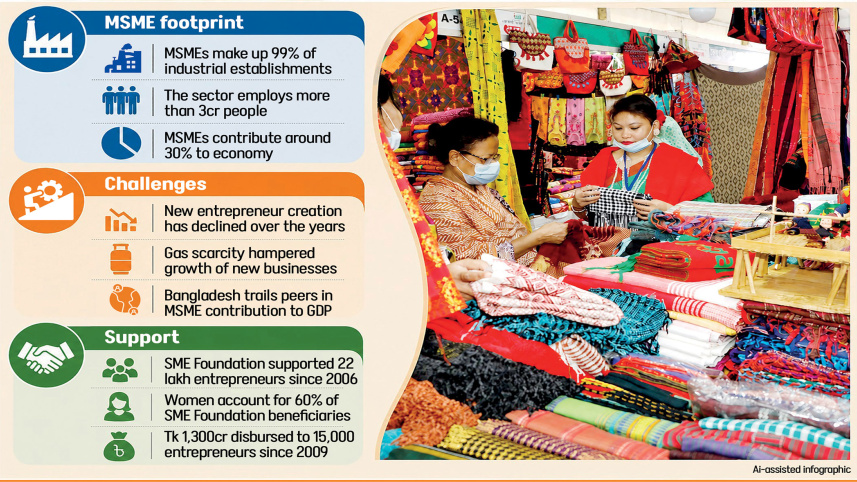
Micro, small and medium enterprises (MSMEs) account for nearly 99 percent of Bangladesh’s 1.17 crore industrial establishments and employ more than three crore people, underlining their crucial role in the country’s economy.
The sector contributes around 30 percent to the economy and provides nearly 85 percent of industrial employment, according to the SME Foundation’s analysis of the Bangladesh Bureau of Statistics’ Economic Census 2024. The analysis was released on the occasion of International MSME Day.

The SME Foundation said the cottage, micro, small and medium enterprise sector remains a key driver of employment and socio-economic development, particularly in a country with a large population and limited resources.
Since its establishment under the industries ministry in 2006, the foundation has supported about 22 lakh small and medium entrepreneurs through various programmes, with women accounting for 60 percent of the beneficiaries.
FY27 budget prioritises MSME development with SME Foundation service platforms, cluster mapping updates, YESS programme, and broad support including mentorship, training, credit access, exports, branding, and market expansion for entrepreneurs
Speaking at a programme marking International MSME Day at the Bangladesh Investment Development Authority auditorium in Agargaon yesterday, Industries, Commerce, and Textiles and Jute Minister Khandakar Abdul Muktadir said Bangladesh still lags behind many regional countries in terms of MSMEs’ contribution to GDP.
“In countries like Vietnam, Cambodia, and even India and Pakistan, MSMEs contribute much more to GDP than they do in Bangladesh. We want to raise their contribution,” he added.
Muktadir said the rate of new entrepreneur creation had declined sharply over the past 12 to 15 years, contributing to rising income inequality.
“Those who already owned industries and factories became bigger, while fewer new entrepreneurs were able to emerge. One of the main reasons was the shortage of gas,” he added. He also said economic opportunities had become concentrated in the hands of a small group.
“This has kept economic activity concentrated among a few people. It is one of the main causes of rising inequality, and unfortunately, we followed that path. As a result, income inequality is much higher today than it was 15 to 20 years ago,” he added.
The minister stressed that strengthening the MSME sector is essential for keeping the economy dynamic and inclusive.
To promote entrepreneurship, the government is preparing a comprehensive plan to support new entrepreneurs through development and mentorship programmes, he added.
The government is also launching mentorship programmes and has started initiatives to establish new industrial parks through the Bangladesh Small and Cottage Industries Corporation in Pabna, Sylhet and Saidpur in Nilphamari.
It also plans feasibility studies for additional industrial parks where existing ones are fully occupied. Addressing the gas crisis, Muktadir said the government would prioritise industries with lower energy consumption while continuing efforts to ease gas shortages affecting factories.
He added that the national budget for FY27 gives special importance to MSME development and creating new entrepreneurs.
The budget includes plans to establish service platforms through the SME Foundation, update SME cluster mapping, and implement the Youth Entrepreneurship & Startups for Students (YESS) programme.
It also includes targeted support for new entrepreneurs through mentorship, technical training, database development, demand-based credit, export support, branding and design assistance, and improved access to local and international markets.
WOMEN REMAIN UNDERREPRESENTED
Nasreen Fatema Awal, president of the Women Entrepreneurs Association of Bangladesh, highlighted the wide gender gap in entrepreneurship.
She said Bangladesh has around one crore male entrepreneurs, compared with only about 7 lakh women entrepreneurs.
 For all latest news, follow The Daily Star's Google News channel.
 “This gap is not just a statistic; it reflects the untapped potential of our economy,” she added.
Nasreen also said that increasing the number of women entrepreneurs would create more jobs, raise household incomes, improve children’s education and healthcare, and make economic growth more inclusive.
Anwar Hossain Chowdhury, managing director of SME Foundation, said more than 250,000 entrepreneurs have received direct assistance from the organisation since its inception.
Since 2009, the foundation has disbursed around Tk 1,300 crore in loans to nearly 15,000 entrepreneurs through its credit wholesaling programme. At least 25 percent of the recipients are women.
He said the foundation continues to promote entrepreneurship, strengthen business capacity, encourage technology adoption, expand market access, and advocate policy reforms to make Bangladesh’s MSME sector more competitive.
Comments