


Weak institutions cost Bangladesh billions in tax revenue: WB
Weak public institutions are holding back Bangladesh’s economic growth and costing the country billions in lost tax revenue, the World Bank said yesterday, urging reforms to tax administration, procurement, auditing and project implementation.
“These are facts, but they are also symptoms of deeper structural issues. At the core of those issues are weak institutions,” said Jean Pesme, World Bank country director for Bangladesh, at the launch of the Strengthening Institutions for Transparency and Accountability (SITA) project in Dhaka.

Citing the WB’s Country-Level Institutional Assessment and Review based on 2023 data, Jean said Bangladesh ranks in the bottom quartile among upper-middle-income countries in eight of 13 institutional clusters. The areas include political institutions, social institutions, integrity, justice, human resource management, public finance, labour and social protection, and service delivery.
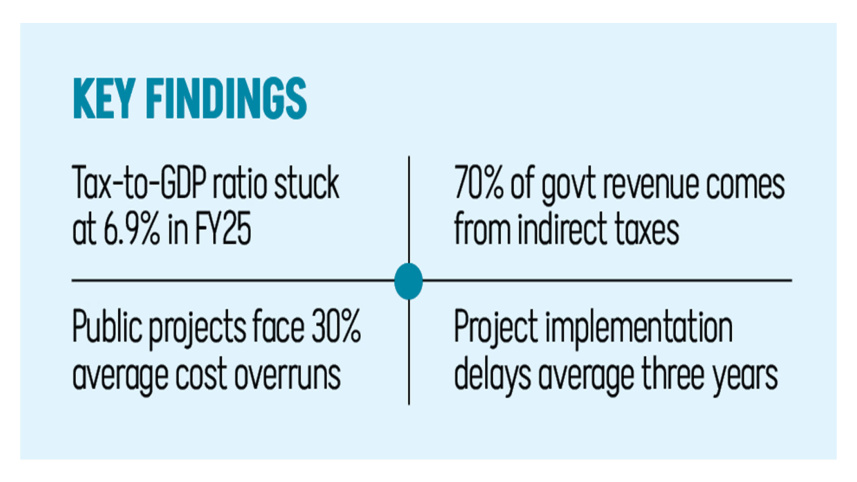
The costs are heavy. Jean pointed out that Bangladesh’s tax-to-GDP ratio stood at only 6.9 percent in fiscal year 2024-25, which is less than half of the roughly 15 percent considered necessary to finance the country’s development ambitions.
Around 70 percent of government revenue comes from indirect taxes, reflecting a narrow and inequitable tax base, he added.
According to the WB, public investment projects face average cost overruns of around 30 percent and implementation delays of about three years, while Bangladesh ranks 116th among 137 countries in infrastructure quality.
“Weaknesses in procurement and public investment management undermine infrastructure outcomes and public service delivery,” Jean said.
He described Bangladesh as being at an “inflection point”, with economic growth slowing over the past three years, fiscal pressures mounting, job creation weakening and external shocks exposing long-standing structural vulnerabilities.
Poverty reduction has also slowed, with 8.9 percent of the population projected to live below the $3-a-day poverty line in 2025.
“The next game for Bangladesh will depend less on policies alone and much more on how effectively institutions can implement them and close the execution gap,” he said.
He welcomed the government’s decision to separate tax policymaking from tax administration, calling it an important step toward stronger accountability and taxpayer confidence.
According to the WB official, the FY27 budget’s revenue and service delivery targets were ambitious but contingent on institutional capacity to deliver.
“It’s about outcomes and results,” he said, adding that the government’s emphasis on digitalising tax administration and improving compliance is consistent with the reform agenda supported by the WB.
The SITA project, financed by a $250 million WB credit, will seek to modernise five institutions: the National Board of Revenue (NBR), the Bangladesh Bureau of Statistics (BBS), the Bangladesh Public Procurement Authority (BPPA), the Office of the Comptroller and Auditor General, and the Planning Division.
Successful implementation of the project is expected to result in higher revenue collection, more efficient public spending, greater procurement transparency and stronger public auditing.
The WB urged authorities to accelerate the rollout of digital tax systems at the NBR, improve data accessibility and timeliness at the BBS, strengthen project selection and monitoring in the Planning Division and the IMED, expand the electronic Government Procurement (e-GP) system and fast-track audit reforms.
“The next 18 months are critical. Only early results will ensure credibility, public trust and reform momentum,” Jean said.
State Minister for Planning Jonayed Abdur Rahim Saki, who inaugurated the project, said the government is committed to strengthening public institutions through technology to improve transparency and accountability.
He said digitising core government agencies would improve revenue mobilisation, public financial management, auditing, procurement and development planning while helping curb corruption, misuse of public funds and money laundering.
 For all latest news, follow The Daily Star's Google News channel.
Comments