


Smarter regulation for a competitive insurance industry

Bangladesh stands at a historic crossroads. As the country prepares for the post-Least Developed Country (LDC) era, sustaining economic growth will require more than expanding exports and attracting investment. It will also require modern financial institutions capable of managing risk, mobilising capital and inspiring investor confidence. Among them, the insurance sector is indispensable.
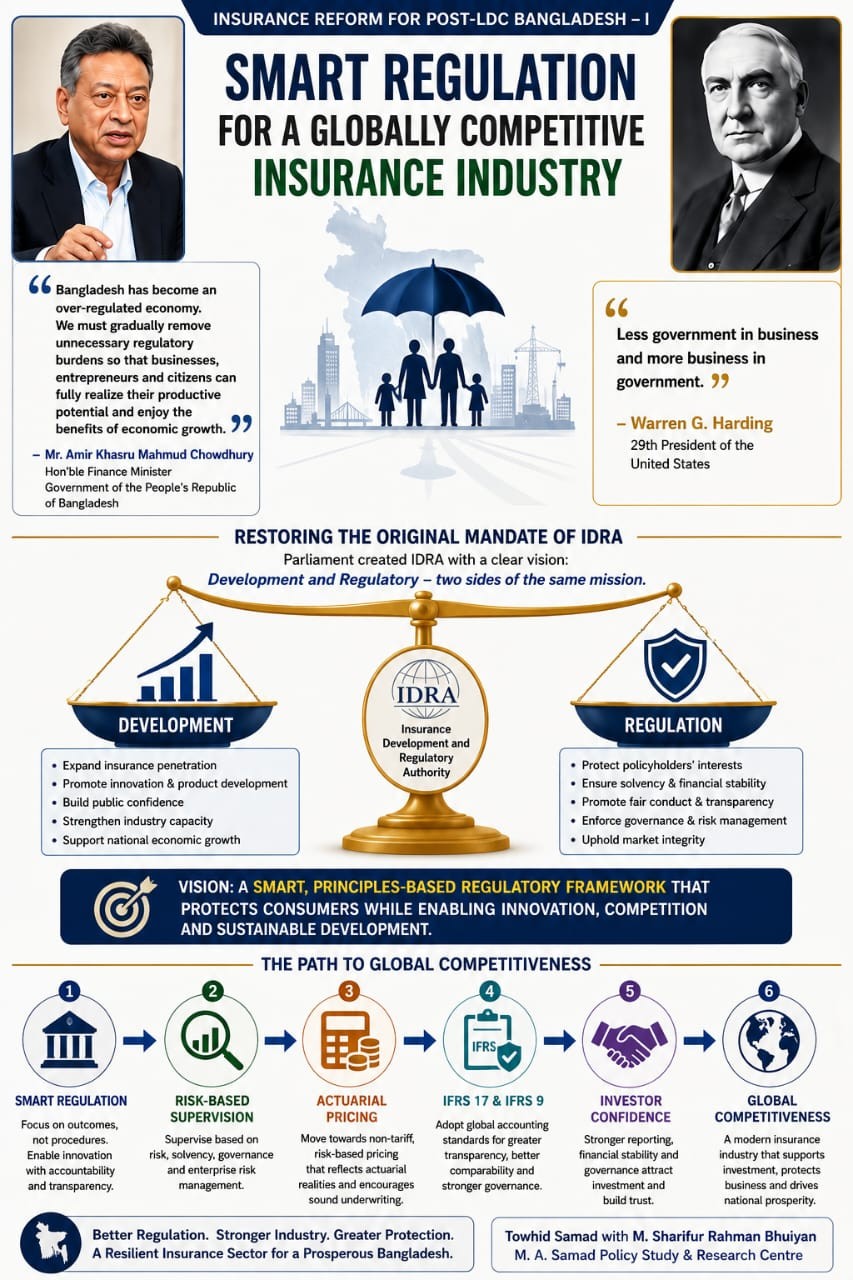
Recently, Finance Minister Amir Khasru Mahmud Chowdhury reiterated the government’s commitment to reducing unnecessary regulatory burdens to improve the business environment, encourage private sector investment and strengthen Bangladesh’s global competitiveness. That reflects an important principle: regulation should protect the public interest while enabling enterprise, innovation and sustainable growth.

The same principle applies to the insurance sector. When the parliament enacted the Insurance Act, 2010, it established the Insurance Development and Regulatory Authority (IDRA). The inclusion of the word “Development” before “Regulatory” reflected a clear legislative vision. The authority was expected to supervise insurers while expanding insurance penetration, strengthening public confidence and encouraging innovation.
Fifteen years later, the sector offers an opportunity for reflection. While the regulatory framework has expanded, the industry’s development indicators have not kept pace. Insurance penetration has declined, public confidence remains fragile, and Bangladesh continues to lag behind many regional economies in insurance density and market development.
This is not an argument against regulation. Effective oversight is essential to protect policyholders, ensure solvency and maintain financial stability. The question is whether the balance between regulation and development now requires recalibration.

Insurance is unlike most other industries. It relies on actuarial science, risk modelling, underwriting, reinsurance, capital adequacy and long-term financial commitments. Modern supervision therefore depends not only on administrative capability but also on expertise in actuarial science, enterprise risk management, accounting, digital innovation and international insurance practice. As insurance markets have evolved, so has regulatory philosophy.
Leading jurisdictions increasingly rely on risk-based supervision, focusing on solvency, governance, capital strength, enterprise risk management and the fair treatment of policyholders rather than prescribing routine commercial decisions. This approach strengthens oversight while encouraging innovation and competition.
Bangladesh has an opportunity to embrace this transition. Several policy measures introduced over the past decade, including fixed tariff structures in selected classes of insurance, restrictions on agency commissions, the discontinuation of compulsory third-party motor insurance and greater reliance on operational circulars, were intended to strengthen oversight.
Yet they also raise an important question: would greater emphasis on principles-based supervision and market development better serve policyholders, insurers and the wider economy? Pricing is one area where reform deserves attention. Fixed tariff regimes may offer administrative certainty, but they are increasingly at odds with modern insurance practice. Around the world, insurers compete through actuarially justified, risk-based pricing.
A gradual shift to a non-tariff framework would encourage innovation, improve underwriting discipline, strengthen capital allocation and enhance Bangladesh’s competitiveness.
Accelerating the implementation of IFRS 17, IFRS 9 and appropriate deferred tax readiness would also improve financial transparency, strengthen investor confidence and align Bangladesh more closely with global reporting standards.
The objective is not less regulation, but smarter regulation: protecting consumers while encouraging innovation, safeguarding financial stability while enabling competition and promoting development with the same determination applied to compliance.
As Bangladesh enters a new economic chapter, the measure of regulatory success should not be the number of rules issued, but the resilience of the industry, the confidence of policyholders and the contribution insurance makes to the country’s long-term prosperity.
The next instalment of this three-part series will be published on August 12
 For all latest news, follow The Daily Star's Google News channel.
Comments