


Stock market loses half its BO accounts in a decade

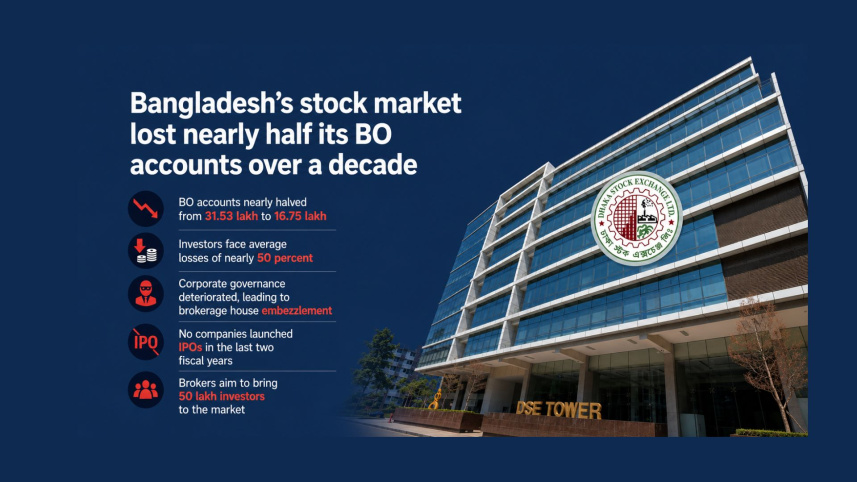
The number of beneficiary owner (BO) accounts -- the depository accounts investors must hold to trade shares in the stock market -- has nearly halved over the past decade, as a dry primary market and an unattractive secondary market pushed investors away.
BO accounts stood at 16.75 lakh at the end of the recently concluded fiscal year 2025-26, down from 31.53 lakh on July 1, 2016, according to Central Depository Bangladesh Ltd (CDBL) data. Such account holders now make up around 0.98 percent of Bangladesh’s population, compared with over 9 percent in India.

“Naturally, investors will remain in the market only when they are assured of earning a reasonable return. We have failed collectively to ensure that, so investors left the market,” said Saiful Islam, president of the DSE Brokers Association (DBA).
Investors who entered the market over the past 10 years now face average losses of nearly 50 percent, he said, as prices of many stocks have fallen by more than half over the decade and many companies have failed to pay dividends.
Islam added that investor protections have been inadequate and corporate governance has deteriorated to such an extent that many investors have suffered losses through certain brokerage houses and asset management companies.
Since 2020, five brokerage houses -- Salta Capital, Moshihor Securities, Banco Securities, Crest Securities and Tamha Securities -- were involved in the embezzlement of around Tk 370 crore combined.
Several banks and non-bank financial institutions have also come close to collapse, compounding investor losses, the DBA president said.
As a result, new investors are reluctant to enter the market while many existing ones have gradually exited, he added.
Furthermore, he noted that many BO account holders keep accounts open solely to apply for initial public offerings (IPOs), but no IPOs have been launched in the past two years, and earlier offerings were generally of poor quality.
Even after BO account maintenance fees were reduced, new account openings remain weak due to the absence of IPOs from fundamentally strong companies, Islam added.
No companies raised funds through IPOs in the last two fiscal years, according to the Dhaka Stock Exchange (DSE). Nine companies raised Tk 841 crore in FY24, and six companies raised Tk 641 crore in FY23. In FY22, eight companies raised Tk 674 crore, while FY21 saw a record 16 companies raise Tk 1,684 crore.
Under these circumstances, stock brokers want to bring 50 lakh investors into the capital market during the tenure of the current government, the DBA President said.
This, however, can only be achieved by bringing quality IPOs to the market, ensuring attractive returns for investors, strengthening corporate governance, and establishing a healthy and well-functioning capital market, he noted.
“We have already discussed these issues with the new commission. Since the reasons behind the market’s poor performance are well known to everyone, and the commission has assured us that these problems will be addressed, I am hopeful that our vision will eventually become a reality,” he said.
Speaking at a DBA event last week, Masud Khan, chairman of Bangladesh Securities and Exchange Commission (BSEC), said the regulator realises the difficulties companies face in listing, and is now trying to ease the process.
“We are going to simplify these rules significantly through amendments,” he said.
 For all latest news, follow The Daily Star's Google News channel.
Comments