Why Bangladesh can’t ignore Myanmar’s diplomatic comeback

In geopolitics, the symbolism of a first foreign visit rarely deceives. When Myanmar’s President Min Aung Hlaing—the retired general who overthrew Aung San Suu Kyi’s elected government in the February 2021 coup—chose India as the destination for his inaugural presidential trip, the region took notice. He arrived in Bodh Gaya on May 30, offered prayers at the Mahabodhi Temple, and flew to New Delhi to meet Prime Minister Narendra Modi with full state honours. Within a fortnight, he was in Beijing, shaking hands with President Xi Jinping in the Great Hall of the People. Two capitals, three weeks. For a former military leader turned head of state under Western sanctions and international isolation, it was an astonishing diplomatic tour de force.
The strategic logic behind each visit is worth unpacking. India chose engagement because Myanmar is its only ASEAN neighbour and an irreplaceable land bridge under New Delhi’s Act East Policy. Two connectivity megaprojects stalled for years by civil war—the Kaladan Multi-Modal Transit Project and the India-Myanmar-Thailand Trilateral Highway—were front and centre on the Modi-Hlaing agenda. India also pressed for access to Myanmar’s vast rare earth deposits and extracted a pledge that Myanmar would not allow its territory to be used against Indian security interests. Receiving Hlaing as president, with all the diplomatic ceremony that implies, was the price of doing business.
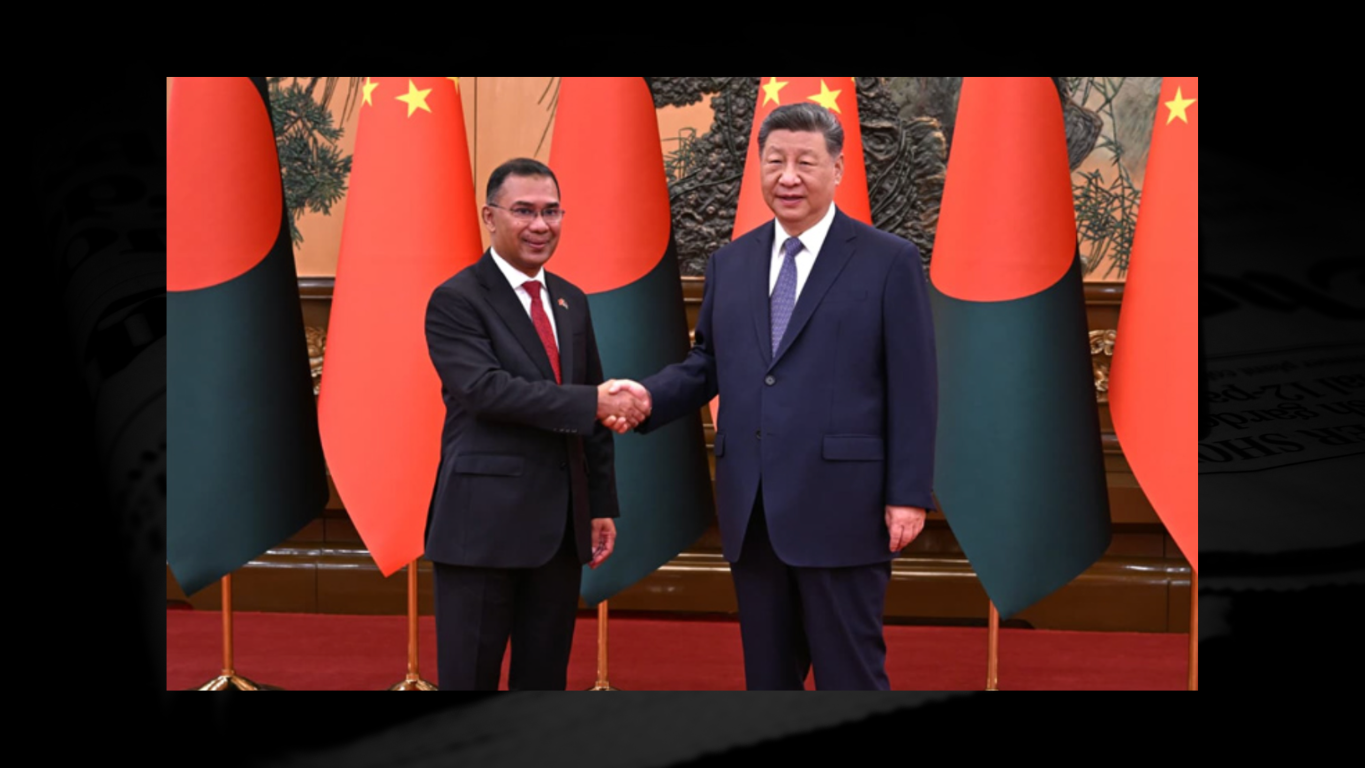
China’s calculation was equally cold-eyed. Beijing has been Naypyidaw’s closest patron since the coup: providing arms, investment, diplomatic protection at the UN Security Council, and pressure on ethnic armed groups. Xi Jinping’s endorsement during the visit—pledging to “deepen comprehensive strategic cooperation” and revitalising the China-Myanmar Economic Corridor linking Yunnan province to the Indian Ocean—was designed to consolidate that patronage. What makes this moment distinctive is that Min Aung Hlaing played both powers deliberately: visiting India first as a signal to Beijing that Myanmar retains alternatives, then flying to China to reaffirm the essential relationship.
It is textbook great-power hedging, executed with considerable skill by a military leader turned politician who spent five years in international quarantine.
Why Bangladesh should be concerned
For Bangladesh, these are not events to observe from a comfortable distance. They are structural shifts happening on its doorstep, and they carry direct, measurable consequences.
The deeper strategic risk, however, is not confrontation but circumvention. If the Kaladan Corridor and Trilateral Highway eventually connect India directly to Southeast Asia via Myanmar, Bangladesh’s potential value as a regional transit hub diminishes. If China’s revitalised Myanmar Economic Corridor takes shape, another major connectivity architecture emerges in which Dhaka is not a node.
The most immediate is the Rohingya crisis. As of January 2026, Bangladesh was hosting over 1.18 million Rohingya, including 143,327 new arrivals, at a humanitarian cost the country can no longer sustainably bear. The 2025–26 Joint Response Plan sought $934.5 million and remains chronically underfunded as global donor attention drifts towards Ukraine, Gaza, and other emergencies. Repatriation—the stated goal of every Bangladeshi government—requires Myanmar to make political commitments on Rohingya citizenship, security guarantees, and property rights that Naypyidaw has consistently refused to honour. A regime now actively courted by Asia’s two regional powers faces even less external pressure to make those commitments. Worse, the territory bordering Bangladesh is no longer controlled by the Tatmadaw at all. Since December 2024, the Arakan Army has held most of northern Rakhine, including Maungdaw. Any repatriation arrangement that ignores this non-state reality is not a plan—it is a fiction.
Along the actual border, the security situation has become acutely alarming. Many Bangladeshi fishermen and Rohingya residents remained in Arakan Army custody as of May 2026, some having been detained for over a year in what has effectively become a prolonged and forgotten hostage crisis. Landmines contaminate agricultural land in Bandarban district. Methamphetamine (Yaba) trafficking through the Naf River corridor has reached record seizure volumes. Bangladesh’s Home Minister has announced plans to fence segments of the 270-kilometre border—a stark acknowledgement that conventional border management has been overwhelmed.
The deeper strategic risk, however, is not confrontation but circumvention. If the Kaladan Corridor and Trilateral Highway eventually connect India directly to Southeast Asia via Myanmar, Bangladesh’s potential value as a regional transit hub diminishes. If China’s revitalised Myanmar Economic Corridor takes shape, another major connectivity architecture emerges in which Dhaka is not a node.
Bangladesh sits at the strategic nexus of South and Southeast Asia, on the Bay of Bengal, bordering both great-power spheres of influence. The danger is that the new regional order is being built around Bangladesh rather than with it. Bangladesh risks not confrontation, but being bypassed.
What should Dhaka do?
So, what must Dhaka do? Three priorities are urgent.
First, Bangladesh’s engagement with Myanmar must become active rather than declaratory. Direct bilateral dialogue with Naypyidaw on repatriation preconditions, border protocols, and detained nationals is overdue. Simultaneously, contact with the Arakan Army—facilitated through UN agencies or civil society—is essential for any repatriation planning that has a chance of actually working. The authority that controls the ground must be part of the conversation, whatever the political complications.
Bangladesh sits at the strategic nexus of South and Southeast Asia, on the Bay of Bengal, bordering both great-power spheres of influence. The danger is that the new regional order is being built around Bangladesh rather than with it. Bangladesh risks not confrontation, but being bypassed.
Second, Bangladesh should use its deepening relationship with China as a specific diplomatic instrument on the Rohingya issue. China is the only external actor with genuine leverage over Naypyidaw. Prime Minister Tarique Rahman’s visit to Beijing in late June 2026 produced a broad-based joint statement on regional security. Future iterations must include explicit, verifiable benchmarks on Rohingya repatriation—not vague expressions of support, but pilot return schemes with defined timelines and independent monitoring.
Third, the relationship with India must be repaired and reactivated with urgency. New Delhi and Dhaka share convergent interests in border stability, counter-narcotics, and preventing the proliferation of non-state armed groups along the Rakhine-Chittagong Hill Tracts corridor—interests too strategically valuable to sacrifice to bilateral friction. A structured dialogue on Myanmar, bringing together security practitioners from both capitals, could help develop a coordinated approach rather than allowing Naypyidaw to exploit any divergence between two of its most important neighbours.
Min Aung Hlaing’s diplomatic offensive is a masterclass in converting great-power competition into personal political survival. Bangladesh faces no such luxury of manoeuvre. But it possesses something the Myanmar President never will: a voice that both India and China genuinely want to hear, a humanitarian burden that confers real moral standing in international forums, and a geographical position on the Bay of Bengal that makes it impossible to ignore. The question is whether Dhaka’s leadership will convert those assets into an active, coherent strategy—or continue reacting to events rather than shaping them. The dragon and the elephant are both in the peafowl’s court. Now it is the tiger’s task to ensure that the game at its doorstep is not played without it.
Md Nahiyan Shajid Khan is a Research Officer at the Bangladesh Institute of International and Strategic Studies (BIISS).
Send your articles for Slow Reads to slowreads@thedailystar.net. Check out our submission guidelines for details.

Can Bangladesh capitalise on the Bay of Bengal’s strategic rise?

Who pays for Israel’s nuclear dominance?

How much higher can oil prices go?

Beyond the ‘end of history’ and the ‘clash of civilisations’ / What kind of world order is emerging?

The South Korea opportunity Bangladesh is overlooking
Geopolitical ghosts and the United Nations
BRICS is bigger, but can it deliver?
Can Tarique Rahman’s plan break the Rohingya repatriation deadlock?
Diplomacy in a turbulent world: How Bangladesh should navigate bilateral ties and regional platforms