


Tax on microsavings interest worries MFIs
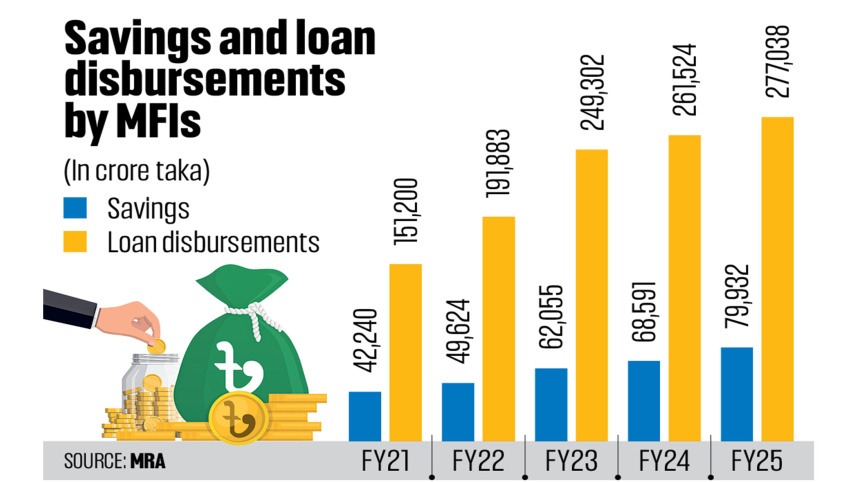
A move by field offices of the National Board of Revenue (NBR) to collect tax on interest earned from microsavings has raised concerns among microfinance institutions (MFIs), which say the measure could discourage poor people from saving.
Several income tax field offices have recently asked a number of MFIs to deduct and deposit 10 percent tax on interest paid to micro savers. They have also suggested that the MFIs pay a 2 percent fine for failing to deduct the tax, citing the Income Tax Act 2023.

The issue affects a large number of low-income savers. As of June 2025, nearly 700 MFIs licensed by the Microcredit Regulatory Authority (MRA) were operating with about 4.40 crore members. Around 90 percent of their members were women, according to MRA data.
At the time, the MFIs had total outstanding loans of Tk 1,74,880 crore and savings of Tk 79,932 crore.
According to the Credit and Development Forum (CDF), an association and not-for-profit umbrella organisation of MFIs in Bangladesh, the institutions paid Tk 4,795 crore in interest to depositors.
A 10 percent tax deducted at source from that interest would generate about Tk 479.5 crore in tax revenue.
In a letter to the NBR, the CDF said the revenue from the tax would be relatively small compared with its possible impact. It warned that taxing microsavings could discourage rural people from saving, reduce the national savings rate and make it harder for MFIs to raise funds.
MFIs encourage ultra-poor and low-income people to save small amounts regularly so they have money available when they need it.
“People can start saving with as little as Tk 10,” said Murshed Alam Sarker, chairman of the CDF.
He said MFIs credit the full interest to savers because the institutions’ service-charge income is tax-exempt.
“Since the current fiscal year, some tax offices have asked us to deposit tax on the interest earned by savers. What is the rationale for collecting tax from poor people?” he said.
Last week, the CDF wrote to the NBR, urging it to keep interest earned from microsavings tax-exempt. It also sent letters to the finance minister and the MRA, Murshed said.
CDF SEEKS CLARIFICATION ON TAX LAW
The CDF said the service charges, or the interest MFIs earn from their microcredit operations, are legally tax-exempt. It cited a provision in the MRA Act 2006 and said collecting deposits is part of the institutions’ operations.
The law also protects savers’ right to earn interest on their deposits, the forum said. As the MFIs’ income is tax-exempt, they have treated the interest paid to micro savers as tax-free, it added.
However, the CDF said the Income Tax Act 2023 classifies interest income from deposits as subject to withholding tax and requires tax to be deducted when the interest is paid.
The Finance Act 2023 made tax deductions on interest payments mandatory but did not clarify whether the provision applies to savings held by microfinance members, the organisation said.
“Most members of microfinance institutions are low-income people whose earnings are well below the minimum taxable income threshold. As they are not liable to pay income tax, they have no legal way to adjust or claim a refund for tax deducted from their savings in advance,” the CDF said.
The forum also pointed out that small, regular savings help build rural capital and provide an informal safety net for families facing illness, natural disasters, crop failures or sudden loss of income.
A senior NBR official said the income tax law provides for tax deductions on interest paid on deposits. “It appears that our field offices have started collecting the tax under this provision,” he said.
 For all latest news, follow The Daily Star's Google News channel.
 The NBR has received the CDF’s letter, and senior officials are expected to discuss the issue soon, he added.
Prof Mohammed Helal Uddin, executive vice chairman of the MRA, said most MFI members are marginalised people who save very small amounts, often just Tk 20 to Tk 30.
“Collecting tax on their savings income would go against the government’s policy of supporting marginalised people and reducing inequality,” he said.
“We will raise the issue with senior government officials and seek to keep interest income from microsavings tax-free,” he added.
Comments