


Why fewer than 1% people in Bangladesh invest in stocks

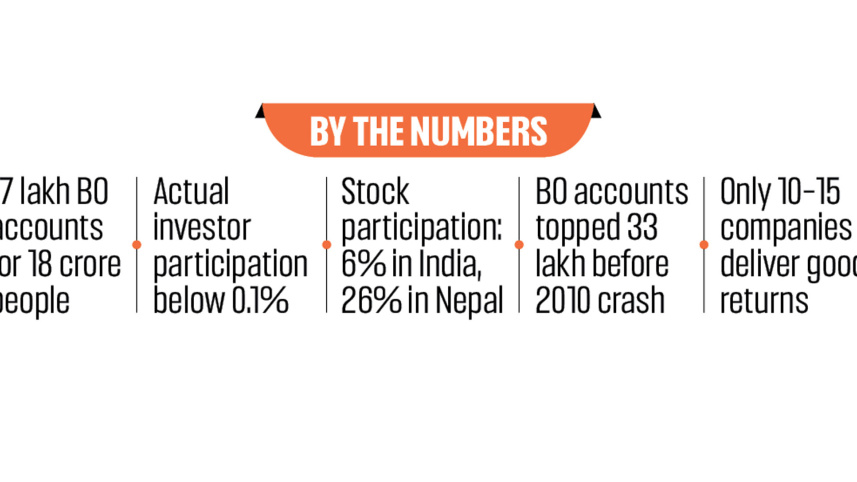
Stock market participation remains low in Bangladesh, with around 17 lakh beneficiary owner (BO) accounts against a population of nearly 18 crore, representing less than 1 percent.
However, the number of BO accounts does not reflect the actual number of investors, as many maintain multiple accounts to hold shares, mutual funds, bonds and other securities in electronic form.

Industry insiders estimate that the actual number of people investing in the stock market is no more than 2 lakh. If so, participation could be below 0.1 percent.
The low number of BO accounts in a country with more than 19 crore bank accounts reflects people’s limited appetite for stocks, mutual funds and bonds.
A comparison with neighbouring Asian countries highlights how far Bangladesh lags behind. Around 6 percent of India’s population participates in the stock market, while the figure is as high as 26 percent in Nepal. However, India’s 6 percent represents more than 10 times Nepal’s 26 percent in absolute numbers.
In developed countries, the proportion of people participating in securities markets is much higher. Why, then, is appetite for the stock market so low in Bangladesh?
It would be inaccurate to suggest that people are inherently reluctant to invest in stocks. In 2010, people rushed to the stock market, pushing the number of BO accounts above 33 lakh. However, the figure began to decline following the infamous market crash that year.
Profitability has always been a key driver of stock market participation. However, Bangladesh’s market lacks reliable investment opportunities, with investors losing their hard-earned money to fraudulent brokerage firms, fund managers and companies whose financial statements are riddled with irregularities.
Even financially strong firms remain conservative in paying cash dividends despite holding hundreds of crores of taka in bank deposits.
Consequently, investors have struggled to improve their financial positions, even by investing in fundamentally sound stocks.
With only 10 to 15 entities generating good returns, prices rose mainly for low-paid-up-capital companies, attracting investors to junk stocks and providing market manipulators with opportunities to profit.
Market manipulators received paltry punishments despite the severity of their wrongdoing. More concerningly, investors often found little protection from the Bangladesh Securities and Exchange Commission (BSEC).
The regulator extended the tenure of closed-end mutual funds by 10 years, delaying investors’ access to their money. It also allowed listed mutual funds to issue bonus shares and approved several companies’ fundraising plans, adding to market liabilities.
Sikder Insurance, for instance, invested around 72 percent of its life fund in junk stocks before launching its IPO (initial public offering). Such regulatory decisions further eroded investor confidence, leaving little incentive to participate in the stock market.
The Dhaka Stock Exchange (DSE) has recently started returning funds embezzled by a couple of brokerage firms to investors. While this is praiseworthy, it remains a modest remedy for years of mistreatment.
Following the fall of the Awami League government in 2024, the Bangladesh Securities and Exchange Commission (BSEC) was reconstituted and began pursuing reforms across various areas. This is encouraging.
BSEC Chairman Masud Khan has outlined his vision for the market and made several commitments. Delivering on them by simplifying the listing process, digitising procedures and protecting investors’ interests could encourage more people to invest.
The market needs a sound equity market alongside a vibrant bond market, with other products introduced gradually. The regulator must also prevent defaults by bond issuers from undermining the bond market.
Attracting well-performing companies, curbing secondary-market manipulation and preventing intermediaries from embezzling investors’ funds should be key priorities. Above all, the regulator must consistently protect investors.
Dictating index movements or turnover is not the regulator’s role. Instead, it should focus on sound policymaking, good governance and accountability.
 For all latest news, follow The Daily Star's Google News channel.
 Delivering on these commitments would be the best gift for investors as Bangladesh prepares to celebrate World Investor Week.
Comments