


Aromatic rice export quotas under review
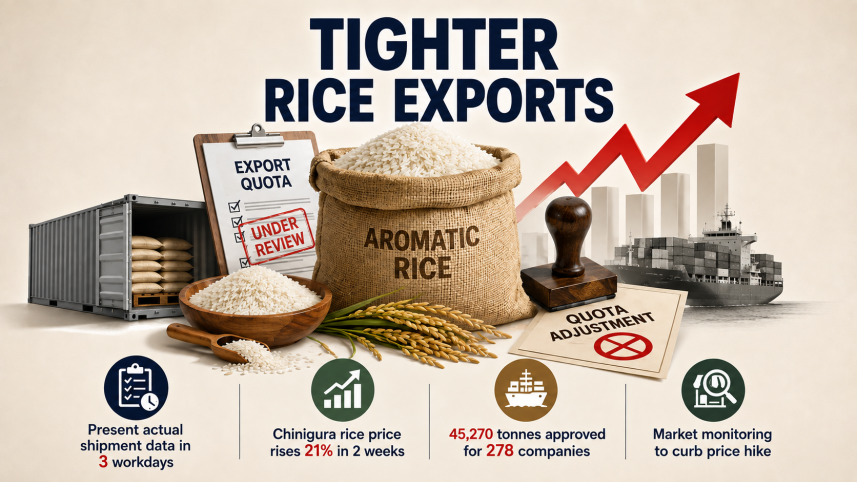
- Exporters asked to submit shipment data in 3 workdays
- Earlier, 278 companies approved to export 45,770 tonnes
- Several exporters failed to use full quotas
- Chinigura rice prices rose 21% in two weeks

The government is moving to tighten exports by reviewing approved quotas amid an unusual rise in domestic demand and prices for aromatic rice.
As part of the effort, the commerce ministry has asked exporters to submit details of their actual shipments within three working days so that unused quotas can be reduced or adjusted.
The instruction was issued by the Export-2 branch of the Ministry of Commerce today.
Meanwhile, the price of Chinigura variety of aromatic rice has risen to Tk 230 per kilogramme (kg) from Tk 190 two weeks ago, marking a 21 percent increase, according to several grocery shopkeepers in the capital.
The latest price is broadly in line with market reports, which show loose Chinigura selling at Tk 220-230 per kg, compared with Tk 180-190 a couple of weeks earlier.
Prices of other aromatic rice varieties have also risen sharply in recent months. Depending on the variety, prices have increased by around Tk 60-80 per kg, traders said.
Mid-range varieties that sold for Tk 140-150 per kg in March are now selling at around Tk 220.
According to the ministry letter, the quantity approved for export may need to be reduced or adjusted in light of the domestic market situation.
Exporters have therefore been asked to provide their actual shipment figures so that the ministry can assess how much of their approved quota remains unused.
The move is particularly relevant for companies that either failed to export their full approved quantities or made only partial shipments. Their unused quotas could now come under review.
The ministry had earlier approved the export of 45,270 tonnes of aromatic rice for 278 companies in two phases, according to the officials. Of them, 211 companies received approval in the first phase and 67 in the second.
At a meeting on August 2, the authorities reviewed production, domestic demand, market conditions and the actual volume of aromatic rice exported. It was found that several approved exporters had not been able to ship their full quotas.
The government is also stepping up market monitoring amid allegations from traders that some large millers are holding significant stocks of aromatic rice and releasing less than the market requires, contributing to higher prices.
After reviewing the situation, the commerce ministry decided to strengthen monitoring with the Directorate of National Consumer Rights Protection and relevant business organisations.
The latest data from exporters will help the ministry determine whether existing export quotas should be reduced or adjusted, while allowing companies with genuine export capacity to continue operating.
 For all latest news, follow The Daily Star's Google News channel.
Comments