


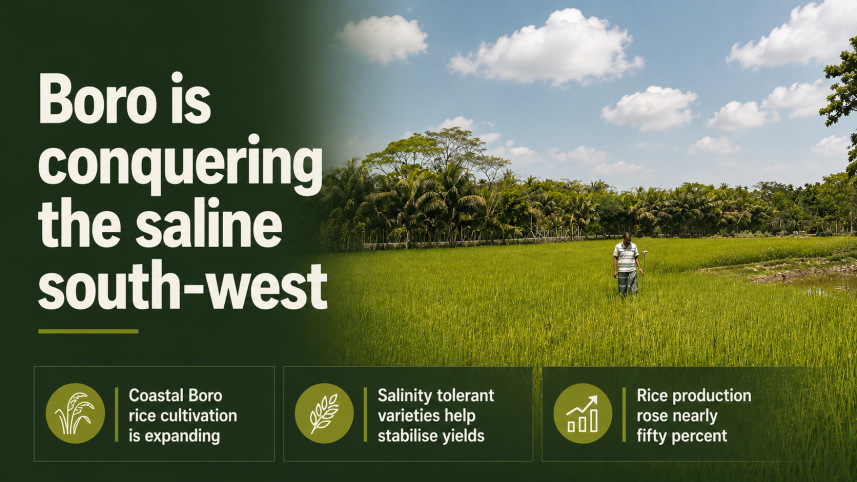
Boro is conquering the saline south-west

Middle-aged Bidhan Mandal is, by nature, a sociable man. He enjoys a good chat and rarely misses an adda. But in the final week of May, there is barely any time for conversation.
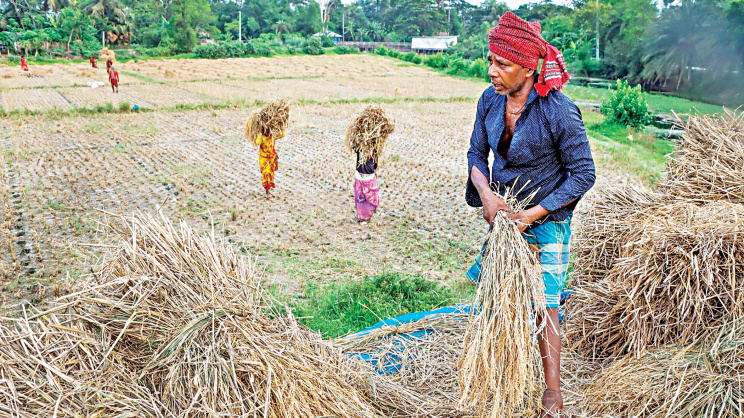
The fields are heavy with ripe Boro paddy. Harvesting, bundling and carrying it home — none of it is small work, even with eight or ten hired labourers.

So Mandal ties a new red gamchha around his head and gets on with it.
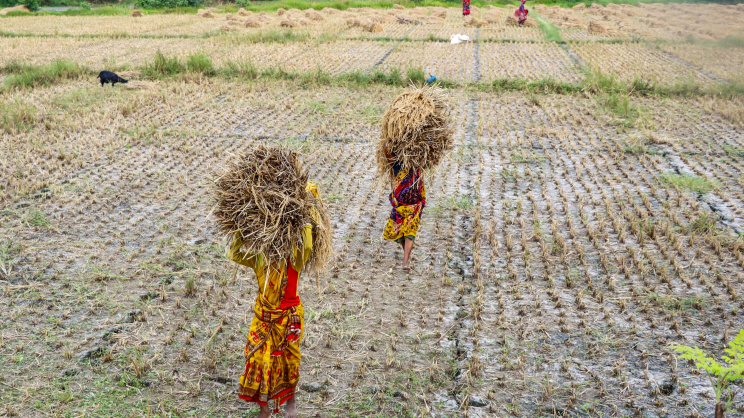
Most of the farm workers are women. They gather freshly cut paddy, tie it into bundles and carry them on their heads from the fields to the raised earthen road. Mandal sits amid tall stacks of grain, watching the bundles move steadily towards the homestead.
The scent of ripe paddy fills the air. Warm Jyaishtha winds pass through the open front of his half-buttoned shirt. Everything is in motion. Everyone has somewhere to be.
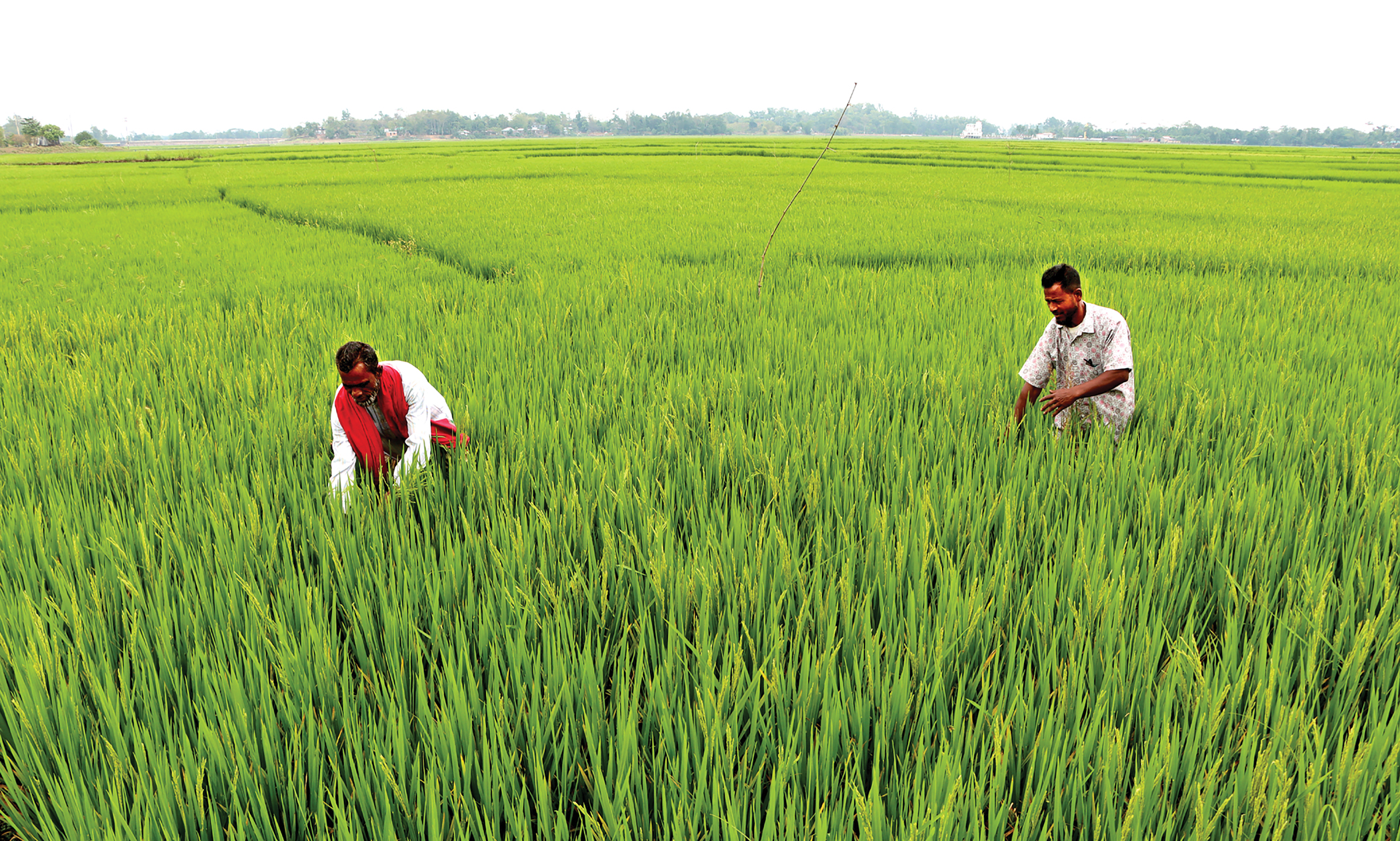
It could be any village in Bangladesh during harvest time. But the story has a wrinkle.
Boro cultivation arrived late in Kalikabati, a village on the edge of the Sundarbans. For decades, much of the south-western coastal belt struggled to farm because of soil salinity. That began to change with the development of salt-tolerant paddy varieties. Over the past two decades, farmers across the region have increasingly turned to paddy cultivation, and many have found steady success.
“O bhai, what paddy is this?” a young man calls out to Mandal as he rides past on a motorcycle. “How is the yield this time?”
“Hira-2. The paddy has turned out quite well,” he says with a smile, without stopping his work.
A few kilometres from Mandal’s fields in Kalikabati village, Mohitosh Roy and his neighbour Herokesh Roy are also busy harvesting Boro paddy in Laudoba Union of Dacope upazila in Khulna district.
Before taking the crop home, Mohitosh has spread the cut grain across his field to dry in the sun and reduce its moisture content.
Nearby, Herokesh Roy, a small farmer, has cultivated the dry-season crop on 12 kathas of land along the edge of a vast green plain.
Just a few weeks ago, the entire plain was covered with watermelons. Those have already been harvested. Now cattle graze where the fruit once grew, while rows of ripening paddy sway in the breeze.
THE FIGHT AGAINST RISING SALINITY
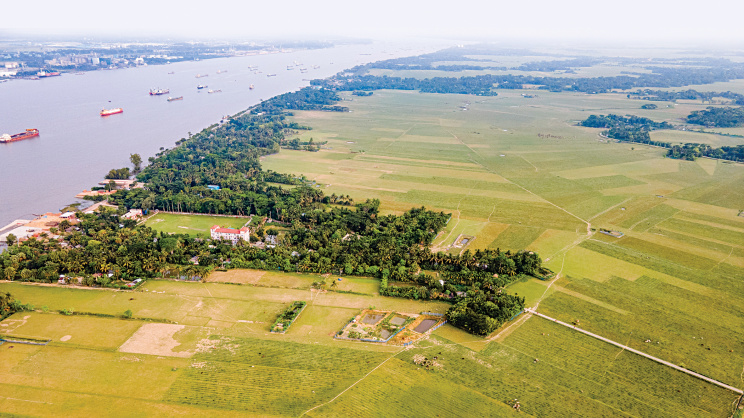
Over the past five decades, once-fertile farmland across Bangladesh’s wider coastal belt has gradually become saline.
A survey by the Soil Resources Development Institute (SRDI) shows that by 2024, about 11.56 lakh hectares of agricultural land had been affected by varying degrees of salinity. This marks a sharp increase from the early 1970s — an expansion of more than 39 percent in terms of area.
A large share of farmland across the coastal districts is now under salt stress, limiting what farmers can grow and narrowing their options season by season.
The SRDI survey also found that large parts of the coastal belt, particularly in Bagerhat, Khulna and Satkhira, are affected by severe to very severe salinity. In many of these areas, salt levels are so high that only a handful of crops can survive.
Ameer Mohammad Zahid, chief scientific officer and head of division at SRDI, said salinity in coastal soils is clearly increasing in both extent and intensity.
 For all latest news, follow The Daily Star's Google News channel.
 He attributed the rise to a combination of factors, including changes in rainfall patterns, fluctuations in upstream river flows, tidal flooding, storm surges, sea-level rise, shallow saline groundwater, brackish-water aquaculture, higher evaporation rates, and local polder and land management systems.
Polders are large areas — generally consisting of farmland — enclosed by embankments that protect fields from tidal flooding and saltwater intrusion.
In much of Khulna Division, climate change, reduced upstream water flow, the unplanned expansion of shrimp farming and blocked canals have further intensified salinity, hampering agricultural activities.
In parts of Bagerhat’s Rampal and Mongla upazilas, low-lying villages have seen export-oriented shrimp farming effectively replace traditional crop cultivation.
In response, farmers across Khulna, Bagerhat and Satkhira are increasingly turning to Boro rice cultivation in an effort to secure household food supplies.
And in this fight against salinity, agricultural scientists have joined farmers on the ground.
The Bangladesh Rice Research Institute (BRRI) and the Bangladesh Institute of Nuclear Agriculture (BINA) have developed and introduced more than a dozen high-yielding rice varieties that can tolerate saline conditions. Of these, BRRI alone has developed around 12 salt-tolerant varieties suitable for both Aman and Boro seasons, according to BRRI Director General Mohammad Khalequzzaman.
“Now we see Boro rice being cultivated in many parts of the south and south-west,” he said.
Farmers in the south-western coastal belt also grow hybrid rice varieties during the Boro season, as some varieties can tolerate a degree of salinity.
While the salt-tolerant varieties are designed mainly to withstand saline stress, hybrid varieties are geared towards maximising yields.
During the recently concluded Boro season, farmers cultivated 35 hybrid rice varieties in Bagerhat alone, according to Md Motaher Hossain, deputy director of the Department of Agricultural Extension (DAE) for the district.
SALT-TOLERANT VARIETIES PAYING OFF
As science has moved into the fields, cooperation between farmers and scientists has begun to pay dividends.
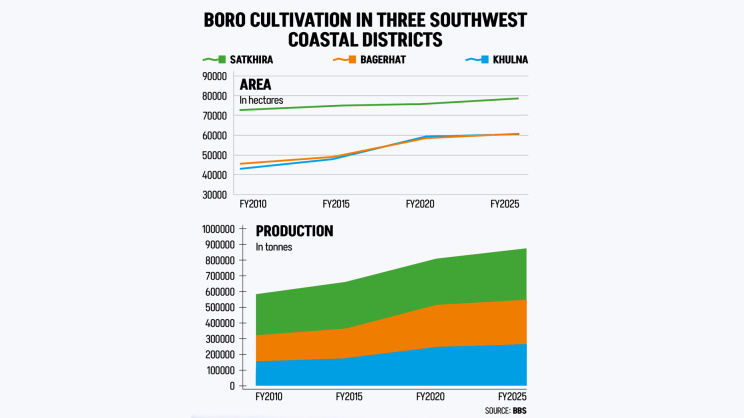
In the south-western coastal districts, the area under Boro cultivation stood at just 1.61 lakh hectares in 2009-10. Over the past one and a half decades, it has increased by 24 percent to nearly 2 lakh hectares.
Production rose from 5.86 lakh tonnes in 2009-10 to 8.76 lakh tonnes at present, an increase of nearly 50 percent, according to the Bangladesh Bureau of Statistics (BBS).
Rafiqul Islam, additional director of the Department of Agricultural Extension (DAE) in Khulna Division, said his office is encouraging farmers to adopt rice varieties capable of withstanding salinity, which peaks during April and May.
Around 57 percent of cultivable land in Bagerhat, Khulna, Narail and Satkhira districts experiences salinity levels above 8 dS/m. At that level, the concentration of dissolved salts in soil water rules out most crops, while conventional rice varieties generally tolerate salinity of up to 3 dS/m.
Islam said salinity levels of 8 dS/m and above are considered highly stressful for rice cultivation.
“We are therefore encouraging farmers to cultivate inbred rice varieties that can withstand salinity levels of up to 10 dS/m,” he said.
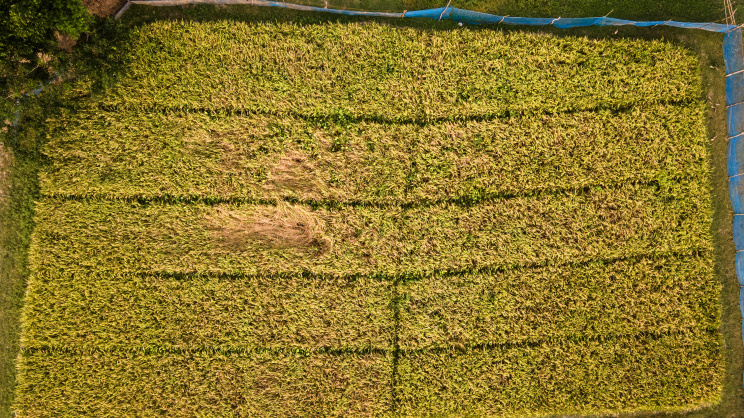
DAE field offices in these districts are promoting BRRI dhan97, BRRI dhan99 and Binadhan-10.
BRRI dhan97 can tolerate salinity levels of 14 to 15 dS/m during the vegetative stage. It can maintain yields under salinity levels of 8 to 10 dS/m through the crop’s salt-sensitive stages, from vegetative growth to reproduction, according to BRRI.
BRRI dhan99 can tolerate salinity levels of up to 14 dS/m at the seedling stage and 8 to 10 dS/m from vegetative growth to the reproductive stage while maintaining yields, the institute said.
Binadhan-10, another Boro variety, can tolerate salinity levels of 10 to 12 dS/m during the vegetative stage and 12 to 14 dS/m at the seedling stage.
However, many farmers still choose hybrid rice varieties.
POLITICS OVER WATER MANAGEMENT STILL A BARRIER
Remember Mandal, Mohitosh and Roy of Kalikabati village? Apart from choosing appropriate varieties and relying on sheer farming grit, another factor has worked in their favour — their land lies in an area less exposed to severe salinity.
The village sits on the western bank of the Pasur River, while Mongla upazila lies on the eastern bank. Farmers in Mongla, despite having relatively elevated land compared with their counterparts in Kalikabati, often do not enjoy the same success in Boro cultivation.
But why?
The coastal belt is criss-crossed by sluice gates and embankments designed for water management.
In many cases, local political influence and large shrimp farm owners determine how these systems are operated. They decide whether sluice gates remain closed or are opened, allowing saline water into low-lying areas used for shrimp farming.
“Farmers on the other side of the river can cultivate even their low-lying land. We cannot, although our land is comparatively higher. This is because of water management,” said Sanmath Kumar Biswas, a resident of Kainmari village in Mongla.
Biswas said outsiders sometimes engage in shrimp farming using political influence and allow saline water to enter canals and fields. Landowners who want to grow crops are unable to do so as a result.
“Our main problem is water. We are surrounded by water, but there is no fresh water to drink or farm,” said Biswas, a 50-year-old farmer.
“We cannot grow crops throughout the year or raise livestock. Once shrimp cultivation brought good income. Now, we can neither get good shrimp yields because of disease nor grow crops properly,” he added.
In these areas, the Local Environment Development and Agricultural Research Society (Ledars), a non-governmental organisation, is working on climate adaptation and mitigation. It has provided farmers with salt-tolerant rice varieties such as BRRI dhan97 and BRRI dhan99 for the Boro season.
Elsewhere, the organisation has helped small farmers dig ponds to store freshwater for irrigating Boro fields. Mohitosh, the farmer from Kalikabati, is one of the beneficiaries.
However, Zahid Iqbal Babla, a resident of Dema union in Bagerhat Sadar upazila, was not as fortunate. In the recently concluded Boro season, he cultivated a hybrid rice variety on more than an acre of land along the bank of the Hoji River inside a polder area.
His hopes of a successful harvest were dashed when a group of politically influential individuals allegedly took control of the area's sluice gates and allowed saline water to enter the polder for fish trapping and shrimp cultivation. The saline water inundated his field and ruined the standing crop.
"I have lost all my investment. It is very frustrating," he said.
Hossain, deputy director of the DAE for Bagerhat, said officials have held meetings with shrimp farmers to discourage the release of saline water into canals and cropland before May.
“But a comprehensive approach involving all relevant agencies and stakeholders is needed to ensure proper water management and sustained food production,” he said.
BRRI Director General Khalequzzaman believes a broader social movement is needed to raise awareness and encourage agricultural activity during the dry season. “Not only rice, but other crops should also be considered for the region.”
SRDI Chief Scientific Officer Zahid said policy priorities should focus on rainwater harvesting and the re-excavation of dying river channels.
Professor M Nazmul Ahsan, vice-chancellor of Khulna Agricultural University, said shrimp farming expanded rapidly across the south-western coastal districts in the 1990s, driven by export demand.
However, as the boom in the sector has faded, many residents have adopted coping strategies such as cultivating rice during the Boro season to survive.
“The south-west coastal region faces numerous challenges. Yet there has been no integrated planning for the region, which is essential for its long-term development,” he said.
Comments