


Clients fuming as banks propose extra fees for 14 services

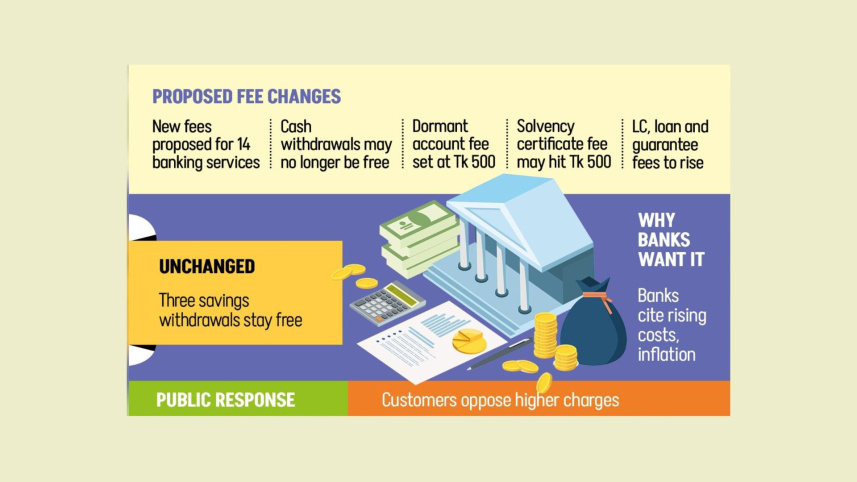
Commercial banks have proposed introducing extra and some new charges for 14 services, including fees on frequent cash withdrawals, reactivating dormant accounts and higher account maintenance charges.
The Association of Bankers, Bangladesh (ABB) has submitted the proposal to the Bangladesh Bank (BB) recently.

Some services that are currently free, such as unlimited cash withdrawals in a month, would become chargeable under the proposal. ABB says the changes are needed to offset rising operating costs driven by inflation.
However, the proposal has sparked criticism among ordinary customers, business chambers and trade leaders, who say that it would increase banking costs for all -- small depositors, borrowers, businesses, importers and exporters.
Some have questioned the timing of the proposal, with the banking sector grappling with a confidence crisis and a mounting stock of non-performing loans.
Businesses are also struggling with high borrowing costs as tighter monetary policy keeps lending rates elevated in an effort to rein in inflation. Private sector credit growth has fallen to a historic low, while many banks continue to face allegations of poor customer service.
According to the proposal, banks would charge customers between Tk 100 and Tk 300 for cash withdrawals beyond a specified monthly limit.
For savings accounts, customers would be allowed three free cash withdrawals a month. From the fourth to the 10th withdrawal, banks would charge Tk 100 per transaction, rising to Tk 300 from the 11th withdrawal onwards.
For current accounts, ABB proposed a Tk 100 fee for withdrawals from the 20th to the 50th transaction in a month. From the 51st transaction onwards, the fee would rise to Tk 150.
The apex body of managing directors and CEOs of banks also proposed a Tk 500 fee to reactivate dormant accounts.
Besides, it sought BB approval to introduce new charges for loan management, monitoring and supervision, risk premiums, early settlement of demand and continuous loans, letter of credit (LC) opening commissions, handling and document endorsement copies.
The proposal also includes new fees for export LC cancellations, buyers’ credit arrangement, deal structuring, risk premiums and commissions on the sale of foreign currency in cash.
ABB also proposed increasing the fee for bank solvency certificates from Tk 200 to Tk 500 and doubling the cheque return fee from Tk 50 to Tk 100.
It also wants to raise charges for account maintenance, loan processing, LCs, bank guarantees, demand drafts, pay orders and several other banking services.
In its letter to the central bank, ABB requested permission for banks to set their own charges below the maximum ceiling according to their business strategy, service model and cost structure.
It also proposed allowing banks to raise the ceiling on charges by up to 10 percent a year in line with inflation, higher technology costs and rising service delivery expenses.
Contacted, Mashrur Arefin, chairman of ABB, told The Daily Star that the proposal was simply an adjustment to reflect the higher cost of providing banking services over the past six to seven years.
Mashrur, who is also managing director of City Bank, said the revision should be viewed in the context of years of inflation and the depreciation of the taka from Tk 87 to the dollar to about Tk 123 today.
“Imagine what the cost of printer toner was in 2020-21, when the banking industry last adopted the ongoing Schedule of Charges, and what it is today,” he questioned.
“Think of the minimum 7 percent inflation per year for six to seven years and the change in the dollar price. Think also of the many banks like us that have invested so much in recent years in setting up branches, sub-branches, agent banking points, and ATMs across the country in order to embrace financial inclusion.”
 For all latest news, follow The Daily Star's Google News channel.
 “What was our locational reach in 2020, and what is it now?”
“Actually, a simple look at all the banks’ operating expenses then versus now, and comparing that with the meagre rise in corresponding revenue, will explain why we felt the need for a revision of the Schedule of Charges to be able to serve customers as they deserve,” added the ABB chairman.
The proposal has, however, drawn a sharp backlash from customers and business leaders.
Sohel Mahamud, an NCC Bank customer, said salaried people will end up paying more whether they keep money in the bank or withdraw it.
As per the ABB proposal, customers maintaining an average half-yearly balance of more than Tk 25,000 in a savings account would pay Tk 300.
“This means banks are asking ordinary customers to pay for their own mismanagement and the burden of defaulted loans.”
“Charging Tk 500 to reactivate a dormant account, Tk 300 for a balance certificate, and raising fees for returned cheques and solvency certificates is simply unfair. If this is the way forward, whatever trust people still have in the banking system will soon disappear,” added Sohel.
“Ridiculous,” said MA Zaman, a private-sector employee who holds accounts with IFIC Bank and Standard Chartered Bank. “Why should I have to pay an additional charge just to withdraw my own money?”
“As a salaried person, I need to withdraw my savings at different times based on my needs. Imposing such a charge would be unfair,” Zaman said.
Taskeen Ahmed, president of the Dhaka Chamber of Commerce & Industry (DCCI), said the proposal is “highly unreasonable, hasty, and unacceptable” at a time when businesses are already struggling with high inflation and elevated lending rates.
Taskeen, who is also vice chairman of IFAD Group, said the move will shift the burden of the banking sector’s structural weaknesses, rising non-performing loans and higher operating costs onto businesses and customers, increasing the cost of doing business and discouraging investment and employment.
He said banks should instead focus on cutting administrative costs, closing unprofitable branches and strengthening governance to recover defaulted loans.
“Otherwise, such a decision will permanently undermine the competitiveness of the country’s trade and industrial sectors,” said the DCCI president.
The Chittagong Chamber of Commerce and Industry (CCCI) has also urged the BB not to approve new banking service fees or increases in existing charges, saying that higher costs will place an even heavier burden on businesses and consumers during a difficult economic period.
In a recent letter to BB Governor Md Mostaqur Rahman, CCCI President Mohammed Amirul Haque asked the central bank to reject the proposal.
The chamber said higher banking charges would raise the cost of doing business, especially for small and medium-sized enterprises, and ultimately lead to higher prices for consumers.
Comments