


Five licences later, one question remains: what is a digital bank for?
This week, Bangladesh Bank issued letters of intent to five proposed digital banks: DK Digital Bank, bKash Digital Bank, Nova Digital Bank, Boost Digital Bank and Kori Digital Bank, which received a fresh LoI after missing its earlier deadline. An LoI is a starting gun, not a finish line. Each bank must raise Tk 300 crore in paid-up capital, fully in cash, and operate on a six-month trial before a final licence is considered.
Within hours, my LinkedIn feed filled with debates about which MFS, telco or agent network each bank should partner with. These are fair questions, but they are the wrong first questions. We are arguing about distribution before anyone has defined the business.

Strip banking to its bones, and a bank does two things: it takes deposits and creates assets, mainly through credit. Everything else is plumbing. The only meaningful question about a digital bank is whether it can do both better than a conventional bank.
Conventional banking's record on the asset side is sobering. By June, non-performing loans stood at Tk 6,06,555 crore, or 32.78 per cent of all loans, and just 10 of the country's 61 banks held more than 72 per cent of them.
The World Bank has pointed to weak corporate governance, regulatory weaknesses and related-party lending. This crisis was not created by the tea-stall owner or the salaried borrower. It was created by failed appraisals, captured boards and a handful of large defaulters, while retail and SME customers remained underserved.
The regulator has already told digital banks where to play. They cannot finance foreign trade or offer term loans to medium and large industries. Their field is the individual and the small business, precisely the customers conventional banking has neglected.
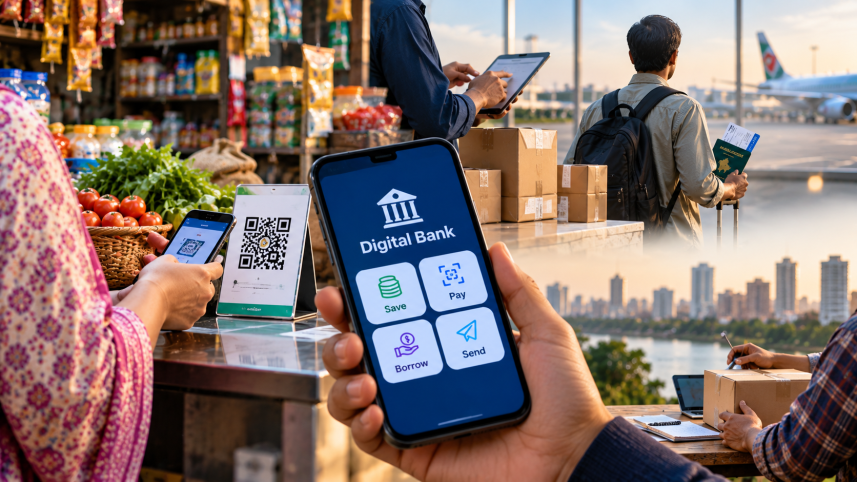
That is where intelligent banking must begin: with the customer's everyday life. A customer buys groceries worth Tk 123; the app rounds up the payment to Tk 130 and moves Tk 7 into a savings goal she has chosen, whether for education, insurance or travel. Multiplied across millions of transactions, that creates a deposit engine that no branch can replicate. At the superstore checkout, the same customer sees a pre-approved offer to split her bill over three months.
The small merchant benefits most. When a shopkeeper buys stock, the digital bank already sees his sales, supplier payments and repayment behaviour. It can offer credit for a day, a week or a month, with pricing based on real cash flows rather than collateral he does not have.
A digital bank closes the loop where visibility creates data, data creates credit, and credit creates more visible activity.
Consider, too, the migrant worker whose visa is ready but who cannot afford the ticket. According to the World Bank, more than 60 percent of temporary migrants borrowed to migrate, and an IOM study found that most moneylender debt carried interest rates of 50 to 150 per cent. A digital bank can verify his documents, lend quickly and recover repayments from the remittances he sends home through the same app. With a record $35.56 billion in remittances in FY2025-26, the opportunity is enormous.
None of this requires the bank to build everything itself. It can act as an orchestrator, connecting merchants, fintechs and platforms through APIs while using MFS and agent networks for reach. But MFS is not a bank, and such partnerships are distribution choices. Define the business model first, and the right partnerships become obvious.
Credit discipline is the real lesson from abroad. Brazil's Nubank, with 131 million customers, credits its proprietary data and credit engine with better underwriting and a lower cost of risk. The principle is to start small, observe behaviour and let credit limits grow as customers prove they can repay. In a sector weighed down by bad loans, digital lending must never mean making bad lending faster.
That also demands responsibility. A bank that knows a customer's income and spending must earn that trust through clear consent, explainable credit decisions and honest affordability checks.
Bangladesh already has 61 banks. If the new digital banks simply put a conventional bank on a mobile app, we do not need them. The six-month trial should test one thing: does this bank make everyday life cheaper, smarter and safer by turning daily spending into savings and savings into fair credit? That is the digital bank worth licensing.
The writer is a digital banking and fintech strategist.
 For all latest news, follow The Daily Star's Google News channel.
Comments