


Govt links 12,000 institutions to broadband
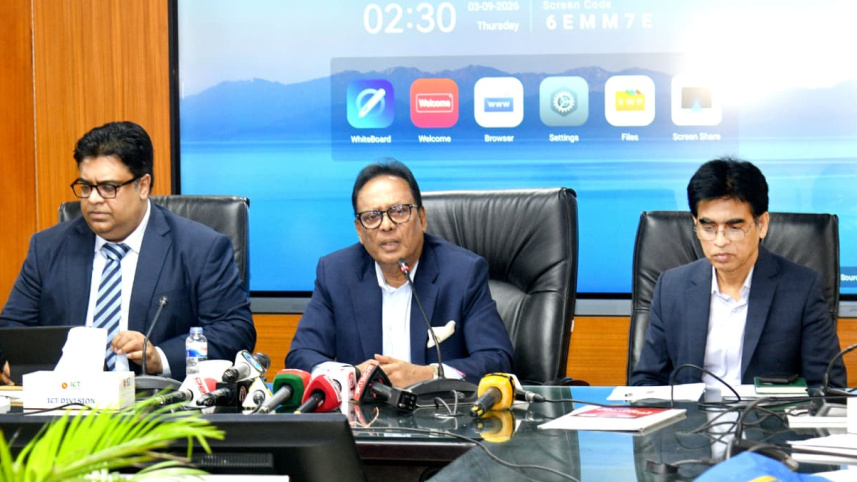
The government has connected more than 12,000 institutions to broadband internet across the country during the first 180 days of its tenure, according to progress reports prepared by the Posts and Telecommunications Division and the ICT Division.
The data was presented at a press conference held to highlight progress on the government’s 180-day action plan based on its election manifesto. ICT and Telecommunication Minister Faqir Mahbub Anam and Prime Minister’s Adviser Rehan Asad were present.

On the manifesto pledge to create 1 million jobs, the ICT Division said 340 individuals and institutions had received nearly Tk 1.7 crore in scholarships, fellowships, innovation grants and special stipends. Agencies under the division also provided job-oriented training to 28,770 people.
The government reported the passage of three major laws -- the Cyber Security Act 2026, Personal Data Protection Act 2026 and National Data System Act 2026.
It also launched a Cyber Incident Response System and a National ICT and Cyber Security Rating System. The Cyber Security Olympiad and National Cyber Drill 2026 were also organised, while the e-Sign Guideline and Digital Signature Interoperability Guideline were updated.
The ICT Division also highlighted several artificial intelligence and digital infrastructure initiatives. National data centre storage capacity has increased by 6 petabytes, with additional GPU servers installed, while construction of a new disaster-recovery data centre has been completed.
The government has allocated land at Purbachal for an AI-driven data centre and is developing an LLM-based virtual assistant for government services.
The government has restructured the startup ecosystem around a Tk 500 crore Startup Fund and launched an integrated national entrepreneurship and startup portal. A startup policy and grant-disbursement guidelines have also been drafted.
The ICT Division said Tk 41.28 crore had been disbursed for 76 research projects, while innovation hubs were established at three universities.
Meanwhile, 87 government services have been digitised through the MyGov platform. A live test of the D-toll system was completed on the Meghna Bridge, while the system was integrated at the Mukterpur Bridge and Dhaka-Bhanga Expressway. Network connectivity has also been established for an RFID-based unified tolling system on the Dhaka Elevated Expressway.
However, several targets remain incomplete. The Posts and Telecommunications Division reported 65 percent progress in establishing 14 nationwide fulfilment centres for e-commerce and f-commerce logistics.
Collection of postal life insurance premiums through Nagad stood at 55 percent of the target, while licensing of courier operators reached 73 percent. Ten previously unlicensed courier firms received licences and 50 expired licences were renewed.
The plan to extend Wi-Fi hotspots to 3,000 locations in haor, hilly and other remote areas reached 90 percent progress, while a project to provide LEO satellite internet to 100 schools in the Chittagong Hill Tracts was 70 percent complete.
Rehan Asad said the government has also taken an initiative to provide every citizen with a “Unified Digital Identity” to access government services, including healthcare and education.
Under the proposed system, children would receive the digital identity immediately after birth, reducing the need to repeatedly provide the same information to different government agencies.
Rehan said work on implementing the project could begin within the next six months.
Currently, children receive birth registration certificates after birth, while NIDs are issued when they turn 18. The unified identity system would address inconsistencies in citizens’ information and reduce the hassle of repeatedly submitting the same data, he said.
Meanwhile, the ministry said a new government email service based on Microsoft Outlook had been rolled out for government offices.
 For all latest news, follow The Daily Star's Google News channel.
Comments