


Investment confidence hinges on policy continuity: Bida chief
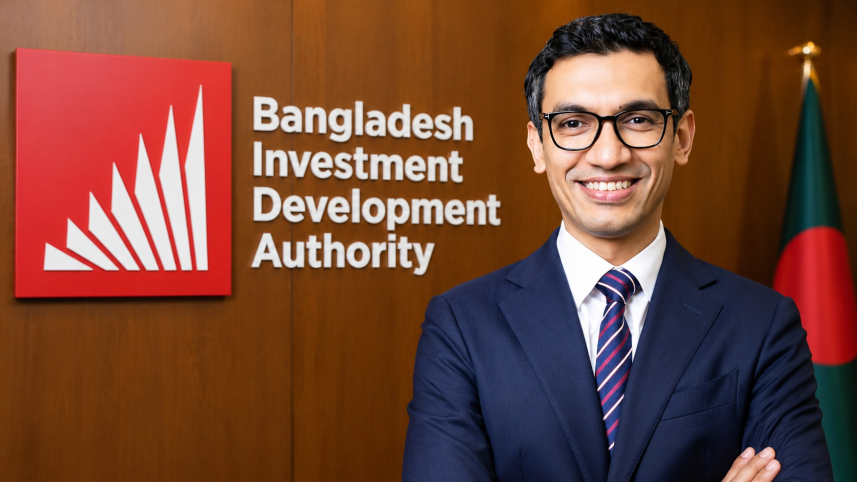
Bangladesh is passing through a tough time in terms of investment, with the prevailing situation creating uncertainty that continues to discourage new investment, said Ashik Chowdhury, executive chairman of the Bangladesh Investment Development Authority (Bida).
The lack of policy continuity and political stability remains one of the biggest concerns for both local and foreign investors, he said.

“The first question we are always asked is why investors lack confidence in Bangladesh. Throughout the past one and a half years, investors have repeatedly pointed to the absence of policy continuity and political stability,” he said.
Ashik Chowdhury made the comments at a briefing, organised by the Bida at its office in Dhaka, on the investment-related outcomes of the national budget for the 2026–27 fiscal year.
The budget offers the government an opportunity to send a strong signal that it remains committed to predictable, investment-friendly policies, he said, adding that while such assurances would not immediately attract large foreign investment, they were essential to rebuilding confidence.
"We cannot expect millions of dollars to flow into Bangladesh the day after such a signal is sent. Investor confidence is built gradually. If we continue to demonstrate that we are serious about policy continuity, investors will eventually believe us and consider Bangladesh more favourably," he said.
Ashik underscored the need for the government to look beyond sector-specific incentives and identify priority sectors in the budget, highlighting ICT and renewable energy.
He said Bangladesh's ambition to become a regional manufacturing hub would depend not only on fiscal incentives but also on reforms in logistics, supply chains and trade facilitation, alongside improving the ease of doing business.
Acknowledging persistent gas and power shortages, he said the government was pursuing both short- and long-term solutions while remaining engaged with industries to minimise disruptions.
He also stressed the need to improve awareness of government support schemes, particularly among entrepreneurs outside Dhaka.
Rehan Asif Asad, adviser to the prime minister on posts, telecommunications, information technology, and science and technology, said the government had consulted businesses extensively before finalising the budget and that the finance minister was leading efforts to reduce unnecessary regulations.
"Deregulation is a journey. We have just started," Rehan said.
He said the budget addressed concerns raised by the ICT and telecom industries, which the government sees as a key driver of growth and central to its ambition of making Bangladesh a global technology hub.
On electric vehicles, Rehan said the transition would be gradual as charging infrastructure could not be developed overnight, while the government remained committed to supporting the shift.
He added that Bangladesh's challenge lay in tax collection rather than tax rates.
Although tax rates are high in some sectors, the country's tax-to-GDP ratio remains around 6.6 percent, among the world's lowest.
The government would gradually expand the tax net through continued consultation with businesses, he said.
Tanvir Ghani, special assistant to the prime minister, underscored the need for banking sector reforms to make banks more resilient and efficient.
He said the financial sector should better support businesses while improving customer service, adding that discussions on reforms were continuing.
Nahina Rahman Rochi, an executive member of Bida, said the budget reflected close collaboration between government agencies and the private sector.
 For all latest news, follow The Daily Star's Google News channel.
 He said 14 of the 17 sectoral and policy recommendations submitted by Bida to the finance ministry had been incorporated into the budget, while around 63 percent of the agency's 19 deregulation proposals had also been accepted.
"This kind of collaboration is quite unique in government, where two agencies work together to deliver practical outcomes," he said.
According to a Bida presentation, the budget includes tax cuts, duty exemptions and export incentives to strengthen domestic manufacturing, attract foreign investment and support the capital market.
Among the measures, leather-sector SMEs will receive a 10 percent export incentive, while advance tax on leather products has been reduced to 0.5 percent from 5 percent.
The pharmaceutical industry will benefit from duty exemptions on 51 active pharmaceutical ingredient raw materials and nine anti-cancer drug inputs, while import duties on dialysis filters, vascular stents and several cardiac devices have been withdrawn.
Edible oil manufacturers using domestically produced oilseeds will receive a 10-year tax holiday, and zero-duty facilities have been expanded for selected industrial machinery and medical manufacturing equipment.
The budget also removes restrictions on foreign investment in the ICT sector, allows businesses in free trade zones to operate without separate bonded warehouse licences, and offers tax incentives for electric vehicle manufacturers alongside lower corporate tax rates for listed companies with higher public shareholding and greater use of banking channels, according to the Bida presentation.
Comments