


Banglalink seeks nod to launch satellite-to-mobile service
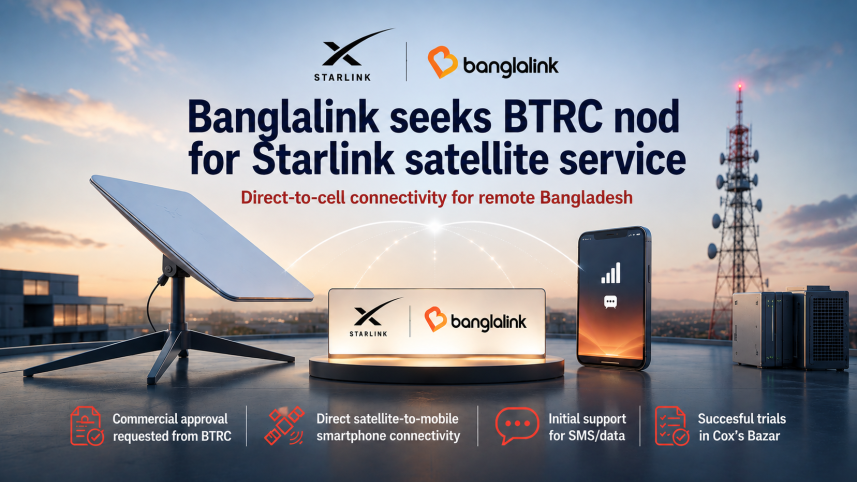
Banglalink has sought regulatory approval to commercially launch a satellite-to-mobile service that will allow smartphones to connect directly to satellites, enabling it to offer connectivity in remote and hard-to-reach areas.
The mobile operator has requested the Bangladesh Telecommunication Regulatory Commission (BTRC) to approve the commercial launch of Direct-to-Cell (D2C) services, initially offering SMS and Lite Data connectivity under its existing Cellular Mobile Services Operator Licence.

The latest application follows an earlier initiative by Banglalink and SpaceX to test satellite-to-mobile connectivity in Bangladesh.
In April, the two companies sought BTRC approval for an initial 60-day trial to integrate Starlink’s Direct-to-Cell satellite connectivity with Banglalink’s mobile network.
In a letter to the BTRC on August 12, Banglalink said it had successfully completed all necessary technical, operational and regulatory assessments during the D2C proof-of-concept (PoC) phase.
A field demonstration of the service was conducted in Cox’s Bazar on August 2 and 3 in the presence of BTRC officials and representatives of relevant law enforcement agencies, according to the letter.
During the demonstration, Banglalink said it validated several capabilities of the satellite-to-mobile service, including SMS and Lite Data connectivity, the generation of call detail records (CDRs) and IP detail records (IPDRs), lawful interception readiness and geolocation mechanisms.
“Starlink’s Direct-to-Cell technology has the potential to strengthen connectivity for communities in remote and hard-to-reach areas, where traditional network infrastructure can be challenging to deploy. By complementing existing mobile networks, this technology can help expand access to essential digital services and bring reliable connectivity to more people,” said Taimur Rahman, chief corporate and regulatory affairs officer of Banglalink.
“Following the successful test, we look forward to the necessary regulatory approvals and the commercial launch of this innovative technology, helping connect more communities across Bangladesh.”
D2C technology allows compatible mobile phones to communicate directly with satellites, which effectively act as mobile network towers in space. This means users can potentially remain connected in areas where conventional mobile towers are unavailable or difficult to deploy.
The technology is different from conventional satellite internet services, which generally require a dedicated satellite terminal or dish. With D2C, compatible smartphones can connect directly to satellites without requiring specialised equipment at the user’s end.
Banglalink said the technology could extend connectivity to remote, coastal, maritime and disaster-prone areas where terrestrial network coverage may be limited or unavailable.
The company also highlighted the potential of satellite-to-mobile connectivity to strengthen emergency communications. During natural disasters, terrestrial infrastructure such as mobile towers and fibre networks can be damaged, disrupting communications. A satellite-based supplementary network could provide an additional layer of connectivity in such situations.
The proposed service is intended to initially support SMS and later Lite Data connectivity, particularly in areas where terrestrial networks are unavailable.
In its latest letter, Banglalink said the introduction of D2C could bring significant national benefits by expanding connectivity, supporting digital inclusion and improving communication resilience.
The company also said the service could benefit fishermen and other maritime users who operate beyond the reliable coverage of terrestrial mobile networks.
If approved, the service would mark a significant expansion of mobile connectivity in Bangladesh by adding satellite-based coverage to the country’s existing terrestrial mobile network infrastructure.
Rehan Asad, telecom and ICT adviser to the prime minister, said recently that the government will allow all new technologies, including satellite-based services, to enable customers to receive better telecom services.
 For all latest news, follow The Daily Star's Google News channel.
Comments