


External pressure shouldn’t dictate reforms: experts
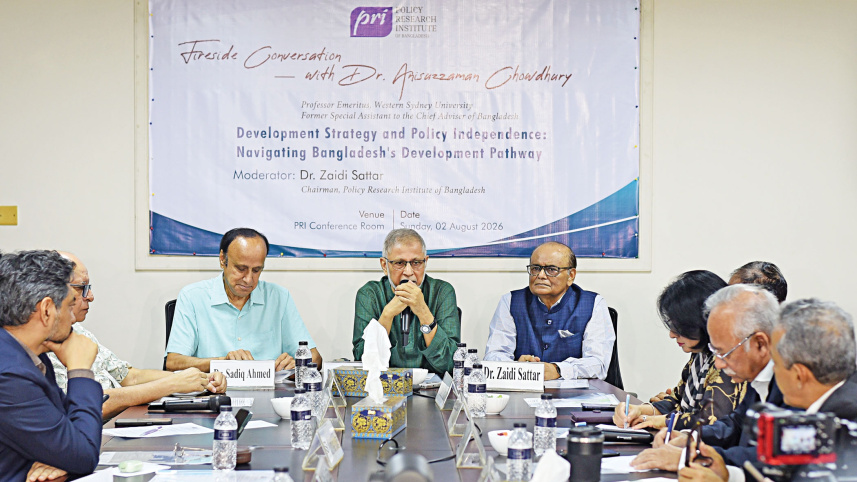
Bangladesh needs greater policy independence to sustain long-term economic growth, experts said yesterday, calling on authorities to implement reforms guided by national priorities rather than external pressures.
The call came at a fireside conversation titled “Development Strategy and Policy Independence: Navigating Bangladesh’s Development Pathway,” held at Policy Research Institute of Bangladesh’s (PRI) conference room.

Speaking at the event, Anisuzzaman Chowdhury, professor emeritus at Western Sydney University and former special assistant to the interim government’s chief adviser, said policy independence had been central to Bangladesh’s economic progress.
He said privatisation initiatives introduced during former president Ziaur Rahman’s tenure, the growth of the ready-made garment sector, and agricultural integration laid the foundation for the country’s development.
The professor, however, argued that Bangladesh’s policy autonomy had weakened over time as reforms became increasingly shaped by external pressures.
Citing Vietnam and South Korea, he said their economic success was rooted in consistent and independent policymaking.
Anisuzzaman also said the Bangladesh Bank did not fully follow certain policy prescriptions of the International Monetary Fund (IMF) during the interim government’s tenure, underscoring the importance of tailoring policies to the country’s economic realities.
He stressed the need to strengthen social capital, empower civil society, remove vested interests and depoliticise public institutions, particularly educational institutions, to ensure effective governance and greater policy autonomy.
Also speaking at the programme, PRI Chairman Zaidi Sattar said Bangladesh’s economic direction changed significantly after 1991, when the government introduced market-oriented reforms, including exchange rate flexibility, current account convertibility, privatisation and financial sector reforms.
He said many of those reforms had since stalled or been reversed, although some modest reform measures were now under way.
The PRI chairman also noted that Bangladesh’s dependence on foreign aid had fallen sharply, with aid declining from about 6 percent of GDP in the 1970s to less than 2 percent today.
Among the panellists, Fahmida Khatun, executive director of Centre for Policy Dialogue, said Bangladesh had strengthened its negotiating capacity over the years, giving it greater policy independence.
She urged policymakers to prioritise long-term structural transformation as the country prepares to graduate from least developed country (LDC) status.
Kamran T Rahman, president of the Metropolitan Chamber of Commerce and Industry; Selim Raihan, executive director of the South Asian Network on Economic Modeling; AKM Waresul Karim, dean of the North South University School of Business and Economics; and Md Rezwan Selim, vice-president of the Bangladesh Garment Manufacturers and Exporters Association, also spoke at the event.
The discussion concluded with participants emphasising the importance of strengthening institutions and pursuing nationally driven reforms to support Bangladesh’s sustainable and inclusive development.
 For all latest news, follow The Daily Star's Google News channel.
Comments