


Rethinking what we mean by good mental health
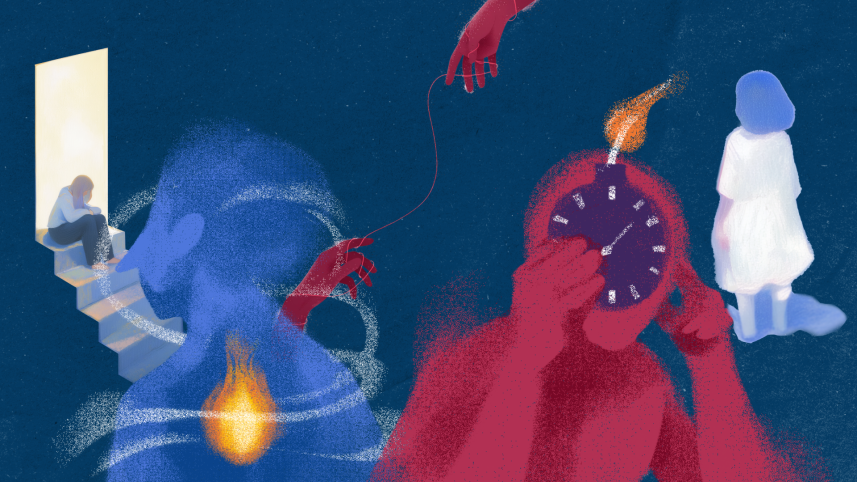
I was recently reading a memoir named I Want to Die but I Want to Eat Tteokbokki, the South Korean writer Baek Se-hee's record of her therapy sessions with her psychiatrist. It was pleasant enough, but I still had an unnerving feeling, and to make sure I wasn't just overthinking it, I went on to the sequel, I Want to Die but I Still Want to Eat Tteokbokki, and that bothersome feeling actually gave way to a harsh truth about mental health.
In the sequel, Baek is clearly burning out as a result of working in a very toxic environment. She talked to her psychiatrist about wanting to quit her job, and yet her psychiatrist never brought up the possibility of her taking a break nor validated her feeling that she was indeed going through burnout. Rather, they kept pressuring the author into admitting that she was making a mistake and that she shouldn't even consider leaving her job, as she was in a good position with quite a few years under her belt; she most definitely shouldn't leave this job to pursue her writing career, even though it was making her absolutely miserable. Thankfully, the author made her own decision, quit, and went on to write this very book.


Sadly, this phenomenon I read about isn't that uncommon, and it is the productivity-and-societal-expectation pitfall of diagnosing mental illness. It’s difficult for people to comprehend that high-functioning people with active social lives can be mentally ill. However, when you are having a bad day and aren't living up to the standard imposed on you, the tables turn.
This creates a rigged sort of test, one where you have to be unwell enough to be believed but never so unwell that you stop being useful. Slip on either side of that line, and someone appoints themselves your diagnostician. Perform competence for long enough, apparently, and even your own psychiatrist will start treating your seniority at a job as more clinically relevant than your burnout.
The psychologist Corey Keyes gave that space a name: “languishing”. Not flourishing, not in crisis; just stalled in the middle. His point was that a person can be free of any diagnosable disorder and still be running on empty. Languishing is what that looks like from the inside: low energy, low interest, and a flatness that no screening tool picks up, because screening tools are built to catch dysfunction, not a dimmer switch turned halfway down.
Sadly, that is precisely where the pitfall lies. Our healthcare system responds to crises by default. So even if someone is languishing, as long as they seem to be coping and managing their responsibilities, their need for help is, more often than not, ignored.
This is also precisely the blind spot researchers have started naming as “high-functioning depression”, arguing for its clinical recognition. It reveals that the traits that get rewarded at work or at home – reliability, ambition, and the instinct to push through – are more often than not the same traits that hide distress from the people near and dear to them. Doctors take these as competence, and so do family, friends, and employers.
None of this actually gives people an outlet to get treatment for themselves, though. When people finally decide to do something about how they're feeling, the decision is rarely purely about themselves. Often, underneath it, is the sense that they've become an inconvenience to a partner, a family, or a friend group that has started to sound tired on the phone. Researchers have a term for this too: “perceived burdensomeness”, the belief that you've become a burden for significant others who would honestly be better off without you. It sits inside a wider architecture of self-stigma, the internalised sense that needing help in the first place makes you weak, which research has linked to people dropping out of treatment early once they've started.

It's worth saying plainly that perceived burdensomeness isn't just an unpleasant feeling to note in passing. In a study on a brief intervention to target perceived burdensomeness in clinic-referred youth, researchers studying suicide risk treat it as one of the more consistent predictors of suicidal ideation, which is a reason the distinction between getting help for yourself and getting help to stop bothering other people matters more than it might sound like it should.
As I said before, people who function well in their lives are not thought to have mental health issues, but that’s mostly because nobody around them was looking for the problem to begin with. I don't think the fix here is a new diagnosis. It's a lower bar for noticing: permission to check on someone before they've stopped functioning enough for it to count.
References:
1. BJPsych Bulletin (2025). High-functioning depression: a hidden burden demanding clinical recognition.
2. Suicide and Life-Threatening Behavior (2022). Brief modular approach to target perceived burdensomeness in clinic-referred youth.
Fabiha is going to put herself in time out for trying to juggle so many things as though she were part and parcel of a circus party. Give her juggling tips at s.fabiha.amreen@gmail.com.
 For all latest news, follow The Daily Star's Google News channel.
Comments