


Manto’s truths still unsettle South Asia, speakers say
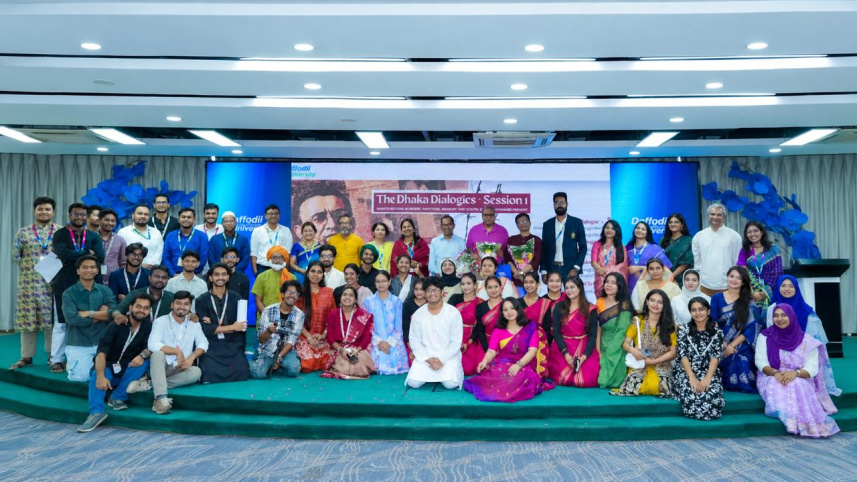
Writers and scholars from Bangladesh, India, and Pakistan revisited Saadat Hasan Manto at a cross-border dialogue at Daffodil International University (DIU) on September 30, reading the Urdu writer through Partition, memory, and language, and through the moral unease that still surrounds his work.
Titled “The Dhaka Dialogics – Session 1: Manto Beyond Borders—Partition, Memory and South Asia’s Unfinished Present”, the event was organised by DIU’s Department of English, with The South Asian Story as co-organiser.

Khan Touseef Osman of Bangladesh opened the discussion, framing Manto not simply as a chronicler of 1947 but as a writer whose questions continue to cross the political borders of South Asia.
Writer and researcher Javed Hussen placed Manto in conversation with Mirza Ghalib, linking two writers known for confronting the contradictions of their times. Speaking on society’s responsibility towards its own history, he said that until people learn to accept responsibility for the history they create, Manto will continue to lie beneath the earth wondering, “Who is the greater storyteller—Manto or God?” The line echoes the epitaph Manto wrote for himself.
Pakistani critic and writer Nasir Abbas Nayyar discussed Manto’s treatment of colonial and postcolonial realities and of Partition and its trauma, and drew attention to two of Manto’s writings concerning the region that is now Bangladesh. “Manto wrote the colonial and postcolonial worlds, the complexities of Partition and its trauma with extraordinary simplicity,” he said.
Speaking on “Why I Love Manto?”, writer and translator Haikal Hashmi focused on the directness of Manto’s literary vision. “Manto could call white ‘white’ and black ‘black’. There was nothing artificial in his stories,” he said.
From India, J A H Khatri examined the semiotics of Manto’s fiction in his presentation, “Language and Creativity: Semiosphere of Selected Stories of Manto”. Drawing on Yuri Lotman’s concept of the semiosphere, he read the stories “Walid Saahib”, “Thanda Gosht”, and “Toba Tek Singh” as multilingual cultural spaces in which names, code-switching, religious markers, and metaphors construct identity, boundaries and belonging.
Md Shamim Mondol, associate professor at Green University of Bangladesh, spoke on “Can Truth Be Civil? Manto and the Politics of Discomfort”. He argued that Manto unsettles readers not merely through provocative subjects but through silence, irony, compression and a refusal to sanitise violence and desire. He also asked what happens when social decorum becomes a way of filtering out uncomfortable truths.
In a special session, Indian scholar Rituparna Sengupta offered a close reading of “Khol Do”, showing how Manto turns sparse language, bodily gesture and omission into a devastating portrayal of Partition violence.
Though the speakers came to Manto by different routes—Ghalib, cultural semiotics, close reading and the politics of discomfort—the discussion kept returning to one question: why a society finds truth disturbing when literature refuses to make it comfortable.
 For all latest news, follow The Daily Star's Google News channel.
Comments