


A legacy carved in clay

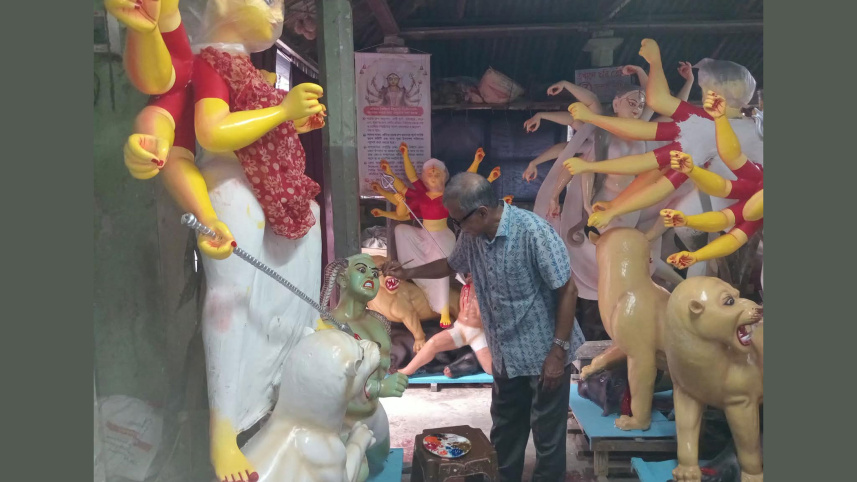
Inside Rupashri Shilpalay in Chattogram city’s Dewanji Pukur Par area, rows of half-finished frames surround a towering idol of Goddess Durga.
Standing before the idol with a paintbrush in hand, Sunil Chandra Paul, a retired professor of zoology at Chittagong College, carefully applies steady strokes to bring its expression to life.

With just days to go before Sharadiya Durga Puja, the largest religious festival of Bangalee Hindus, the workshop is abuzz with activity, its air thick with the earthy scent of drying river clay, varnish and acrylic paint.
For Sunil, however, making idols is not a commercial pursuit but an inherited passion that has drawn him back to the artisan’s bench after retirement.
The Paul family’s tradition of idol-making dates back to the mid-20th century and has been passed down through generations.
Sunil’s father, late Radha Shyam Paul, began crafting idols in Chattogram in the 1950s.
“I was born in 1955, and since my childhood, I saw my father working passionately and professionally in his workshop,” Sunil recalled. “My brothers and I used to assist him during our pastimes.”
Sunil’s second brother, Ratan Krishna Paul, carried on the family tradition as a full-time artisan, fulfilling his father’s wishes.
Although Sunil and his other brothers pursued higher education and different professions, they continued to help at the workshop whenever possible.
“Ratan is very busy now and has to frequently travel to different upazilas with his team ahead of Durga Puja. So, we assist him whenever we can,” Sunil said.
“We focus on the quality of work rather than quantity,” Sunil said. “During Durga Puja, we take orders for 30-35 sets of idols, even though the demand is much higher. This year, we stopped taking orders two months ago once our limit was filled.”
A specialised team of three artisans needs at least three days to shape the clay structures for a set of idols, followed by another day of painting. Sunil and his artist brother Arun help with the latter stage.
The craft, however, faces growing challenges, including rising costs of raw materials and artisans’ wages and difficulties in sourcing traditional river clay from the Karnaphuli river, sometimes complicated by local extortion.
Many traditional artisans are also moving to other professions because of a lack of year-round work.
Despite the challenges, the Paul family tries to keep its work affordable.
“We try to limit the budget so it remains within the reach of worshippers,” Sunil said.
A complete set of handcrafted idols from their workshop costs between Tk 50,000 and Tk 1,00,000.
As the idols receive their final coats of paint, drapery and ornaments, Sunil steps back to inspect his work, recalling a childhood spent watching his father shape figures of divinity from clay.
 For all latest news, follow The Daily Star's Google News channel.
Comments