


What Jamir Nazir’s Commonwealth win tells us about literature in the age of AI

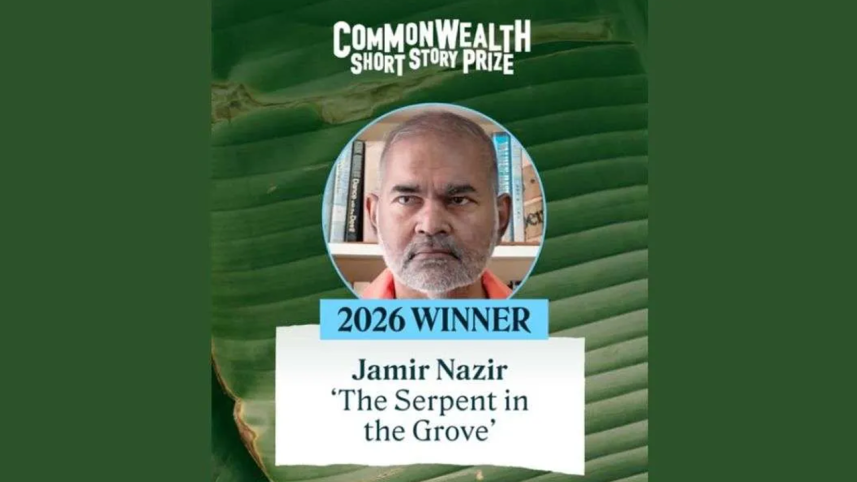
By now, everyone with even the slightest exposure to the world of literature must be familiar with the name Jamir Nazir. Commonwealth winners come and go every year, but few have managed to ignite a literary debate quite like he has.
In mid-May, the Trinidad-born writer was named the Caribbean regional winner of the Commonwealth Short Story Prize for his story "The Serpent in the Grove".

Within hours of the announcement, critics on social media descended upon the story with forensic intensity, running it through AI-detection software and dissecting its sentences with the precision of investigators searching for evidence of fraud.
One detector flagged the work at 100 percent, while the literary magazine Granta, which had long partnered with the Commonwealth Short Story Prize, later announced it was ending that partnership.
Critics claimed Nazir’s story bore “obvious markers” of artificial intelligence: too many “not x, but y” constructions, the liberal use of lists of three and certain distinctive turns of phrase. They argued these were examples of algorithmic profundity masquerading as genuine literary craft.
But what these critics overlooked was the literary power of the story itself.
"The Serpent in the Grove" follows Vishnu Mohammed, a struggling farmer whose obsession with a woman drives him to plot the murder of his wife, Sita, by luring her to an abandoned well.
Sita survives after being rescued by a neighbour, and her resilience becomes the emotional core of the story as she slowly rebuilds her life. Vishnu, meanwhile, is left to confront the guilt and moral ruin of his actions.
Rather than offering easy redemption, the story explores survival, memory and the slow, imperfect possibility of change.
It is precisely this kind of serious literary work that convinced the Commonwealth judges to recently name Nazir the overall winner as well.
In doing so, the judges made an unmistakable statement. We, too, need to acknowledge that we have arrived at a dangerous moment in literary culture, where stylistic analysis is increasingly replacing genuine literary judgment.
The reality is that, before long, almost everyone engaged in writing will use some form of AI assistance. When that day arrives, what will the critics do?
Will they reject every manuscript that bears signs of digital assistance? Or will they finally learn to distinguish genuine slop from work that, regardless of how it was polished, contains ideas and insights that are unmistakably human?
Let us be honest. This very article you are reading right now has also been refined with AI assistance. Does that make everything in it the product of artificial intelligence? Of course not.
Every idea contained in these paragraphs -- the argument itself, the perspective and the conviction that drives it -- originated from human thought.
So, will you judge this article solely by the construction of its sentences while ignoring the substance of what it is trying to say? Or will you recognise that to do so would be to mistake technique for content, to confuse the vehicle with the cargo?
To obsess over whether AI played any role in producing a piece of writing is to suggest that ideas no longer matter, that originality no longer matters, that only the pristine fingerprints of unaided human labour deserve recognition.
Artificial intelligence is here to stay and will soon become woven into the fabric of creative work. Human creativity, however, will endure because the power of an original idea -- one born of genuine thought and lived experience -- will always surpass the algorithmic recombination of patterns.
As AI becomes commonplace, the question will no longer be whether a writer used AI, but whether the work offers ideas and insights that could only have come from a deeply human mind.
Here lies the paradox that saves us: truly great ideas cannot be manufactured. They emerge from deep study, voracious reading, rigorous thinking and, perhaps most importantly, from experiencing different facets of life.
 For all latest news, follow The Daily Star's Google News channel.
 The more you learn, read, think and experience, the stronger your writing becomes -- not because of the tools you use, but because your mind grows richer and your perspective deeper.
New literary voices and innovations in technique will continue to emerge from human imagination pushing against boundaries that machines can imitate but never originate.
That is why, no matter how advanced artificial intelligence becomes, human creativity will always remain one step ahead.
This is the future worth fighting for: a literature judged not by the purity of its production but by the audacity, originality and authenticity of its thought.
Comments