


Actor Nasima Khan passes away, leaving behind anguish over missing son
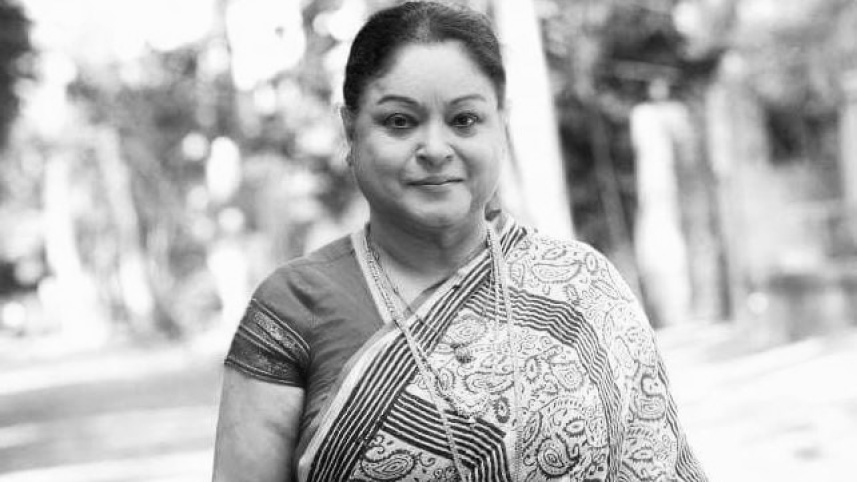
Veteran actor Nasima Khan, who was once a familiar face in Bengali and Urdu cinema, passed away on Sunday (October 11) while still awaiting news of her missing younger son. She was 82.
Nasima breathed her last around 7:30pm while undergoing treatment at a private hospital in Uttara, Dhaka. Nurjahan Begum, who had been looking after the actor, confirmed her death to Prothom Alo.

Nasima was among the actresses who gained recognition in Dhaka’s film industry during the 1960s, when Bengali and Urdu films were being produced in what was then East Pakistan. She went on to establish herself in both Dhaka and Lahore’s film industries, appearing in films including “Je Nodi Moru Pothe”, “Surjasnan”, “Begana” and “Ujala”.
According to Nurjahan Begum, Nasima had been suffering from physical and mental health problems for some time. Her condition deteriorated seven days before her death, prompting her admission to a private hospital in Uttara.
Actor Sony Rahman, organising secretary of the Bangladesh Film Artistes’ Association, also confirmed her death.
Nasima had reportedly been emotionally distressed since her younger son, Nabil Nasir Rahman Kushal, went missing in February this year. She had repeatedly appealed through the media for information about his whereabouts.
In a report published by Channel i Online on February 17, the actor spoke about her desperate wish to find her son.
Her elder son, Shabab Nasim Rahman, lives in the United States. Nasima had been living in the Niribili Swapnabilash area of Pathalia Union in Ashulia, on the outskirts of Dhaka.
Early life and entry into cinema
Born on August 6, 1944, in Lalbagh, Old Dhaka, Nasima’s ancestral home was in Rarikhal village of Srinagar upazila in Munshiganj. Her father, Mohammad Masud Khan, was a businessman.
Growing up in a family familiar with cultural activities, Nasima developed an interest in the arts from an early age. She attended Kamrunnessa School and also received dance training.
Her entry into cinema was closely connected to actor and filmmaker Khan Ataur Rahman, who lived near her family’s home in Lalbagh and maintained close ties with them.
Although her family initially hesitated when she received an opportunity to act in films, they eventually agreed on the condition that she would not neglect her studies.
Nasima made her screen debut in a small role in AJ Kardar’s Urdu film “Jago Hua Savera”, released in 1959.
Based on Manik Bandopadhyay’s novel “Padma Nadir Majhi”, the film had poet Faiz Ahmed Faiz associated with its screenplay and featured actors including Tripti Mitra and Khan Ataur Rahman. It won a gold medal at the 1959 Moscow International Film Festival.
Following her debut, Nasima received further acting opportunities, including a role in Baby Islam’s Urdu film “Tanha”, alongside Shamim Ara, Sumita Devi and Shabnam.
Her popularity grew after she appeared in Salahuddin’s 1961 film “Je Nodi Moru Pothe”. Her subsequent performance in “Surjasnan” helped establish her as a leading actress.
Throughout the 1960s, she continued working regularly in Bengali and Urdu films.
Her notable works include “Dharapat”, “Kar Bou”, “Ujala”, “Begana”, “Apon Dulal”, “Uljhan”, “Main Bhi Insan Hoon”, “Dui Bhai”, “Gouri”, “Amar Bou” and “Dheuer Pore Dheu”.
Over the years, she shared the screen with prominent actors including Anwar Hossain, Hasan Imam, Rahman, Golam Mustafa and Azim.
Work in Lahore and later career
Beyond Dhaka, Nasima also worked in Lahore’s film industry in what was then West Pakistan.
 For all latest news, follow The Daily Star's Google News channel.
 According to the Pakistan Film Magazine database, her Lahore productions included “Nayi Laila Naya Majnu” (1969), “Geet Kahin Sangeet Kahin” (1969), “Aansoo Ban Gaye Moti” (1970) and “Road to Swat” (1971).
She was also involved in producing “Geet Kahin Sangeet Kahin”.
Following Bangladesh’s independence, Nasima gradually stepped away from films. She later returned to the screen through television presenting and subsequently appeared in films and television dramas.
Although she made occasional comebacks throughout her career, her acting appearances became increasingly infrequent in later years.
Among her later films were “Matritwa”, “Kusum Kusum Prem” and “Matir Pinjira”. According to the Bangla Movie Database, she appeared in the 2013 film “Matir Pinjira”.
Memories of a changing film industry
In an autobiographical account published in the Eid edition of the weekly “Bichitra” in 1990, Nasima reflected on her experiences in the film industry.
The recollections, transcribed by film critic Mahmuda Chowdhury, were republished by the Bangla Movie Database in 2025.
In the account, she recalled working with Anwar Hossain during the shooting of “Surjasnan”, sustaining an injury after falling down a staircase while filming “Kar Bou”, and the demanding shooting schedule of Zahir Raihan’s “Dui Bhai”.
She also reflected on the collaborative atmosphere of the film industry in the 1960s and the dedication of the artistes working at the time.
Her memories offered a glimpse into an era when formal acting training was limited and performers often learnt their craft directly from experienced actors and directors.
From the black-and-white era of cinema to the decades that followed, Nasima remained associated with Bangladesh’s entertainment industry.
Her death marks the passing of another member of the pioneering generation of Dhaka-based actresses who worked across Bengali and Urdu cinema.
Comments