


Rudmila Chowdhury’s footwork finds words in ‘Handbook of Bharatanatyam’

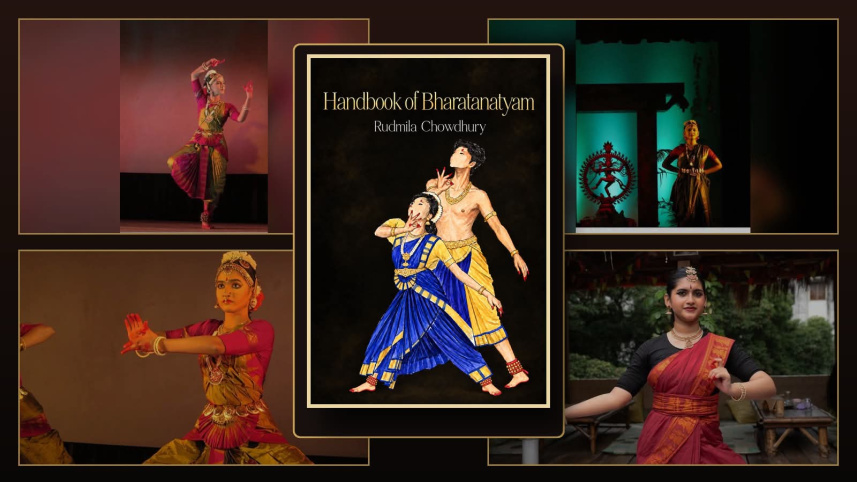
Before every theory examination, Bharatanatyam practitioner and author Rudmila Priyonty Chowdhury had to search through teachers’ handouts and numerous online sources for the information she needed. By the time she completed her Diploma in Bharatanatyam at Kolpotoru in 2022, those materials had filled an entire shelf.
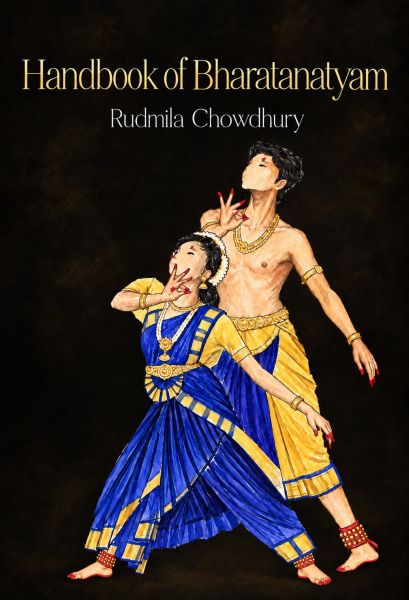
That collection of notes would eventually become “Handbook of Bharatanatyam”, her forthcoming book aimed at making the dance form’s theoretical foundations more accessible to students in Bangladesh. The book will launch today at the WOW Festival at Aloki.

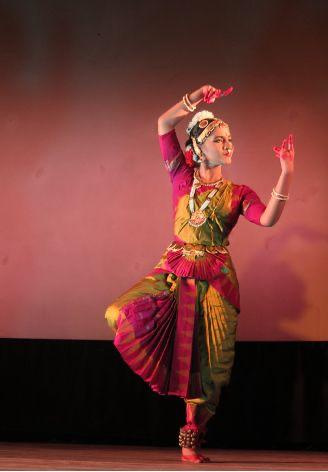
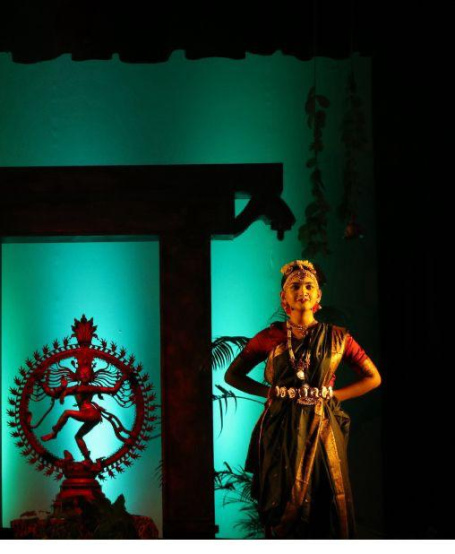
Audiences may notice the precise movements, expressions, and rhythm of a finished performance, but the years of theoretical study behind it often remain unseen. As Rudmila put it, “An audience watching a three-minute piece has no idea how much of it is theory.”
Her connection with Bharatanatyam began years before she started compiling those notes. Inspired by her mother’s interest in dance, Rudmila joined Kolpotoru at an early age and began her formal training there.
Her dedication to Bharatnatyam deepened while preparing for Rongoprobesh, a milestone performance in a classical dancer’s training. She and her friends rehearsed for five to six hours a day, seven days a week. The schedule was physically exhausting, but it transformed the way she understood the form.
“That period really showed me the beauty of Bharatanatyam and made me determined to embody it, not merely dance it,” she said.
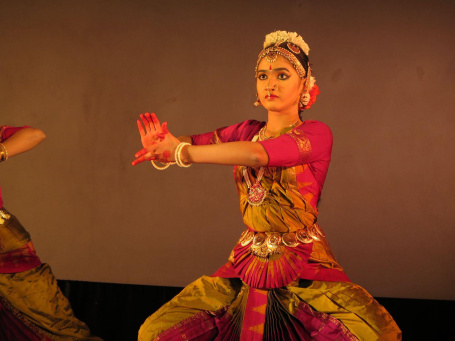
The academic demands of classical dance often surprise those outside the field. “I have been asked multiple times by family members whether it is not enough to know how to dance,” she said. “But performing a jati in any talam is quite different from writing a five-mark answer on what a jati is.”
After completing her diploma, Rudmila watched her juniors face the same difficulties while preparing for their theory examinations. She realised that the notes gathering dust on her shelf could become the guide she herself had needed as a student.
She initially imagined the project as a small revision guide for Kolpotoru’s students. Lubna Marium, whom Rudmila affectionately calls Lubna khala, encouraged her to develop and publish it as a full-length book.
The handbook introduces readers to the fundamentals of Bharatanatyam, including its origins and history, the traditional margam repertoire, foundational treatises, bhedas, mudras, and the lives of pioneers who helped shape the form. Although written primarily for students preparing for examinations, Rudmila hopes it will also appeal to readers encountering Bharatanatyam for the first time.
According to her, students in Bangladesh have long lacked a locally available guidebook bringing this information together. Books published in India are not always accessible or affordable, leaving many to search through numerous sources for answers to basic theoretical questions.
“My main goal was to put the fundamentals in one place, so that a student or beginner does not have to search through a dozen sources for a single answer,” she explained.
Yet documenting a form traditionally passed from guru to student presented an immediate challenge: how could movement be translated onto a static page?
Rudmila is careful to clarify that the handbook is not intended to replace formal instruction.
“Bharatanatyam can only be taught through demonstration and practice,” she said. “This book should be used alongside training rather than replacing it.”
Instead, it explains movements and their applications while offering the historical and theoretical context necessary to understand them.
The most difficult section to produce was the chapter on bhedas, the different movements of the head, eyes, neck, and other parts of the body used in dance.
In the section on shiro bheda, for instance, Rudmila needed to illustrate movements such as circling the head or moving it repeatedly up and down. A single photograph could show a position, but not the progression that created the movement.
She spent nearly two weeks trying to solve the problem. Working with Sagar, who photographed the bhedas, she eventually decided to use sequences of images that readers could follow frame by frame.
Choreographing a piece requires further knowledge of rasas and the precise mudras needed to communicate a scene.
 For all latest news, follow The Daily Star's Google News channel.
 That theoretical grounding does not mean Bharatanatyam can only communicate with viewers already familiar with its vocabulary. Rudmila approaches performances for informed and unfamiliar audiences with the same commitment, trusting the emotional language of the form to travel beyond technical knowledge.
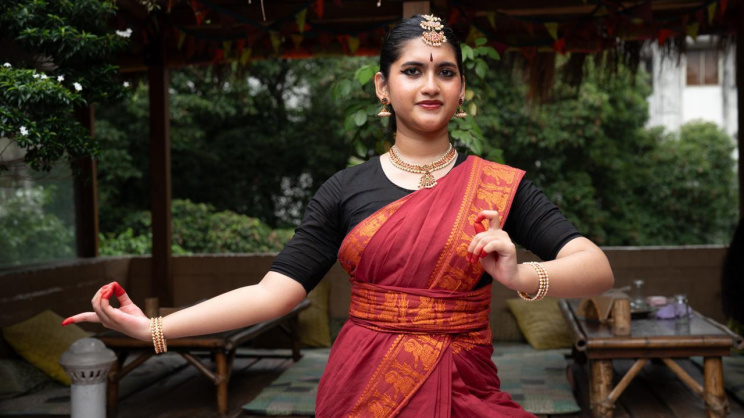
“Talam, laya, and abhinaya carry further than people expect,” she said. “An audience that has never seen Bharatanatyam can still distinguish between a good performance and a bad performance. They may not know the mudra for a deer, but they understand fear or longing when they see it.”
Through the handbook, she hopes readers unfamiliar with Bharatanatyam will gain enough insight to recognise some of what unfolds before them during a performance. For students, she hopes the book will make theory examinations easier to prepare for.
She also hopes the publication will encourage further writing and research on Bharatanatyam in Bangladesh.
Her conversations with dancers Shoma Mumtaz and Belayet Hossain Khan during the writing process drew her attention to the long, largely undocumented journey of Bharatanatyam in Bangladesh. Although the form originated in India, generations of practitioners have helped it take root and develop within the country’s cultural landscape.
“Bharatanatyam has been a part of me since the age of eight, and I have no intention of setting it aside,” Rudmila said. “I believe this handbook was my first step as a dance writer.”
Her next ambition is to look beyond the fundamentals and document the people, institutions, and histories that have sustained classical dance in Bangladesh -- stories that, like the labour behind a three-minute performance, have too often remained outside the audience’s view.
Comments