


‘Staging a Lifetime’ chronicles Ramendu Majumdar’s journey

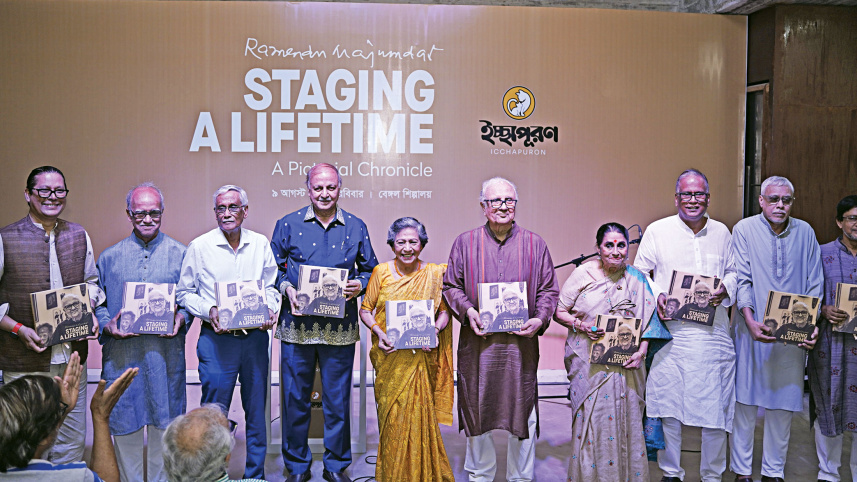
A life spent across stages, television studios, cultural movements and continents can be difficult to contain within pages. Yet, yesterday, decades of Ramendu Majumdar’s journey sat between the covers of a book, passed from hand to hand among many of the people who had shared parts of that journey with him.
“Ramendu Majumdar: Staging a Lifetime — A Pictorial Chronicle” was unveiled at Bengal Shilpalay in Dhanmondi yesterday (August 9), coinciding with the eminent theatre personality’s 85th birthday. The evening also marked the journey of newly launched publishing house Icchapuron, named after Majumdar’s granddaughter, Iccha.
Hosted by Majumdar’s son-in-law Syed Apon Ahsan, the gathering brought together family, friends and familiar faces from Bangladesh’s cultural landscape, transforming what could have been a conventional book launch into something closer to a collective recollection of a life in the arts.
Among those present were Majumdar’s wife, acclaimed actor Ferdousi Mazumder, their daughter Tropa Majumdar, actor and cultural personality Afzal Hossain, Prothom Alo Editor Matiur Rahman, journalist Qurratul-Ain-Tahmina, and mountaineer Nishat Majumdar, alongside numerous theatre practitioners and cultural figures.
Speakers revisited their own encounters with Majumdar, speaking of his talent, discipline and contribution to Bangladesh’s cultural sphere, while also wishing him on his birthday. Their recollections reflected the many identities that Majumdar has inhabited throughout his career—actor, director, producer, organiser, advertising professional and an internationally recognised advocate for theatre.
For Tropa, however, one of the earliest versions of her father was perhaps the one heard before he was seen.
She recalled a time when many people primarily recognised Majumdar as a newsreader, particularly for his distinctive voice—a detail that finds its own place within the chronicle of a career that consistently moved between mediums.
And the book is structured much the same way.
Rather than limiting itself to Majumdar’s celebrated association with theatre, “Staging a Lifetime” traces the different worlds he has occupied. Beginning with his roots in Lakshmipur, it moves through his involvement with Theatre magazine and theatre school, before documenting his work with the International Theatre Institute (ITI), advertising, radio, television and film.
Later sections turn towards the man beyond these public identities. Chapters dedicated to Ferdousi Majumdar, his daughter, family and friends sit beside accounts of his professional life, allowing personal photographs and memories to exist alongside the milestones for which he is publicly known.
Majumdar’s international contribution remains another significant thread. A former worldwide president of the International Theatre Institute, his engagement with theatre extended far beyond Bangladesh, connecting the country’s theatre movement with a wider international community. He was awarded the Ekushey Padak in 2009 for his contribution to theatre.
Yet, photographs remained at the centre of Sunday’s occasion.
Across the book, formal milestones sit beside considerably calmer moments. Old photographs, encounters with fellow cultural figures, professional engagements and family memories collectively construct a record that is less concerned with presenting a single version of Ramendu Majumdar than preserving the many versions that have existed across 85 years.
That idea also made the timing particularly fitting. On a birthday usually meant for looking back, Majumdar’s past was being formally archived, while a publishing house carrying his granddaughter’s name was beginning its own story.

 For all latest news, follow The Daily Star's Google News channel.
Comments