


Land without utilities: The Sirajganj industrial gridlock

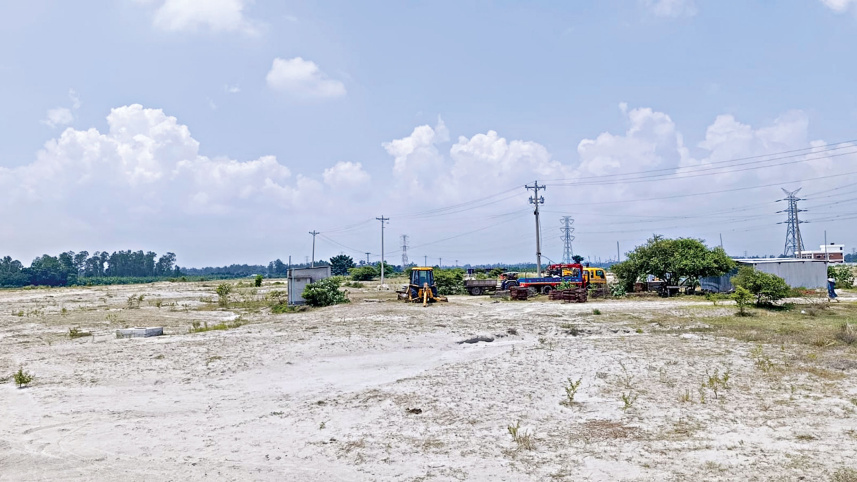
Md Abul Kalam Azad was eager to set up a factory in Sirajganj’s BSCIC Industrial Park. He had good reason to be.
“Sirajganj BSCIC Industrial Park is different from other industrial units in the country because of its excellent communication facilities, with wide road, rail, and river routes surrounding the park,” says the founder of Jamuna Paper Mill.

“Besides, sufficient water is available from the Jamuna river, and there is a large workforce in the river-erosion zones of the district who currently travel to other districts in search of work.”
So, when BSCIC began allotting plots in 2025, he took four at a cost of Tk 3 crore. He planned to make hard paper from recycled paper waste, employing 120-150 workers.
That plan has yet to come to fruition. His plots are not ready for construction, gas and electricity connections are unavailable, and banks will not lend against land for which BSCIC issues no lease document until he has paid in full.
The Sirajganj Economic Zone, one of the country’s largest private economic zones, has left investors such as Apex Footwear, allotted land five years ago, waiting in much the same way.
Such hurdles are not new. Sirajganj has long been viewed as a potential industrial hub, with handloom, agriculture, dairy and river trade anchoring its economy, thanks to its logistical advantages.
Successive governments have tried to turn those advantages into industrial clusters for more than a quarter of a century.
But the take-off is yet to happen.
A SMALL ESTATE, OUTGROWN
Sirajganj got its first industrial estate in 1985. The Bangladesh Small and Cottage Industries Corporation (BSCIC) set up an estate on 10 acres, about three kilometres from the town as part of a nationwide push for industrialisation.
It was one of 21 BSCIC estates built between 1985 and 1998, according to economist Monzur Hossain’s 2019 ADB Institute working paper.
It worked well enough to outgrow itself. By 2009, the estate held 19 units while entrepreneurs were seeking another 40 acres because little space remained. Pollution and drainage problems had also set in.
A PARK THAT KEPT MISSING ITS DEADLINE
The government had already planned something far larger. In June 1999, the Board of Investment decided to build a new park at Saidabad beside the Jamuna.
The timing was significant. The location had also become more attractive. The Jamuna Bridge was opened in 1998, strengthening Sirajganj’s road connection with Dhaka and the eastern part of the country. Its rail and river links provided access towards northern and western Bangladesh.
Land, power, water, gas and communication facilities were among the factors cited in selecting the location.
In December 1999, BSCIC took up the project at an estimated Tk 197 crore. It would cover about 400 acres, create around 100,000 jobs and help reduce poverty in the northern districts.
The first deadline was June 2004. In April that year, the project was scrapped.
Amid growing demand from entrepreneurs, the project was revived in August 2010 at Tk 379 crore, to be finished by June 2014.
 For all latest news, follow The Daily Star's Google News channel.
 The deadline ended without construction beginning. Lengthy land acquisition, which was completed in 2014, and bureaucratic complications delayed work. The project director at the time said work could not begin without environmental, water ministry and other approvals, and land development started only in 2018.
The cost had risen again, first to Tk 489.96 crore, then Tk 628.10 crore, then Tk 719.21 crore, nearly double the 2010 estimate, while the deadline slid to 2015, June 2019, June 2021 and June 2022.
By April 2022, project officials said, 73 percent of the physical work was done and 63 percent of the money spent, but only five of 17 work items were complete.
Just five of a planned 17 kilometres of roads and seven of 34 kilometres of drains had been built. In September 2023, in the project’s 14th year, the Executive Committee of the National Economic Council (ECNEC) approved it for a fourth time without a cost increase. The monitoring division asked for the remaining work to be done by 2024 and recommended no further extensions.
PLOTS WITHOUT FACTORIES
BSCIC took over the park in 2024, after construction ended, and began preparing to hand land to investors even though sand-filling was still under way.
“There are many official procedures to complete before the BSCIC Industrial Park becomes fully operational after construction,” said Md Mahabubul Islam, assistant general manager (AGM) of the park. “Therefore, we took over the project and started the next phase of work.”
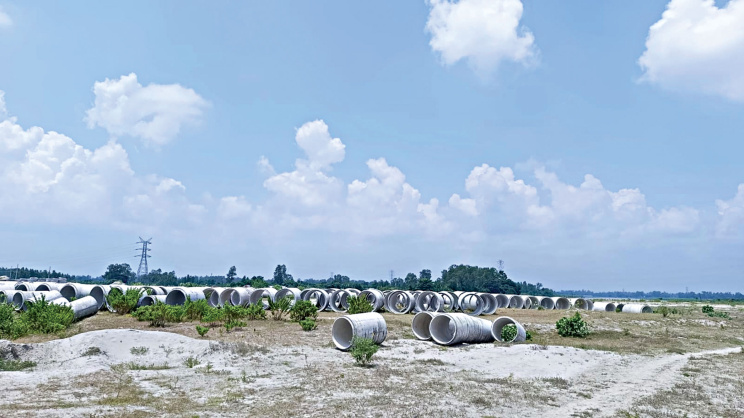
Western Engineering Private Ltd, the contractor responsible for site preparation, then left without finishing the fill. “Despite repeated notices, they did not finish the work, so we stopped payment to the company and seized their security deposit,” Mahabubul said.
BSCIC has set aside Tk 22 crore for the unfinished land development, and a high-level meeting in Dhaka was due to address it, he added.
The contractor could not be reached for comment.
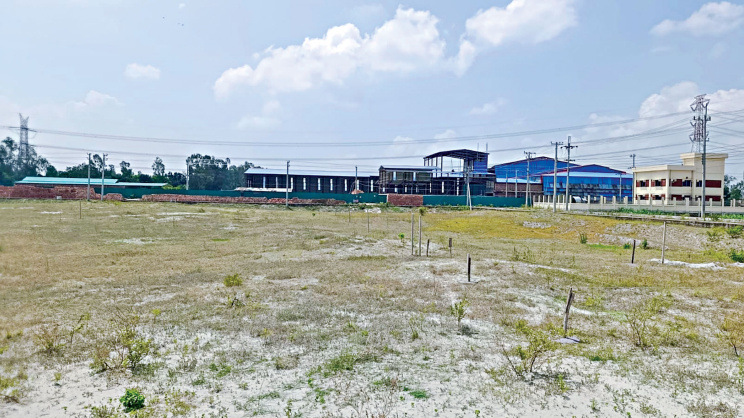
Allotments began in 2025. Of the park’s 829 plots, 272 have gone to local investors, but a recent visit found only 10 to 15 with construction or other work under way, according to officials. Most allotted plots stood vacant during a visit last month.
Azad’s are among them. He says his land sits 6-7 feet below the level required for construction, and that BSCIC initially agreed to help with land development but has taken no action in the past year.
Money is the second obstacle, and it follows a rule change. BSCIC once issued lease documents after a down payment, and investors borrowed against them. Azad says two instalments used to be enough. Now BSCIC signs leases only after full payment.
“Since most traders pay for the land in instalments, we cannot issue lease documents until full payment is made,” said Mahabubul.
Banks, in turn, will not lend without one. Azad has paid Tk 56 lakh of the Tk 3 crore.
BSCIC’s position is that financing is the investor’s responsibility, since allottees sign an agreement to invest their own capital. Azad says he has applied to BSCIC to resolve the problem.
“If I cannot start my factory, I will have to bear the burden of huge financial losses,” he said.
Utilities are a third wait. Pashchimanchal Gas Company Ltd (PGCL) has laid the main supply line, but work on the internal network has stalled over uncertainty about gas availability.
Mahabubul said PGCL has assured BSCIC the pipeline will be finished within six months, but that supply ultimately depends on government approval.
A senior PGCL official, seeking anonymity, said national shortages have forced adjustments to industrial allocations, and that the ministry will decide allocations once it has reviewed the demand estimates PGCL requested from investors in a letter on August 25.
“Without assurance of gas connection there is no way to start installing plants in the BSCIC,” said Abdul Kader, president of the BSCIC plot owners’ association.
BSCIC says four substations have now been built, awaiting transformers, and expects electricity connections by December.
The foreign money the park was meant to draw has not come either.
It originally aimed to attract more than $500 million, mostly foreign. BSCIC reserved 550 plots for CAMC Engineering Company, a Chinese state-owned institution, while it held talks with its business partners.
“However, the Chinese authority sent an email in June this year stating they would not be investing,” Mahabubul said, adding that they did not state why they backed out.
BSCIC is now moving forward to allocate those plots to other investors. A circular dated August 13 reallocated the plots to local firms in garments, food processing and agro-based industries. The reservation had left two-thirds of the park unused.
THE SECOND BET
By the time the park was struggling through its revisions, the government had turned to a different model. The 2010 Economic Zones Act created the Bangladesh Economic Zones Authority (BEZA) to develop large industrial enclaves with dedicated infrastructure. Sirajganj was picked early, at BEZA’s second board meeting in February 2015.
A private consortium of 11 business groups received its final licence in October 2018, and the zone was inaugurated in April 2019. Billed as the country’s largest private economic zone, it spans about 1,041 acres along the Jamuna, with projections of more than $2 billion in investment and as many as 500,000 jobs.
By 2021, 14 companies had been allotted 110 acres, among them Apex Footwear, Continental Garments Industries, Square Accessories and Square Electronics. In 2019, Infrastructure Development Company Ltd (IDCOL) and IDLC Finance agreed to raise Tk 502.5 crore in loans for the first phase.
An environmental and social impact assessment prepared for IDCOL in August 2021 shows what was then expected. It covered a 415-acre first phase costing Tk 748 crore, with a construction schedule running to December 2022.
The assessment rated land loss for residents as a medium-to-high impact.
Project director Md Monwar Hossain says a model village with housing, civic amenities and land is being built for those affected.
That schedule has long passed. The first phase now covers 367 acres with 158 plots, and the second 409 acres with 109 plots.
Land filling for the first phase is complete and internal roads and drainage are under way, but boundary walls and utility networks have yet to begin.
“We anticipate completing primary site preparation by 2028,” said Md Tofazzal Hossain, the zone’s executive engineer. About Tk 700-800 crore has been spent of roughly Tk 3,000 crore, with consortium members financing the work progressively.
Apex Footwear, drawn to invest there for the same reasons as Jamuna Paper Mill, still wants in.
“It is one of the best locations for investment due to its excellent communication and transport facilities,” said Md Omar Faruque, its company secretary. “Apex wants to expand business there.”
However, he added, “In the five years since we were allotted land, we have seen little headway. The site is not yet ready for setting up operations. When we visited last year, it was not prepared enough for a major investment.
“We are eagerly waiting for work on this highly promising EZ to be completed as soon as possible so that we can proceed with our investment.”
“The lack of infrastructure and the uncertainty of utility services are major disappointments. If we cannot secure a gas connection and other basic utilities for production, investing makes no sense,” he also said.
Finance is the other brake. Md Abdul Quader Khan, adviser to the Private Economic Zones Association of Bangladesh, said banks are reluctant to lend against unregistered leases, and that long-term leases must be registered so investors can use them as collateral.
With new gas uncertain, the developers are targeting industries that run mainly on electricity and water, and plan a central steam facility and, eventually, a 300MW solar plant.
Monwar Hossain said foreign investors have visited the site, but no final agreements have been signed.
PLANS AND PROMISES GROW, REMAIN UNFULFILLED
Sirajganj has been considered for an export processing zone (EPZ) for nearly three decades. In January 1998, BEPZA planned three more EPZs, including one in Sirajganj, citing demand from potential investors. It never materialised. The idea is back.
In the FY2026-27 budget speech, Finance Minister Amir Khosru Mahmud Chowdhury said EPZs in Gaibandha and Sirajganj were in the pipeline.
The promises for the district, meanwhile, keep growing. The park’s one lakh promised jobs of 1999 became around two lakh in later estimates, and the zone projects as many as five lakh.
Comments