


Dhaka Swagger smoke, salvage and street attitude
I find Dhaka endlessly colourful, its people carrying a swagger that outshines even Tamil cinema stars. A streak in me leans toward this gangster arrogance, an instinctive pull toward that defiant edge. No wonder -- I was born and raised in Dhaka, a city that often feels like the Peaky Blinders script come alive. In my mind, I am Aunt Polly, her steel and intuition mirroring my own, both of us shaping the story from inside the smoke.
And as crazy as my dream sounds, I keep meeting people who carry that definitive Dhaka swagger -- the kind that begins with a sharp “Amare chinosh?” Do you know who I am? Bangla expressions like that lose their bite in English -- raw authority that belongs only to Dhaka’s streets.

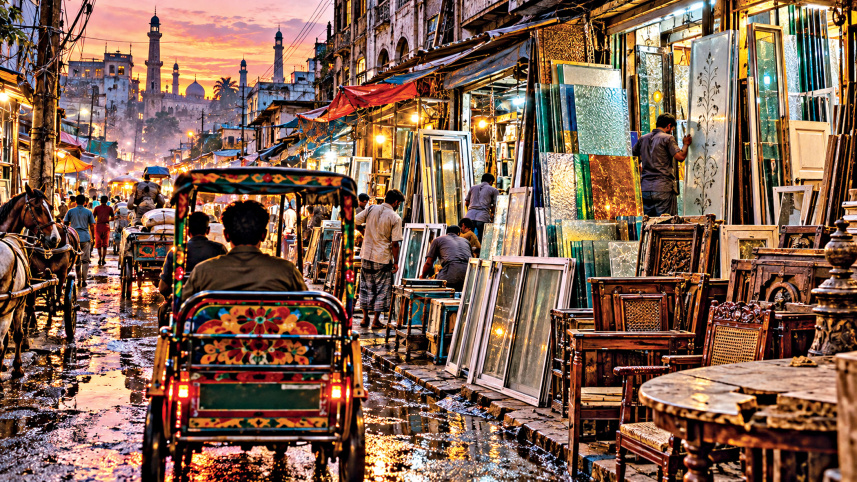
As the sun leaned back and dusk draped the city, I was rattling along in a battery‑rickshaw, half‑lost, following locals’ shouted directions to my evening stop. The stench of horses mixed with waterlogged drains was torture of its own kind. Yet me being me -- a die‑hard fan of Dhaka’s nasty, dirty lanes -- I finally rolled into Anandabazar, that historic pocket near Nimtali and Fulbaria.
Anandabazar is the city’s salvage bazaar, where glass and hardware from demolished buildings find a second life. Contractors, students, locals—all hunt here for tempered doors, frosted panels, sliding windows at a fraction of Babubazar’s price.
But it’s always a game of measure and bargain. Salvaged glass is sold as‑is, pre‑cut, unforgiving if your frames don’t fit; inspect the edges -- one hairline crack and the whole sheet can shatter.
This is Dhaka grit in commerce: cheap, risky, and rewarding if you know how to play it. And I didn’t know the game. Wherever I go, I meet characters whose attitude is beyond big‑headedness.
For instance, my Anandabazar adventure: the man I spoke to own a glass shop. I was asking for old, coloured glass sheets. The gentleman, not interested in direct eye contact, glanced to his right and pointed to a small box of samples. I was supposed to choose, and only then would he be bothered. When I asked the square‑foot price, he turned left and said he couldn’t tell me unless I gave exact measurements and cutting instructions. I explained I was only doing a bit of recce -- scouting, not buying yet; he dismissed me -- “I don’t do business that way.”
I instantly found him cool, and I kept touching the glass sheets, which earned me a scolding. Rightly so, since one cut my hand. I hid the wound to avoid further rebuke. After much attitude and back‑and‑forth, I tried to find the right colour, width, and thickness. He was clearly annoyed, but his rules were his rules. In Dhaka, it doesn’t matter if you’re a managing director or a nobody -- you play by their terms.
That’s the city’s swag: they don’t care who you are. Later, I wandered into the backstreets of Shegunbagicha, where “old” furniture is sold. Most of it isn’t old at all --new pieces painted in tacky orange varnish to look worn. Still, I stumbled upon a half‑broken table whose legs I loved. When I asked if it was for sale, the shopkeeper said no; it was his own stash. Defying logic, he refused to sell what was clearly stock.
Finally, I met young Shobuj, who deals in actual old furniture. He led me to a secret hideout, and though I feared some tragicomedy -- which, according to a friend, is my forte, where joy and grief frequently coexist in my daily adventures -- it turned out to be a treasure trove.
Beautiful in my terms -- rotten, rundown, throwaway pieces I adore. Collecting them is another story for another day, but that evening I struck a bargain and hauled the goods home in a pickup. Even the pickup driver had attitude, softened by friendly bargaining banter.
That’s Dhaka for you -- everyone carries this unshakable swagger. Yet when they finally sense sincerity, not an intention to cheat them, they soften. By the end of the day, I had made two friends: Shobuj -- who laughed and said he agreed to my price only because he needed quick cash to buy gifts for his friend’s wedding that very evening -- and my Tamil hero in Anandabazar, whose name I’ll remember in time. With them, I sense future dealings will be good.
 For all latest news, follow The Daily Star's Google News channel.
Comments