


Kishwar breaking the boundaries with her ethnic cuisine

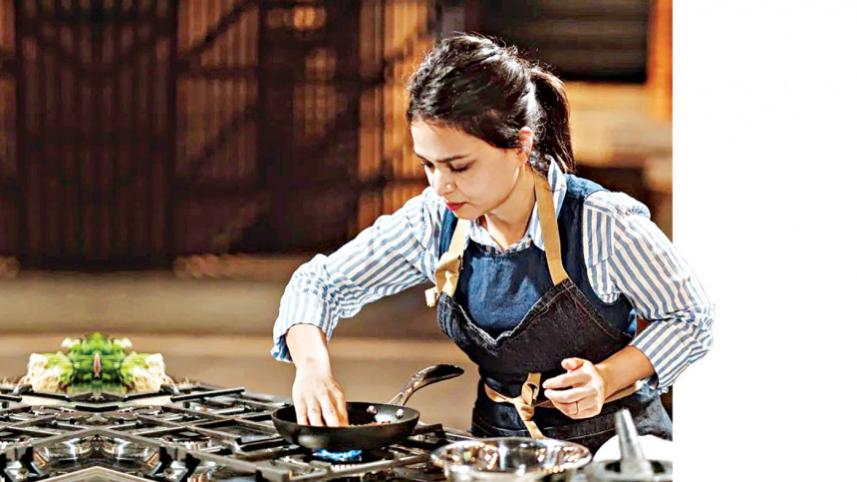
At the very beginning, selection round of MasterChef Australia 2021 after tasting her food the judges were asking "where have you been?" she answered with tears "Just at home". Kishwar, a 38-year-old homemaker and owner of a printing business, competed in MasterChef Australia with her ethnic pride. A very few honest souls can translate their ethnic pride into the dishes they made on an international platform like MasterChef Australia. Kishwar Chowdhury is that honest and vibrant Bangladeshi soul. She presented her heritage and culture with pride and sophistication.
Throughout her journey in MasterChef, she stuck to the term "authenticity". No matter the challenges she was given, she came up with an innovative idea but didn't lose her authenticity. Even in the grand finale, she changed her cooking completely upside down just to re-grab her authenticity.

In her journey on MasterChef, she introduced Australia to 100 percent authentic deshi dishes like begun pora bhorta, letka khichuri, chotpoti fuchka, and the list goes on. Frankly speaking, as Bangladeshis, we didn't even know anyone could present those dishes in such a manner. We eat this food, we have these food, we inherited the recipes without even knowing what we are carrying within us -- we pass them on from generation to generation but never understood the hidden power of this ethnic foods.
I can promise that Kishwar's dessert version of mishti paan (ice cream with betel leaf) gave goosebumps to many of us. Who could even think of such a creative move with such a traditional item? Last but not least, "panta bhaat" and "alu bhorta" as finale dishes! Seriously Kishwar? You need to have tremendous courage to experiment with those dishes on a platform like the MasterChef Australia grand finale.
One question (I would rather put it as criticism) was raised from the Australian audience on social media: "Do her dishes qualify as fine dining?" In these questions, many Australians just disqualified her food, especially the curry she made. Now the question arises, what does one mean by "fine dining"? What are the criteria to consider whether a certain dish is worthy of this label or not? The most important question is, who defines it?
This question is strongly political. For the answer itself is political. Does it mean that only Eurocentric cuisines are qualified to be considered "fine dining"? And the way people consume the food -- whole or partially as one portion, or using fork and knife or hand to eat the food -- will that define the standard? Doesn't it mean that we are bringing class segregation into our food culture? And as usual, doesn't it mean the type of food Europeans consume or the way Europeans eat is better than that of Asians or South Asians? When you put the judgment based on your cultural orientation, it defames other heritages or cultures. Then your judgment is political. When you compare your food culture with other food cultures and pointed out it's "lesser" than yours, then food becomes political. At that point, judge Jock said, "MasterChef is not about fine or polished dishes."
To me, the most attractive part of Kishwar's cooking was bringing up all the overly familiar food that we have, like "panta bhaat" or "paan". We knew that our grandparents, parents of their grandparents have eaten these! But have we ever considered how ancient these foods can be? We don't know for sure, and at the same time we didn't even recognise the power of our ancient food culture.
And the most exciting episode was cooking in Northern Territory: cooking with their local indigenous ingredients. NT is culturally different from all over Australia because this state is the place of the Australian indigenous people. MasterChef team was given indigenous ingredients collected from the desert bush. Kishwar not only nailed her dishes but also explained the dishes with such respect and honour to the indigenous culture of Australia that brought tears to judge Mellisa's eyes.
The fearless lady has broken the conventional definition of sophisticated food. She has broken the cultural hierarchy with her ethnic representation. She broke the geographical boundaries with her authentic ethnic dishes. This is the time to send Kishwar a love letter from Bangladesh.
Dilshana Parul is presently working as Deputy Director (M&E) at BLAST. She is also founder of a feminist online portal "Bilkis has a point of view".
 For all latest news, follow The Daily Star's Google News channel.
Comments