


Israel, Iran trade fire
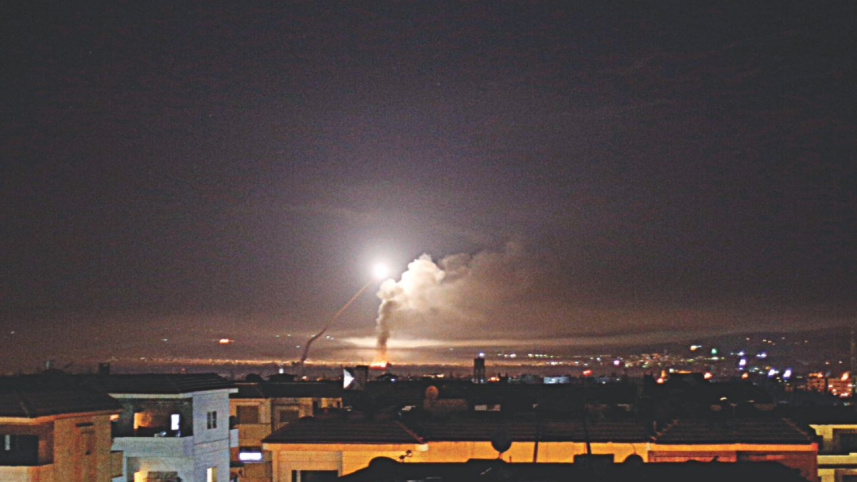
Israel said it attacked nearly all of Iran's military infrastructure in Syria yesterday after Iranian forces fired rockets at Israeli-held territory for the first time.
The incident came after weeks of rising tensions and followed US President Donald Trump's decision to withdraw from a key 2015 Iran nuclear deal on Tuesday, a move Israel had long advocated.

It led to immediate calls for restraint from Russia, France and Germany.
"The escalation of the last hours shows us that it's really about war and peace," warned German Chancellor Angela Merkel.
The White House, in a statement, condemned Iran's "provocative rocket attacks" from Syria and said it supported Israel's right to defend itself.
The raids that a monitor said killed 23 fighters were one of the largest Israeli military operations in recent years and the biggest such assault on Iranian targets, the military said.
"We hit nearly all the Iranian infrastructure in Syria," Defence Minister Avigdor Lieberman told a security conference.
"I hope we've finished this episode and everyone understood."
"We don't want an escalation, but won't let anyone attack us or build an infrastructure to attack us in the future," he added.
Israel carried out the raids after it said 20 rockets, either Fajr or Grad type, were fired from Syria at its forces in the occupied Golan Heights at around midnight.
It blamed the rocket fire on Iran's Al-Quds force, adding that Israel's anti-missile system intercepted four while the rest did not land in its territory.
No Israelis were wounded.
If confirmed, the incident would be the first time Iran had sought to directly attack Israeli-controlled territory aside from an alleged attempted drone attack in February.
"We know that comes from the Al-Quds force," army spokesman Lieutenant-Colonel Jonathan Conricus said, referring to the special forces unit affiliated with Iran's elite Revolutionary Guard.
A senior pro-regime military source in Syria confirmed the salvo of rockets, insisting that Israel had fired first.
Later, in the early hours of the morning, explosions were heard in Damascus, while live images were broadcast on television showing projectiles above the Syrian capital and several missiles destroyed by anti-aircraft systems.
Syrian state media reported that Israeli missile strikes had hit military bases as well as an arms depot and a military radar installation, without specifying the locations.
The official SANA news agency added that "dozens of missiles were shot down by anti-aircraft systems in Syrian airspace", acknowledging a number of missiles had reached their targets.
Israel's military later confirmed it had carried out the raids, saying some 70 targets had been struck and all of its aircraft had returned safely.
The army's Conricus said intelligence, logistics and storage facilities and vehicles were targeted as well as the origin of the rockets.
 For all latest news, follow The Daily Star's Google News channel.
 Syrian air defences, which fired dozens of times on Israeli forces, were also targeted, he said.
There had been no comment from Iranian officials.
The Syrian foreign ministry said the Israeli attack indicated "the start of a new phase of aggression" against Damascus.
France urged Iran on Thursday to refrain from all "military provocation" and cautioned it against "all temptations for regional hegemony".
Russia, which is generally friendly to Israel but fights in Syria's civil war on the same side as Iran, called on both to show restraint and resolve differences through diplomatic means.
Israel and Russia have established a hotline to avoid accidental clashes in the war-torn country. Russia was informed in advance of Israel's strikes, Conricus said.
Israel has long warned that it will not accept Iran entrenching itself militarily in neighbouring Syria, where Tehran is supporting President Bashar al-Assad's regime in the country's seven-year civil war.
Israel has been blamed for a series of recent strikes inside Syria that have killed Iranians, though it did not acknowledge those raids.
It does acknowledge carrying out dozens of raids in Syria to stop what it says are advanced arms deliveries to Iran-backed Hezbollah, another key foe of Israel.
Israel had been preparing itself for weeks for possible Iranian retaliation.
Trump's withdrawal from the nuclear deal has added to tensions and led to a new level of uncertainty over how Iran will respond.
In February, Israel accused Iranian forces at the T-4 base in central Syria of sending a drone into Israeli territory.
After targeting Iranian units in Syria in retaliation, an Israeli F-16 was shot down by Syrian anti-aircraft fire.
Israel, which said the drone it downed had been armed, carried out what it called "large-scale" raids on Syrian air defence systems and Iranian targets in the country.
Comments