


Child development centres: The caged promise of a second chance

Truck driver Roka Mia still remembers the last phone call from his only son.
Seventeen-year-old Parvez Hasan, known as Rabbi, spent three months in Khulna Central Jail before being transferred to the government-run Child Development Centre in Jashore’s Pulerhat, where he remained for more than eight months facing criminal charges.

For weeks, he pleaded with his father to get him out.
“Abba, can you not get me out of here? Increase my age on my birth certificate if you have to. I would rather spend the rest of my life in another jail than stay here,” Roka recalled Rabbi telling him on August 13, 2020 -- the last time they spoke.
Later that night, Roka learnt that Rabbi, then 17 years and five months old, along with Rasel alias Sujon, 18, and Naeem Hossain, 17, both from Bogura, had died inside the centre following alleged torture by officials.
“My son was in the government’s custody. They were supposed to rehabilitate him and help him become a better person,” Roka told The Daily Star recently. “Instead, it was like a prison. They took him into their custody only to beat him to death.”
According to the police charge sheet, after the centre’s chief guard was assaulted, 19 officials and staff allegedly decided to punish the boys accused of the attack.
Investigators alleged that 18 detainees were taken from their dormitories, tied to window grilles with their legs bound and towels stuffed into their mouths, and beaten with iron rods and cricket stumps. Three, including Rabbi, died and several others were seriously injured.
The deaths triggered nationwide outrage, but more than six years later, the trial remains unresolved, with all the accused out on bail.
While Rabbi’s story ended inside the system, children who remain there are still waiting for the rehabilitation they were promised.
Sixteen-year-old Rony Hasan -- a pseudonym used to protect his identity -- is among them.
Detained at the Tongi Child Development Centre for 22 months under the Women and Children Repression Prevention Act, he wants to rebuild his life despite the conditions.
“I have been here for 22 months. I try to change myself, but it is very difficult to cope with the environment here. The place is extremely overcrowded. Around 20 of us sleep in one room. There is a playground and some vocational training, but because there are so many children here, we cannot even play every day.”
All the rooms in the centre measure just 18ft by 14ft.
Child development centres were established to rehabilitate children in conflict with the law through education, counselling and vocational training rather than punishment. But visits to the government-run centres, interviews with children, officials, lawyers, psychologists and child rights advocates, and a review of official records reveal a system struggling to live up to that promise.
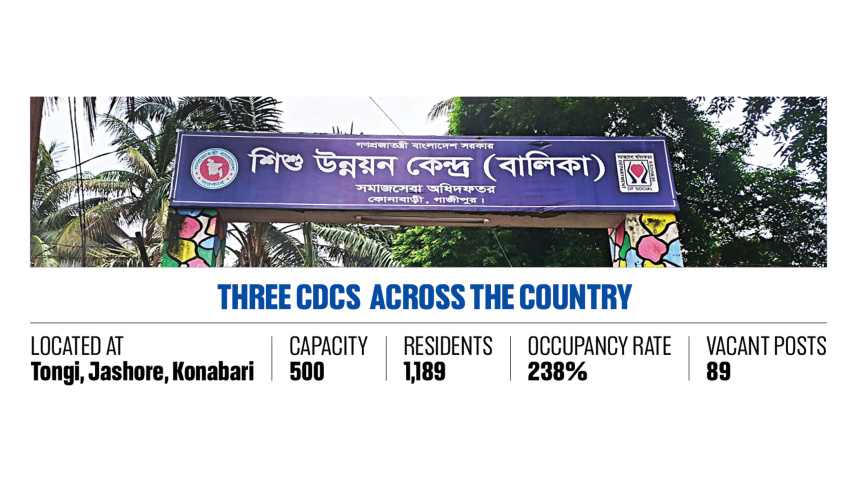
Bangladesh has three government-run CDCs for children under 18 sent there by courts or families for care, rehabilitation or behavioural support. Run by the social welfare ministry, the centres in Tongi and Jashore house boys, while one in Gazipur’s Konabari accommodates girls.
However, rampant abuse, chronic overcrowding, severe staff shortages, inadequate mental health and vocational services, and ineffective post-release support raise questions over whether children receive the second chance the law intends.
Nazia Kabir, barrister-at-law and secretary general of Ain o Salish Kendra, said parents send children there expecting rehabilitation and protection.
“If they are instead abused, killed or deprived of the services they are entitled to, that is unacceptable.”
She called for regular inspections, closer monitoring, prompt investigations into abuse allegations, enforcement of existing laws and punishment for rights violations, alongside counselling, community-based support and programmes to help children overcome trauma and reintegrate.
 For all latest news, follow The Daily Star's Google News channel.
 “I have been here for 22 months. I try to change myself, but it is very difficult to cope with the environment here. The place is extremely overcrowded. Around 20 of us sleep in one room. There is a playground and some vocational training, but because there are so many children here, we cannot even play every day.”
Kamal Chowdhury, professor at Dhaka University’s Clinical Psychology department, said the CDCs function more like juvenile detention facilities than rehabilitation institutions, with serious consequences for children’s mental development.
“Children cannot develop normally in an institutional setting unless it provides opportunities for healthy emotional, social and educational growth.”
He said many counsellors lack formal training and are ill-equipped to support children who have experienced trauma or violence.
Meanwhile, Mohammad Rezaur Rahman, deputy director of the Department of Social Services, cautioned against drawing broader conclusions from individual incidents, saying conflicts may occur among children but a single incident does not show torture is routine.
“These are children in conflict with the law, and we try to keep them separately in accordance with the law.”
Asked about the 2020 Jashore deaths and torture allegations, he declined to comment on the pending case.
OVERCROWDED, UNDERSTAFFED
CDC officialsacknowledged severe overcrowding, chronic staff shortages, inadequate healthcare, limited vocational and digital skills training, and ineffective post-release follow-up.
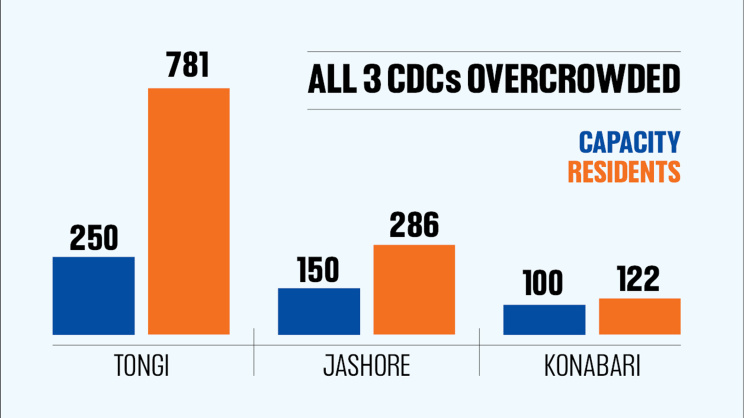
Built on 1.5 acres in 2003, the Konabari centre houses 122 residents against a usable capacity of 100. It has 31 employees, with three posts vacant and two staff members posted elsewhere. It offers counselling, legal aid, education up to Grade 5, sewing and embroidery training, religious education and recreational activities, but no computer training.
Assistant Director Borhan Uddin said staff shortages make supervision difficult and prevent effective post-release follow-up, increasing the risk of reoffending.
“Although the government allocates Tk 5,000 per child each month, only Tk 100 is earmarked for medical care, which is grossly inadequate.”
Of the rest amount, Tk 4,000 goes to food, milk and fuel, Tk 300 to clothing, Tk 250 to vocational training, Tk 200 to education and sports and Tk 150 to toiletries.
The Tongi CDC, founded in 1978, houses 781 children against an approved capacity of 300 and physical capacity of 250. Of 68 approved posts, 49 -- around 72 percent -- are vacant. It has only 10 computers.
Jashore’s centre, the country’s second-largest rehabilitation facility for children, houses 286 children against a capacity of 150. Of 52 approved posts, 37 are vacant. Opened in 1995, it has no computers, while a planned computer training programme has yet to begin.
Social services department’s Rezaur said the government has begun addressing staff shortages. “A recruitment circular was published on June 23, and the recruitment process is now underway.”
He acknowledged limited formal academic opportunities. “Children registered for public examinations can sit for them with court permission, but the centres otherwise have no formal academic programme.”
RIGHTS ON PAPER, GAPS IN PRACTICE
Bangladesh is a signatory to the UN Convention on the Rights of the Child, while the juvenile justice system is also guided by the UN Beijing Rules and Havana Rules. These standards require detention to be a last resort, with rehabilitation, education, healthcare, counselling, vocational training and aftercare at the centre of the system.
Yet conditions at the three CDCs reveal a significant gap between these standards and reality. Children have limited access to formal schooling, with basic lessons provided but little opportunity for formal education beyond Grade 5.
Mental health support is also severely limited. The Tongi centre has one psychosocial counsellor for 781 children, Konabari one for 122 and Jashore two for 286.
Superintendent of Tongi CDC Md Emran Khan said, “We have only one psychiatric social worker who isn’t an expert and doesn’t have a professional degree in psychology. Our psychosocial counsellor is also not sufficiently trained to provide specialised counselling for children.”
Prof Kamal said many frontline caregivers are demotivated and emotionally exhausted, while institutional accountability and resources for quality psychological care remain inadequate.
“Counselling alone is not enough. Children need a safe environment where they can recover physically, emotionally and socially. Without that, meaningful rehabilitation is extremely difficult.”
Comments