


Hospitals in Khulna overwhelmed

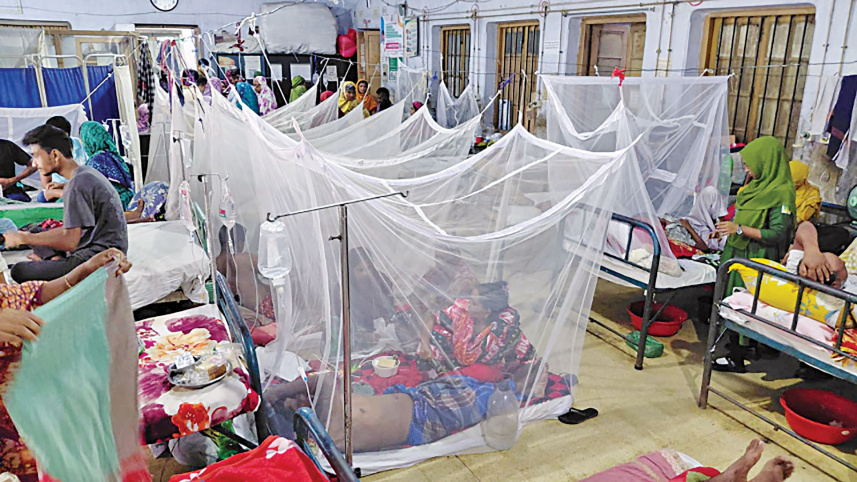
The corridors of Khulna Medical College Hospital are no longer merely passageways for patients and attendants. They have become makeshift treatment spaces as dengue patients arrive in growing numbers.
Those who cannot find beds are being treated in the open spaces between ward beds, as well as on verandas, in corridors and in other available spaces. In the sweltering heat, patients lie under mosquito nets while anxious relatives sit beside them, arranging medicines, food, and other essentials.

Srijan Kundu, a student from Keshab Lal Road in ward-6 of Khulna city, contracted dengue last week. He tried to get admitted to at least seven medical facilities, including KMCH, Khulna General Hospital, and Khulna Specialised Hospital, but failed to manage a bed.
He is now receiving treatment at home on doctors’ advice.
Srijan’s mother Lipika Kundu said hospital treatment provides a sense of security, quick access to doctors and easier monitoring.
“Regular blood tests are also difficult to manage at home. But with no bed available, my son had no choice but to stay home,” she said.
Three other members of the family have also tested positive for dengue. One is receiving treatment on the veranda of a government hospital, while the other two are being treated at home.
His grandfather, Kanu Kundu, said caring for three dengue patients is a huge financial burden. Medicines and nutritious food, including green coconuts, cost a lot.
Like Srijan’s family, hundreds of dengue patients and their families are struggling amid the rising number of cases.
According to KMCH, 1,920 people, including 215 dengue patients, were receiving treatment at the 500-bed hospital as of yesterday morning. Only 70 beds are dedicated to dengue patients.
The pressure is not confined to KMCH. In the 24 hours until 8:00am yesterday, 316 dengue patients were hospitalised across Khulna division, according to the Directorate General of Health Services (DGHS).
The latest admissions brought the number of dengue patients in the division this year to 11,349. At present, 1,093 dengue patients are undergoing treatment in hospitals across the division. During the 24-hour period, 284 patients were discharged after recovery.
The division has recorded 36 dengue deaths this year.
Khulna district has been the worst affected, with 117 new patients reported in the latest 24 hours. KMCH alone reported 52 new dengue patients.
Other new cases were reported in Bagerhat (39), Jashore (35), Satkhira (20), Jhenaidah (11), Kushtia (10), Narail (9), Chuadanga (8), and Meherpur (6). Satkhira Medical College Hospital reported nine new patients. Magura reported none.
The rising admissions are putting hospitals under strain. Doctors and hospital officials say beds are filling rapidly, and patients who need admission sometimes have to wait for a vacant bed. Those already admitted are being treated in increasingly crowded conditions.
Sujat Ahmed, assistant director of KMCH, said dengue patients need rest, adequate hydration, close monitoring and timely medical attention. But treating patients in corridors and verandas makes it difficult to ensure privacy and a comfortable environment. “In the intense heat, the discomfort becomes even more acute.”
KMCH is also treating patients with other diseases, while suspected measles cases are rising, Sujat added.
Khulna City Corporation has intensified mosquito-control operations. Since September 1, it has deployed 155 additional workers to destroy Aedes larvae, with five assigned to each of the city’s 31 wards. They conduct larvicide operations in drains, stagnant water bodies, and other breeding grounds.
Fogging is being carried out across all 31 wards. KCC is also applying light diesel oil in WASA manholes and conducting weekly cleanliness drives. Around Tk 33.13 crore has been allocated for mosquito control and related activities.
 For all latest news, follow The Daily Star's Google News channel.
 KCC Administrator Nazrul Islam Monju said they have taken preventive measures in line with government directives after the World Health Organization warned of rising dengue infections.
The city has been divided into red, orange, and yellow zones according to infection rates, with mobile courts conducting drives, he added. “If a house is found to have an unclean yard or breeding grounds for Aedes mosquitoes are detected, the owners are being fined and warned.”
For Nusrat Jahan and her family, the wait for a new baby turned into grief within days.
Nusrat and her husband, Nahid Hasan, met a doctor last week. A caesarean section had been scheduled for Sunday as they were expecting their third child. They had even chosen a name for the baby.
But on Friday, Nusrat tested positive for dengue. She was admitted to a private hospital in Khulna. As her condition worsened, doctors advised ICU care.
Her family members tried several hospitals but found no vacant ICU beds. They finally took her to Khulna Medical College Hospital but failed to secure an ICU bed.
They then left for Dhaka by ambulance. Near Bhanga in Faridpur early Sunday, Nusrat became unresponsive. Doctors at a local hospital declared her dead. Attempts to save her unborn baby also failed.
Seven-month-pregnant Sadia Afrin Sumaiya died at another private hospital on Sunday. Her mother and father had tested positive for dengue days earlier.
Sadia developed a fever but initially thought it was related to pregnancy complications. On Saturday night, she began bleeding. Doctors advised ICU care, but no ICU bed was available. She died early Sunday, leaving behind her one-and-a-half-year-old daughter.
Comments