


Support families of missing fishermen
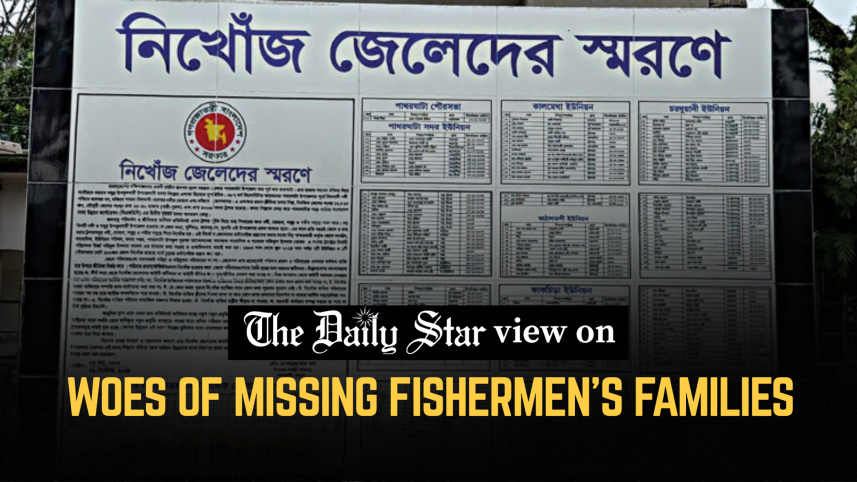
It is concerning and unjust that families of fishermen who go missing at sea or in rivers receive neither financial aid nor other forms of government support, unlike the families of those who die while fishing offshore. According to a recent report in this daily, at least 196 fishermen from Patharghata upazila of Barguna have gone missing while fishing at sea or in rivers over the past 33 years.
The families of these fishermen already belong to one of the most marginalised and impoverished communities in the country. Thus, when the breadwinner—often the lone one in a household—goes missing, the families are thrown into greater financial woes. Besides, no death certificate can be issued for a missing person, which makes it impossible to sell or transfer the properties owned by them even years later. While this legal barrier applies to missing persons, whether they are lost at sea or somewhere else, the case of the missing fishermen demands special attention as commercial fishing has always been a risky operation. In fact, the United Nations’ Food and Agriculture Organization considers fishing at sea one of the most hazardous occupations in the world, with an estimated fatality rate of 32,000 per year. Besides, climate change is causing seas to become increasingly unpredictable, with more intense natural disasters such as cyclones occurring more frequently, thus adding to the risk of commercial fishing.

In Bangladesh, more than 10 lakh people are engaged in this profession in at least 19 districts of the coastal region. Yet, there is no comprehensive data on the total number of Bangladeshi fishermen who go missing at sea every year. Their stories remain largely preserved in the memories of families and loved ones, who endure prolonged uncertainty and, in many cases, deepening poverty. With no financial assistance from the government, the families of missing fishermen are often forced to make difficult choices—children dropping out of school to enter the fishing profession, or wives and mothers taking up the nets, fighting not just the waters but also societal barriers.
Since climate change is making the sea more turbulent, leading to more intense and frequent natural disasters, commercial fishing is becoming increasingly risky. As a result, the number of missing fishermen is also going up, according to stakeholders. Therefore, it is time for authorities to rethink the cases of missing fishermen, start recording data, and innovate policies to support their families. Additionally, lighthouses and other infrastructure should be built strategically to help lost fishermen find their way home. We cannot leave a vulnerable community to the whims of fate indefinitely.
 For all latest news, follow The Daily Star's Google News channel.
Comments