


We must carry Shahed’s fight against corruption forward

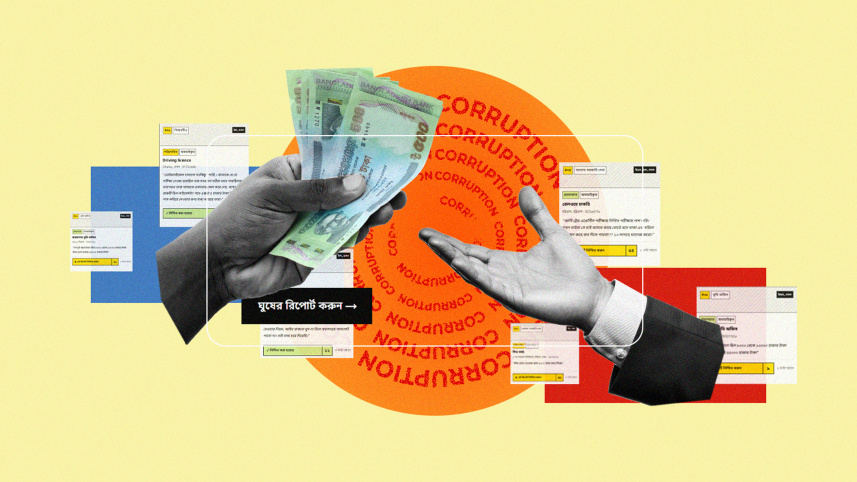
There are reasons to be both sad and hopeful about Shahed Sharif Ahmed. The teenager was exposed to the harsh realities of adult life too early: his family’s difficulties in securing the provident fund and pension of his mother, a deceased schoolteacher, led Shahed to create a web portal where people can anonymously report instances of bribery in the system that stalls or delays legitimate services. Within nine days of launch, the page received nearly 10,000 complaints over alleged demand for bribes worth Tk 320-332 crore, according to a recent Prothom Alo report.
First, the Mymensingh City Corporation authority, and then the Prime Minister’s Office, contacted Shahed about the project. Shahed was told that his plans would be conveyed to the prime minister. While the response is encouraging, the larger question remains unsettling: why did a teenager have to build a public ledger of bribery before the machinery of the state took notice? And why did this site have more transactions than the recent reports of TIB and IRI?

One possible reason is that the routine ritual of publishing corruption health cards by international organisations can be brushed aside as foreign propaganda guilty of supporting local vested interests. Corruption is a secret hidden in plain sight. It is an everyday experience that we have learnt to normalise. According to TIB, 81.6 percent of households encountered some form of corruption while seeking services in 2025, while 63.6 percent were forced to pay bribes. Per TIB estimates, Tk 12,633.2 crore were paid as bribes. The worst affected sectors are passport services, transport authority, law enforcement, judicial services, land administration, healthcare, and local government. The IRI report indicates that most of the respondents who paid bribes did so in exchange for employment.
To clear Shahed’s mother’s dues, Tk 1 lakh in bribe was demanded. This regressive tax, imposed without legislation and without a receipt, must be “checked”. I refrained from using the word “stopped” and chose “checked” as one official explained that in a country where people are inherently corrupt, you cannot expect car engines to run without lubricant. The metaphor aptly exposes the eroded ethical values in our culture.

But values do not deteriorate in isolation. The collapse occurs when we repeatedly reward manipulation of the system and ridicule honesty. The young generation ushered in a wind of change by protesting against party affiliations and nepotism, which they identified as the main sources of securing a job. You read about honesty in textbooks and see examination questions leaked, assignments purchased and admissions influenced. The hidden curriculum of corruption teaches students about the pragmatic side of their civics content.
Education cannot produce ethical citizens if educational institutions do not live by examples. Families cannot serve as effective moral instructors if they are forced to compromise their values in their visible pursuit of success. We live in a society where wealth is celebrated with a no-question-asked attitude towards the source of acquisition. We expect young people to be honest inside a system that often presents honesty as irrational or foolish.

The contradiction becomes critical when the transition to adulthood is guarded by the relentless threat of unemployment. Before they earn money, the young job-seekers realise that their recruitments may depend on money, loyalty or access. They start losing faith in all the pep talks they heard in their ethics or religious lectures. Trust in the institution is “checked”. The meaning of merit is damaged. Individuals are compelled to seek shortcuts or to believe that they must also buy access today to recoup their investment tomorrow. Thus, a bribe paid to obtain a job does not end with the appointment. It may become the seed capital of future corruption.
Pascal’s law that we studied in elementary physics can be useful in understanding how the impact of petty bribery can be transmitted throughout the system. If a real estate organisation is forced to pay at 20 different offices to acquire several licences, it will distribute the charges with additional profits among its clients. Every petty bribery relates to the larger political economy. From the purchase of land to an aeroplane, the message is clear: public authority can be converted into private gain. And this phenomenon is symptomatic of crony capitalism, too. A select group of people privatises profits, while the public bears the risks and losses.
The shameless display of greed is another symptom of crony capitalism. Social media glorifies enviable lifestyles, but not the means to enjoy such aspects of life. There is also a sense of insecurity and fear that leads people to hoard wealth. The invisible social security net makes people sceptical of the health services, the pension system, the banks, the courts or the future. People use such insecurities as a pretext to normalise corruption. This is because most of our earnings do not even cover basic needs. But we have the urgency to secure our children or our position against the next crisis. This pursuit of private security leads to collective insecurity. The more we depend on personal connections, illicit wealth and private protection, the less we invest in public institutions. As institutions weaken, people feel even more insecure and accumulate even more aggressively. It is a vicious cycle: fear produces corruption, and corruption produces more fear.
That is why the present situation of corruption has become a ticking bomb. Some may argue that the bomb has already exploded through capital flight or collapsing institutes. Different watchdogs have systematically placed us at the highest tier of corruption (The Corruption Perceptions Index 2025 ranks us 150 among 182 countries). Meanwhile, as ordinary citizens, we know that the system treats every service as a commodity. However, the new generation, as Shahed has shown, does not confine itself to passive voyeurism. They can act with convictions. We have seen them emerge as children of July, cockroaches, or nepo kids in the recent past. This generation compares what we say with what we do. Their anger is not impatience, nor should it be romanticised as automatic moral superiority. When a teenager has to launch a website to record bribery after struggling to obtain his dead mother’s pension, the older generation must resist the temptation to lecture him about values. We must begin by asking: what values have we demonstrated to him?
The website Shahed has created cannot be a proxy for the Anti-Corruption Commission, professional journalism, or a credible grievance resolution system. The grapevine that he designed is powered by public whispers. Something beneath the ground is shaking. Ignoring the signs can be fatal. The government must come up with credible complaint mechanisms, publish official service fees and processing times, track files digitally, protect whistleblowers, limit discretionary power, enforce open procurement, and make unexplained delay an auditable event. Educational institutions must teach integrity not as an exam chapter but as an institutional practice.
The current trends of spectacular arrests and seasonal anti-corruption slogans have long lost their vitality. Fear of punishment alone cannot build an ethical society. We must create conditions in which honesty is rational, respected and materially possible. Shahed’s mother spent her life as a teacher. In death, she appears to have left her son with an important lesson: to fight for the right. Now it is our turn to learn from Shahed.
Dr Shamsad Mortuza is vice-chancellor at the University of Liberal Arts Bangladesh (ULAB).
Views expressed in this article are the author's own.
Follow The Daily Star Opinion on Facebook for the latest opinions, commentaries, and analyses by experts and professionals. To contribute your article or letter to The Daily Star Opinion, see our guidelines for submission.
 For all latest news, follow The Daily Star's Google News channel.
Comments