


Can Bangladesh turn Wall Street interest into investment?

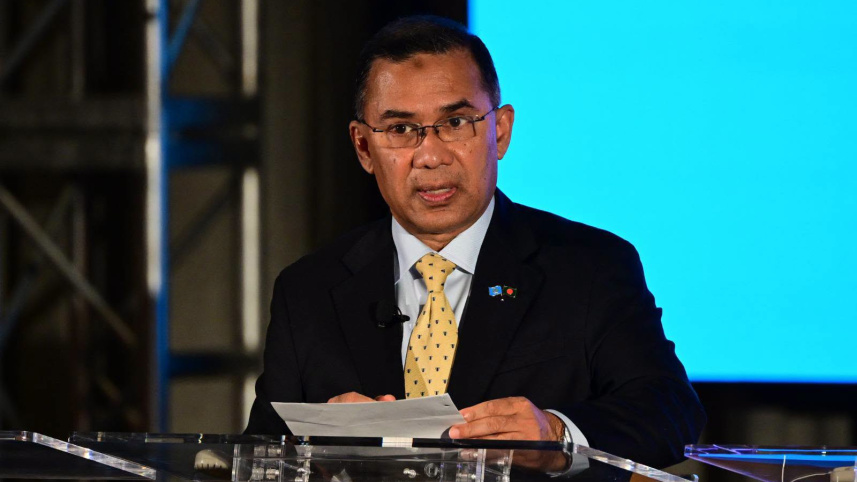
Some meetings fill a diary while others redraw a map. The breakfast JP Morgan hosted at its New York headquarters in the last week of September was the second kind. Prime Minister Tarique Rahman and Finance Minister Amir Khosru Mahmud Chowdhury sat down with senior figures from 15 institutions, including BlackRock, PIMCO, TPG, Macquarie, I Squared, Farallon, Jane Street, and GoldenTree. Bangladesh has rarely faced so much global capital in one room, with its own sovereign bond on the agenda.
A day earlier, at an investor symposium hosted by VEON and Banglalink, the finance minister announced approval of a new digital bank licence backed by VEON, Banglalink, and Square Group. Then, in California, a ministerial delegation met chip engineers, venture investors and the founders of Zscaler and Replit, and opened talks with Arizona State University on chip-design education. The delegation included State Minister for Foreign Affairs Shama Obaed Islam and ICT Adviser Rehan Asif Asad. In four days, Bangladesh spoke to the bond market, the private-capital market and the technology frontier.

This is more than the usual round of roadshow handshakes, because each audience points to a real transaction. The firms at the JP Morgan table are, almost name for name, the natural buyers of a debut emerging-market bond. The Cabinet Committee on Economic Affairs, which the finance minister chairs, has already approved in principle JP Morgan as lead manager for Bangladesh's first international issue, with $500m to $1bn under discussion. A debut that prices well does more than just raising money gives every Bangladeshi bank, utility, and exporter a benchmark to borrow against.
The private-capital names matter for a different reason. TPG, Macquarie, and I Squared invest in infrastructure and energy, and Farallon in private credit. This is the money that builds power plants, ports, and data centres, and it barely shows up in conventional foreign investment statistics. The Silicon Valley talks, meanwhile, connect Bangladesh to something that grows faster than capital: engineering talent.
The pitch also rests on firmer ground than it has in years. Remittances hit a record $35.56 billion in the fiscal year to June, up 17.3 percent. Usable reserves stand above $31 billion, close to five months of imports. Moody's moved its outlook to stable in September, citing reduced political and external pressure after the February election. UNCTAD recorded the fastest growth in foreign direct investment in South Asia in 2025, up 45 percent.
History shows what turns a meeting into an economy. In the mid-1990s, Costa Rica, then best known for coffee and bananas, set out to win a chip-assembly plant from Intel. Officials and the investment agency CINDE held about 19 meetings with the company before it committed $115m in 1997. Within 15 years, Intel had invested around $900m and had become the country's largest exporter. Vietnam's experience with Samsung, which has invested $23.2bn since 1995, tells a similar story on a bigger scale. In both cases, the decisive factor was not the first meeting but the discipline of the nineteenth. That is why the September meetings should be treated as the start of a process with deadlines, and five steps over the next hundred days could make it one.

The first is to give every investor a named contact. The finance ministry and the Invest Bangladesh Authority should assign a senior counterpart to each of the 15 institutions, with a promise to answer follow-up questions within a fortnight. Serious investors judge a country by its response time. The second is to return the visit. Within six months, Dhaka could host the same firms at a closed-door Dhaka capital dialogue chaired by the finance minister, ahead of the bond roadshow. It should include trips to Chattogram, the economic zones, and the design floors where Bangladeshi engineers already serve global clients.
Third, the government should prepare a pipeline: a short list of about a dozen investment-ready projects in energy, logistics, and digital infrastructure, each with a data room, a named owner, and a clear risk-sharing structure. Capital follows pipelines, not presentations. Fourth, the bond should be treated as a national brand launch. A tightly priced, well-subscribed issue would set the yield curve for a generation of borrowers, and a quarterly investor letter from the finance minister on reform milestones would help keep spreads steady afterwards.
Fifth, the Silicon Valley track should be made permanent. That means a memorandum with Arizona State University on chip-design courses, a fast-track window at Invest Bangladesh for chip and AI firms, and a diaspora fellowship that brings senior engineers home for six-month assignments. None of this is costly. Together, it would tell the market that Bangladesh follows through.

Each investor in that room also has its own reason to come. Bond buyers get a sizeable new benchmark from an economy whose external flows are anchored by remittances. Infrastructure and private-equity firms get a market of more than 180 million people whose demand for power, logistics, housing, and digital services is far ahead of supply. Technology companies get a young, skilled, and competitively priced workforce. And all of them get early entry to an economy at the start of a re-rating, when the best returns are made.
The Prime Minister reminded his Wall Street audience that investors "ultimately judge a country by what happens after the speech". The speeches have been made, and they landed well. The next 100 days will show whether Bangladesh can turn the attention of the world's most demanding investors into commitments from its most patient ones. If it can, historians may look back on a breakfast in Manhattan as the moment Bangladesh entered global capital markets in earnest.
Ashfaq Zaman is chief strategist of the Dhaka Forum Initiative, a Dhaka-based policy think tank.
Views expressed in this article are the author's own.
Follow The Daily Star Opinion on Facebook for the latest opinions, commentaries, and analyses by experts and professionals. To contribute your article or letter to The Daily Star Opinion, see our guidelines for submission.
 For all latest news, follow The Daily Star's Google News channel.
Comments