


Can BNP protect journalists from its own rank and file?

During the Awami League’s three consecutive terms in office over a decade and a half, the then-opposition BNP demanded the right to speak, organise and criticise without being branded an enemy of the state. Now in government, the roles seem to be reversed, and so is the question whether the now incumbent party can protect the rights of those who criticise its leaders and activists. Its record so far—though still early in office—is hardly reassuring.
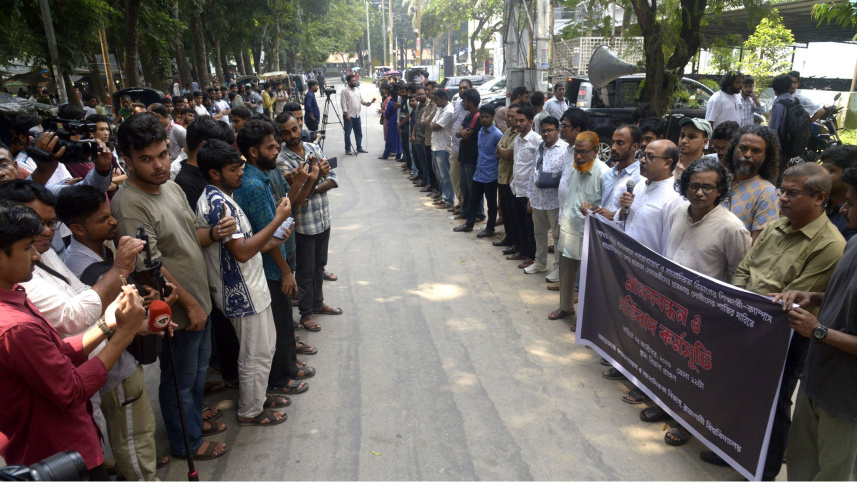
The October 4 attack on several Rajshahi University correspondents has once again made this question urgent. According to witnesses, around 8:30pm on Sunday, several Bangladesh Jatiotabadi Chatradal (JCD) activists pounced on two journalists—Mainul Islam Raju of Samakal and Dwin Islam of Ajker Patrika—when they tried to take video footage of the local weapons the JCD activists were allegedly carrying. When other university correspondents went to the scene to rescue their colleagues, the JCD activists attacked Nur Ahsan Mridul, RU correspondent of The Daily Star, Zahidul Islam of Agamir Shomoy and Arifuzzaman Korban of bdnews24.com, as per video footage. At least 10 people were injured during the incident and journalists who sought to protect their colleagues were also allegedly threatened.

Following the incident, JCD formed a two-member committee to probe the allegations. Later on Monday, the RU administration filed a case with Motihar Police Station against unnamed accused. However, campus journalists criticised the administration for failing to name the attackers in the case, as the video footage, circulated on social media, clearly shows the faces of those involved in the attack on journalists and students. No arrest has been made in relation to the assault at the time of this writing.
If the allegations are substantiated, those responsible should be expelled from the university. But it remains to be seen whether the probes—both by the JCD committee and RU’s five-member one—will result in meaningful accountability, including legal consequences, instead of simply being a damage control exercise. The bigger question is whether the BNP will confront the increasingly alarming pattern of intimidation surrounding journalists, which was already visible before October 4.
On August 25 in Shariatpur, three journalists, including the local correspondent of The Daily Star, alleged that BNP activists had assaulted them while they were covering a rally. Although district BNP Joint General Secretary Arifuzzaman Molla denied beating the journalists, he later contradicted himself, saying, “Journalists will write, and we will beat them again.” He also boasted of having a list of journalists.
Four days later, on August 29, The Daily Star’s Jhenaidah correspondent Omar Ali Sohag alleged that district BNP Joint General Secretary Asif Iqbal Makhan had branded him an Awami League accomplice and ordered JCD activists to beat him. Sohag said 15 to 20 activists had assaulted him. Makhan admitted to preventing Sohag from covering a programme where the law minister was in attendance but denied involvement in the assault.
The incidents expose a familiar tendency: when power dislikes what is written, drawn or published, attention turns from the work to the person behind it. Authenticity and accuracy of a journalistic report become less of a priority than the journalist’s loyalty. Once labelled an Awami League accomplice, an opponent of the government or a hostile reporter, the journalist can be denied access, threatened or attacked. The allegations raised in the report in question no longer need to be answered; the sole focus turns to discrediting the reporter.
During the Awami League rule, critics were often given such political labels, cases were used against them, and official access only favoured loyalist journalists. Even during the interim government’s tenure, we saw some of the most disturbing manifestations of this trend, most notably the arson attacks on The Daily Star and Prothom Alo buildings on December 18, 2025, highlighting the dangers of inflammatory labelling regardless of who is in power. The lesson here is clear: threats and labelling cannot be dismissed as minor excesses as impunity can turn them into something far more dangerous.
There is no evidence that the BNP’s central leadership condoned such labelling or the alleged attacks by its office-bearers or activists against journalists in recent months. But it cannot distance itself from their alleged conduct. Repeated promises of inquiry without visible action may convince local leaders that their party positions will protect them.
JCD should publish its probe report and hand relevant evidence to police. Otherwise, expelling a few leaders may contain the scandal without addressing the wider pattern.
The state has its own case to answer here. On May 18, the police’s Special Branch instructed its Dhaka units to collect information about journalists and cultural personalities. It sought data on their political affiliations, social media accounts, “adverse information,” and their families’ political backgrounds. Why does a security agency need a journalist’s family political history? Such information has nothing to do with assessing the truth of a news report. It helps the state classify journalists by presumed loyalty. A journalist reporting on power becomes a person for the state to monitor rather than a citizen whose professional rights the state must defend.
Some examples should illustrate different dimensions of the danger. On June 18, Bogura Detective Branch of police arrested Agrajatra Pratidin acting editor Md Rezanur Islam under the cyber law and an extortion case for publishing reports alleging corruption by State Minister for LGRD Mir Shahe Alam. Shahe Alam said he neither directed nor authorised the case. Rezanur later secured bail. The Editors’ Council called the arrest an “alarming repetition” of Awami League-era harassment.
On August 29, police in Jashore detained Md Robiul Islam, who identified himself as a regional newspaper reporter, after he posted a cartoon of Prime Minister Tarique Rahman on Facebook. Police said he criticised the government. Although Robiul was later released, the question remains: why should criticism of the prime minister be grounds for detention?
As per a Human Rights Support Society (HRSS) report, at least 359 journalists faced attacks or harassment in 220 incidents between March and August this year. Incidents were up 33 percent from the same months of 2025. HRSS recorded 192 journalists injured, 58 assaulted or humiliated, 55 threatened and 18 detained.
Journalists are not above scrutiny. Reports can be inaccurate, unfair or unethical. Anyone aggrieved by a report may present contrary evidence, seek a correction, complain to the editor or the press council, or take lawful action. But no error gives a political leader or activist the authority to seize a phone, remove a reporter, order a beating, issue a threat, or prepare a list.
The BNP promised press freedom and professional security for journalists, and it is time it delivered on that promise. Police must investigate every allegation of attacks on press freedom impartially. The ruling party must publish probe findings and remove any office-bearer found responsible for attacking or threatening journalists. State agencies must stop collecting political information about journalists and their families.
The BNP should understand the danger better than most. For years, its leaders, activists and supporters were watched, labelled, sued and arrested for opposing those in power. It demanded an end to a system in which the government decided who was loyal, who was hostile, and who could speak without fear. If it now allows threats against journalists to go unpunished, political profiling to continue, and critical reporting to invite arrest, will the party not be walking in the same path that it once termed wrong?
Arafat Rahaman is a journalist at The Daily Star. He can be reached at arafat.mcj@yahoo.com.
Views expressed in this article are the author's own.
Follow The Daily Star Opinion on Facebook for the latest opinions, commentaries, and analyses by experts and professionals. To contribute your article or letter to The Daily Star Opinion, see our guidelines for submission.
 For all latest news, follow The Daily Star's Google News channel.
Comments