


Miyawaki forests can cool Dhaka, but only if we scale and protect them

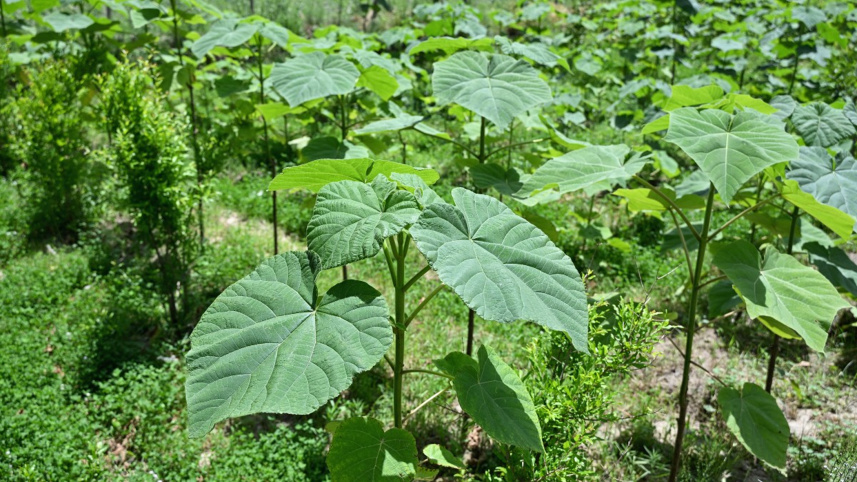
For three decades, Dhaka has steadily lost its green cover, even as officials repeatedly promised to restore it. However, in recent times, the city has witnessed a shift: two Miyawaki urban forests have been opened in quick succession by different actors. The Dhaka North City Corporation’s (DNCC) forest at Diabari in Uttara, with 53,400 trees across 2.6 acres, has been joined by a second forest in Uttara’s Sector 17, inaugurated on July 28 with 6,100 trees from 93 native species, implemented by Shakti Foundation and Mutual Trust Bank with support from Rajdhani Unnayan Kartripakkha (Rajuk).
That a public institution and a civil society body backed by private finance have moved simultaneously to plant a forest signals a shift. But this momentum does not reflect a policy shift. To become replicable, the government should now prioritise two things: a credible monitoring framework and enforceable protection for what is planted. The method is proven and the ecological need for it is documented. What we need now is institutional will.

A study tracking three decades of satellite imagery found that Dhaka’s healthy vegetation fell from 17 percent in 1989 to just 2 percent by 2020—an 88-percent decline. Dhaka lost 185 hectares of tree cover between 2010 and 2022 alone, driven by construction, population growth, and infrastructure expansion. As concrete replaced canopy, the urban heat island effect intensified. Built surfaces absorb solar radiation and release it slowly at night, keeping city temperatures above surrounding rural areas. The Bangladesh Meteorological Department confirms that average temperatures have risen sharply over the last three decades. A government dialogue in January 2026 noted that roughly 13 percent of Bangladesh’s air pollution originates from brick kilns. The people absorbing this regularly are rickshaw pullers, construction workers, street vendors, public transport users, and schoolchildren.
This is precisely the kind of problem that nature-based solutions (NbS) address. The International Union for Conservation of Nature (IUCN) defines NbS as actions that restore natural ecosystems to address societal challenges while delivering biodiversity co-benefits.
The Miyawaki method—dense, multi-layered, native-species forests that become self-sustaining within two to three years—delivers documented performance: ambient air temperature reduction of up to 5 degrees Celsius, interception of up to 15 percent of airborne particulate matter, carbon sequestration of 60 kg per square metre and biodiversity support 18 to 20 times higher than conventional plantations. Improved water uptake also reduces urban flooding risk.
The most relevant precedents are in India. In Delhi, DCB Bank and NGO Green Yatra converted a 2,200-square-metre barren park into a native woodland using 7,000 saplings of 25 indigenous species. In Maharashtra, the Green Schools Mission established 100 Miyawaki forests across 100 schools in Aurangabad district, using 70,000 saplings and with teacher-student teams trained in monitoring and stewardship—demonstrating that school campuses can serve as both ecological restoration and environmental education sites.
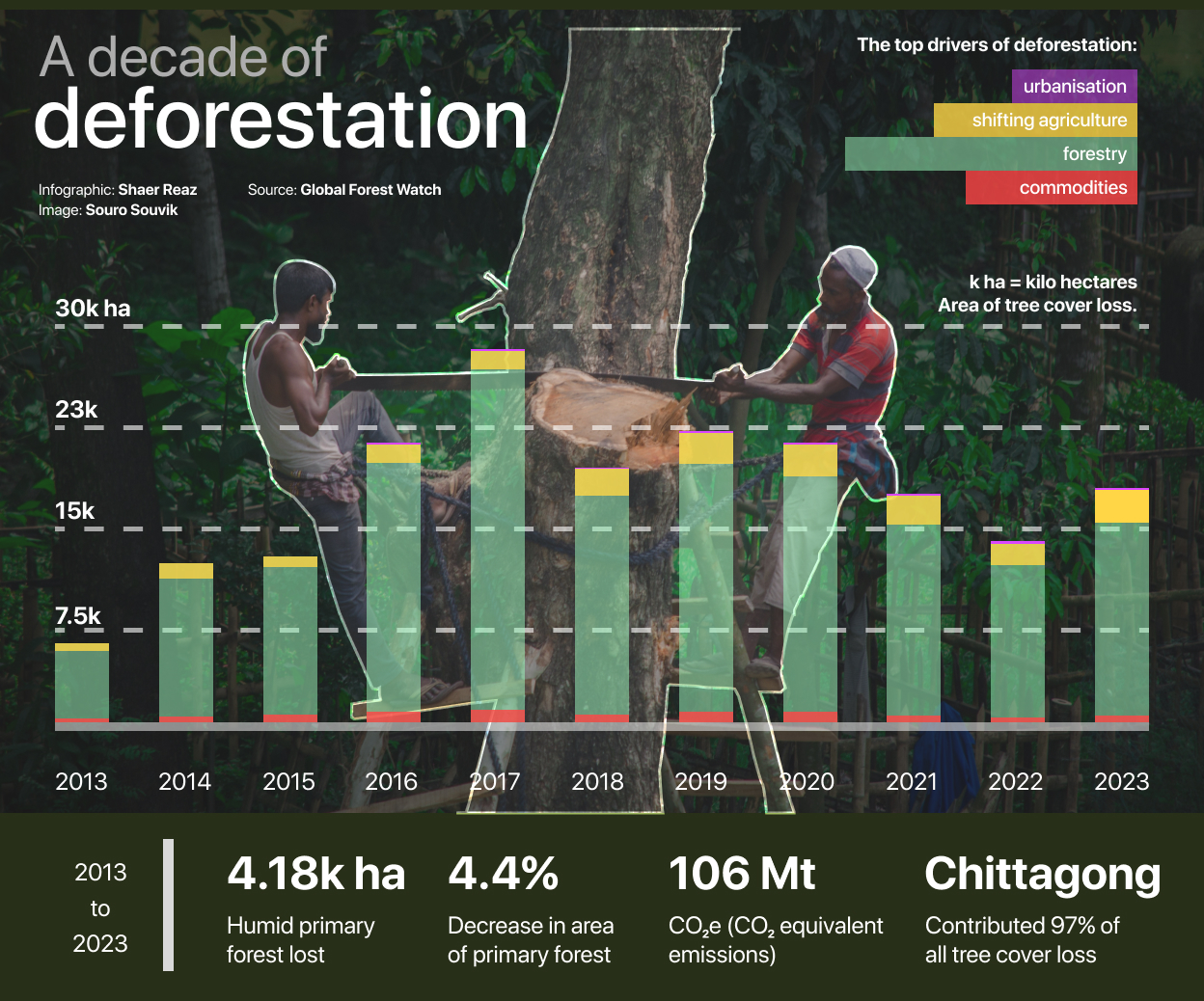
Bangladesh’s demonstration of what this looks like in practice came through Prokolpo Sonapahar, a private initiative in Mirsarai, Chattogram, that planted 120 native species on a hillside previously degraded by brick kilns. Thirteen months later, some trees stood 17 feet tall. The DNCC’s Diabari project and the Shakti Foundation’s Sector 17 forest are part of the institutional response to what civil society demonstrated.
The BNP’s election manifesto had pledged plantation of 250 million trees over five years, a digital tree monitoring app, and a centralised measurement, reporting, and verification (MRV) system—commitments that the Miyawaki method is well-suited to support. The manifesto also cites World Bank projections that Bangladesh could earn up to $1 billion annually through carbon credit markets—a goal that requires site-specific sequestration data—exactly what a monitored network of Miyawaki forests produces. But an analysis found the 250-million-trees target lacks a credible delivery plan. The green belt designation protecting Diabari forest is only as durable as the institutional will to enforce it.
Urban schools are where the cost of lost green cover is most immediate. In June 2023, government primary schools closed for days during a severe heatwave. In April 2024, temperatures reaching 41.5 degrees Celsius triggered nationwide closure of all educational institutions for seven days, with heat alerts issued across 37 of 44 meteorological stations. When temperatures dropped, schools reopened with the same treeless concrete yards. Miyawaki forests in schools could address the conditions responsible for such closures.
The case for school forests is not only ecological. Research from the Swedish University of Agricultural Sciences (2025) visiting Miyawaki forests in Europe and Brazilian schools found that children who participated in planting became stewards of the forest, developing the kind of ownership they extended to their families. Forests planted with students prove more durable than those handed over to them. Student-led monthly data on tree growth, canopy spread, and temperatures provide a ground-level verification layer that strengthens whatever official monitoring system is in place.
Bangladesh’s Nationally Determined Contribution (NDC) commits to increasing tree cover from 22.37 percent to 24 percent by 2030. The National Adaptation Plan (NAP) similarly identifies urban afforestation as a priority for climate-smart city development. Both the DNCC and Shakti Foundation initiatives are consistent with these frameworks. But two projects do not constitute national policy—no binding requirement exists for other institutions to follow and no systematic replication mechanism is in place. What would constitute national policy is mandatory green cover requirements for institutional land users, enforceable green belt protection, and a school-based Miyawaki programme generating independently verified ecological data for credible national climate reporting.
The ecological need for such forests is documented, and existing projects from both the government and private sector in Dhaka give proof of capability. What is needed next is the institutional framework to connect them, monitor what they produce, and scale what works.
Mohammad Julfiqar Haider is independent researcher working on climate change and development. He can be reached at julfiqarrobin@gmail.com.
Views expressed in this article are the author's own.
Follow The Daily Star Opinion on Facebook for the latest opinions, commentaries, and analyses by experts and professionals. To contribute your article or letter to The Daily Star Opinion, see our guidelines for submission.
 For all latest news, follow The Daily Star's Google News channel.
Comments