


Tea workers deserve a say in reforms to their industry

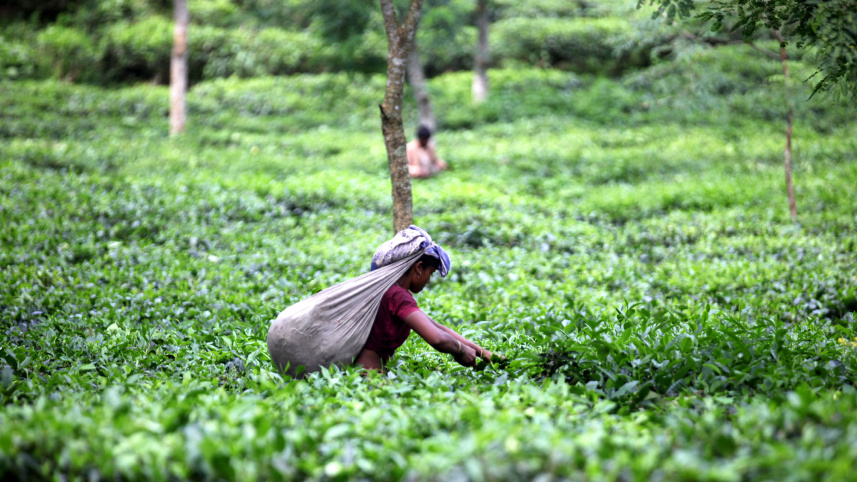
Imagine a woman buckling under the weight of a heavy basket of freshly plucked tea leaves. Her feet are wet and her back strained, her hands moving swiftly through the tender shoots. At the end of the day, she will have earned a wage that can scarcely sustain her family. Her home is a cramped dwelling in a tea garden’s labour line, and the land it stands on does not belong to her. Her family has lived and worked on the same estate for generations, yet they remain excluded from its ownership, prosperity, and decision-making.
This is the human face of Bangladesh’s tea industry, whose verdant landscapes conceal a deeply unequal socioeconomic order.

The government is moving ahead with an ambitious initiative to restructure the sector, confronted by rising production costs, mounting debt, declining productivity, and weakening export earnings. A task force formed in July 2026 proposed 59 recommendations, including recognising tea as an agricultural commodity, reducing VAT, restructuring loans, modernising factories, and establishing a Tk 2,050-crore assistance fund. A high-powered monitoring and advisory committee, chaired by the commerce minister, was subsequently constituted to oversee the process.
These measures seem necessary as the tea industry is in serious trouble, and doing nothing is not an option. But a fundamental question remains: who is this restructuring ultimately meant to serve? If the answer is only garden owners, financial institutions, and the industry itself, Bangladesh risks rescuing an industry while overlooking the very people whose labour has sustained it for generations.
An industry in distress, a workforce in despair
The recent protests that lasted for over a month between July and August this year over a daily wage increase to Tk 500, alongside union elections and formal land rights, have again brought this issue to the fore.
Earlier, in 2024, more than 12,000 workers in 12 gardens of the state-controlled National Tea Company (NTC) endured weeks of uncertainty over their wages. In Fultala Tea Garden, around 1,600 workers reportedly went without wages for 12 weeks. Imam and Bawani estates in Habiganj also had experienced prolonged management crises since 2023. Across the industry, 79 gardens were reported to be in distress, with provident fund contributions unpaid, utility connections severed, and factories unable to operate normally.
The response of NTC, in which the state holds 51 percent of the shares, illustrates how political interference, weak management, and financial indiscipline can cripple an enterprise. Yet the problem is not confined to state-controlled gardens. Private estates, too, have suffered from mismanagement, corruption, and financial irregularities over the years.
The owners could conveniently attribute the industry’s difficulties solely to falling tea prices and rising production costs. These are genuine concerns, but they do not explain why some gardens perform well while others remain chronically unproductive.
Ispahani’s Zareen Tea Estate in Moulvibazar, for instance, provides an instructive contrast here. Its reported production per acre is nearly twice the national average, while workers enjoy comparatively better housing and working conditions. The lesson is clear: productivity and workers’ welfare need not be opposing objectives. Good management can advance both.
The people missing from the reform table
The task force and the subsequently formed high-powered committee bring together senior government officials, financial authorities, and tea industry representatives. But, troublingly, tea workers and their trade union have no representation in the process.
According to the task force’s figures, approximately 1,02,000 permanent and 40,000 temporary workers are employed in the sector. Their labour is indispensable to tea production, yet their voices are absent from decisions that may fundamentally alter their livelihoods, employment relations, and future. Tea garden workers are not passive beneficiaries of industrial policy. They are participants in production and holders of labour rights, and are thus entitled to a say in decisions affecting their lives.
Bangladesh’s constitution guarantees freedom of association, while labour law provides for worker representation, participation committees, and collective bargaining. Yet, tea gardens have long failed to implement these provisions meaningfully. Workers’ absence from the current restructuring process is therefore not an isolated oversight, but part of a deeper, long-held pattern of their systematic exclusion.
A government committed to reform should correct this imbalance, not bolster it. In its first meeting on September 20, the advisory committee emphasised the need to restore the tea industry’s long-term economic strength and reduce its dependence on government support, loans, and incentives. Participants stressed improving estate management, financial sustainability, and regular contributions through taxes and VAT, while protecting workers and the local economy. However, in any discussion exploring additional income from “unused” estate land through solar power, agriculture, forestry and cluster initiatives, the tea workers and their representatives must be consulted.
The unfinished business of colonial exploitation
Bangladesh’s tea industry was established under British colonial rule, bringing labourers from across the subcontinent. Their descendants, from diverse ethnic and linguistic minority communities, still live in tea gardens. Though colonial rule ended, its social and economic legacies remain entrenched.
Of the approximately 1,40,000 tea workers, around 95 percent are non-Bangalee. They have their own languages, cultures and histories, yet remain among the country’s most disadvantaged communities. Generations of labour have not secured them ownership of the land they cultivate or the homes in which they live. Their economic dependence on the gardens is almost absolute.
This is why tea workers’ poverty cannot be understood simply as a consequence of low wages. It is rooted in a system of dependency that limits their mobility, bargaining power and ability to claim rights.
The daily cash wage of Tk 196, raised from Tk 187, remains an emblem of this injustice. Tea workers also face unequal provisions for casual and earned leave, lack appointment letters, and are deprived of gratuity. Despite legal provisions concerning workers’ participation in company profits, they have not received the benefits to which they should have been entitled.
 For all latest news, follow The Daily Star's Google News channel.
 In many tea gardens, basic workplace facilities—including toilets, washing facilities, shaded eating areas, and safe drinking water—remain inadequate. Housing conditions are frequently found to be poor, despite provisions requiring employers to provide and maintain workers’ accommodation. These are not privileges to be granted when an industry becomes profitable; they are obligations that must be fulfilled regardless of the financial condition of an enterprise.
Economic recovery must go hand in hand with workers’ rights
Recognising tea as an agricultural commodity could help gardens access cheaper credit and other financial benefits. There is an economic rationale: tea cultivation involves agricultural activities, while processing harvested leaves is industrial. Bangladesh Bank itself describes tea as an agro-based or agro-industrial sector. However, reclassification must not weaken workers’ status as industrial workers under the Bangladesh Labour Act, 2006, and the Tea Act, 2016, or undermine their rights to organise and bargain collectively. There should be enforceable commitments to wages, housing, safety, social security and legal protections. Justice is not replaceable in the pursuit of competitiveness.
The immediate priority is to establish a common understanding among the state, employers and workers on the future of the industry. Tea workers and their representatives must participate meaningfully in restructuring; labour laws must be enforced; and a just wage structure must be established through credible consultation. Housing, land access, provident fund, gratuity, healthcare, education, and social security must become integral to reform. Tea gardens must demonstrate sound management and commitment to workers’ welfare before receiving government support.
Ultimately, restructuring cannot be measured solely by production, profitability, exports, or company balance sheets. Its true measure is whether a woman worker, for example, can feed her family, live in a decent home, educate her children, retire without fear, and claim her rights without intimidation.
Tea is more than a commodity in Bangladesh; it embodies generations of labour, history, and sacrifice. Rebuilding the tea industry while leaving its workers trapped in poverty would only preserve its oldest injustice under the banner of modernisation. We need more than a profitable industry; we need one where workers share in the prosperity they create and enjoy dignity, security, and a meaningful voice in decisions that affect their lives.
The writer acknowledges the support of Fahmida Afroze Nadia, from the Society for Environment and Human Development (SEHD), in conducting background research.
Philip Gain is a researcher and director of the Society for Environment and Human Development (SEHD), Bangladesh.
Views expressed in this article are the author's own.
Follow The Daily Star Opinion on Facebook for the latest opinions, commentaries, and analyses by experts and professionals. To contribute your article or letter to The Daily Star Opinion, see our guidelines for submission.
Comments