


The Pink Bus paradox and the price of women's safety

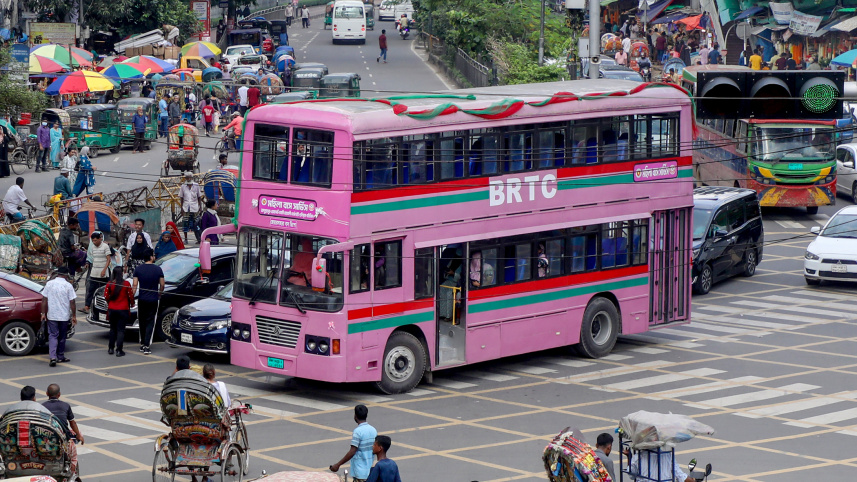
How do you pay the price of safety as a woman living in Bangladesh? For many, the answer is with dignity. Dignity is an invisible, abstract construct that no one can measure directly; yet, for Bangladeshi women, dignity is often tied to and thus measured by the length of her clothes, in covering her chest, her marital status, her father’s financial capacity, and so on. But now the price of the safety for a Bangladeshi woman is also the crippling uncertainty of whether she can find a bus to reach her destination.
The women-only “Pink Bus” services were launched in Dhaka on August 19. According to the Bangladesh Road Transport Corporation (BRTC), 14 buses have been introduced so far—10 will be operating in Dhaka and nearby areas such as Narayanganj and Gazipur, while two each in Chattogram and Bogura. This bus service, operated by women drivers and conductors, was initiated as part of the BNP’s election commitments and 180-day action plan for safer, comfortable public transport for women. Admittedly, launching a by-women-and-for-women transportation service can be deemed one of the most impactful and commendable initiatives taken by the current government. A glance at the statistics on the living conditions of women in Bangladesh will tell you why.

In the 2026 Women, Peace, and Security Index (WPSI), Bangladesh’s score dropped to an unprecedented low of 0.526 out of 1. This index measures how a country ensures women’s inclusion, justice, and security. For Bangladesh, the score has been on a declining trend for three consecutive years. This kind of ranking is not new. A survey conducted by the Thomson Reuters Foundation in 2017 revealed Dhaka as the world’s seventh most dangerous megacity for women.
Bangladeshi women are joining the workforce, representing approximately 38.40 percent of it, according to the Bangladesh Bureau of Statistics (BBS). Consequently, the demand for public transport has surged among women. Beyond the workforce, countless others depend heavily on these buses for everyday travel. How safe are these transportation services for women? A 2025 study titled “Transportation Accessibility and Safety in Dhaka City: A Gender Based Assessment” indicated that around 79 percent of female commuters in Dhaka face sexual harassment on public transport. A Bangladesh Road Safety Network study showed approximately 83 percent of female passengers had experienced physical or psychological harassment while travelling by public buses in urban areas. This demonstrates that most public transport is structurally unfriendly to women.
However, to what extent will launching Pink Buses solve women’s concerns? Over the last few days, videos, images, and posts on social media revealed the hostility by public bus conductors, helpers, and drivers towards female passengers in numerous places in Dhaka. They are refusing to let women board because women now have separate bus services, and apparently 10-14 buses have the seating capacity of all the female commuters of Bangladesh. One woman detailed her frustration on Facebook after waiting 30 minutes at a designated stop, only to be denied a seat. Another commuter arrived an hour late for work, stranded on a route with no Pink Bus. For a university student, this same refusal cost her the 9:00 am class.
These are not isolated incidents. The collective mindset of our patriarchal society is the primary factor behind such behaviours of the male conductors. The majority of the population in this country still believes that a woman should stay home, fulfil all the needs of her husband and in-laws, raise children, and take care of all household chores. The depth of this patriarchal mindset is backed by alarming data. According to the 2021/22 Global Women, Peace, and Security Index (WPSI), over 57 percent of men aged 15 and older outright reject the idea that it is acceptable for women in their families to pursue paid work outside the home.
For a long time, patriarchy has weaponised religion, family honour, marriageability, social reputation, fear, and lack of security to prevent women from getting education and becoming financially independent. Despite all these systemic barriers at every step, women have constantly challenged the deeply ingrained patriarchal norms by stepping outside their comfort zone, earning degrees, and landing jobs. In doing so, they have been subjected to sexual harassment, physical and psychological abuse, and manipulation. When the government attempted to address this abuse by introducing the Pink Buses, did decision-makers consider the new host of challenges this segregation would bring to women’s lives?
Launching more women-only buses, offering digital ticketing facilities, and incorporating advanced technology such as CCTV cameras, Wi-Fi, and vehicle tracking systems are a must. But how to dispel the misogyny and chauvinism that is woven into the very fabric of our society and firmly embedded in the minds of most men? If women are not “allowed” to board the bus simply because of being women, how will they travel to get education, do their job, and contribute to society?
Nadia Afroze Disha is lecturer at BRAC Business School of BRAC University.
Views expressed in this article are the author's own.
Follow The Daily Star Opinion on Facebook for the latest opinions, commentaries, and analyses by experts and professionals. To contribute your article or letter to The Daily Star Opinion, see our guidelines for submission.
 For all latest news, follow The Daily Star's Google News channel.
Comments