


Time for lawmakers to side with the rivers
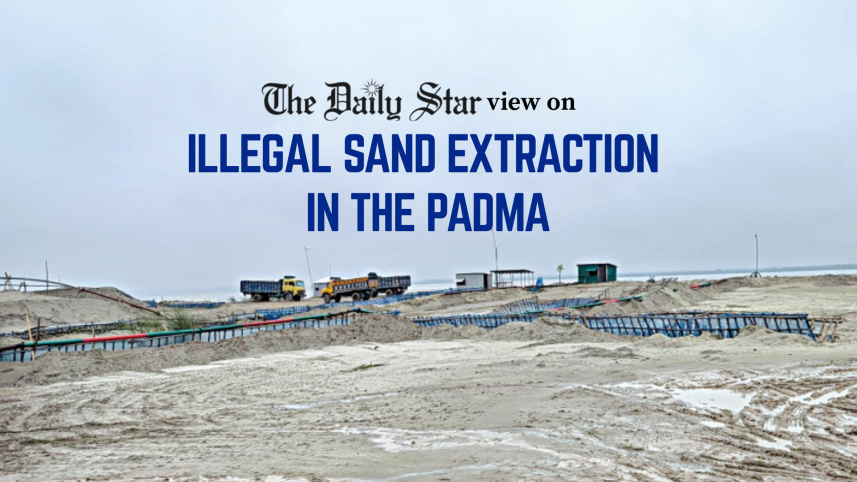
It is undeniable that the one factor that has allowed illegal sand mining to thrive in the country for decades, regardless of who is in power, is political patronage of influential, powerful groups. This collusion of power and money shows little regard for laws, court orders, law enforcement drives, or the environment. The illegal sand trade in the Padma River along the Kushtia-Pabna border is no different.
According to a report in this daily, even a 2025 High Court ban, suspended leases and repeated enforcement drives could not stop the illegal extraction of around 3,50,000 cubic feet of sand daily in at least five locations in the two districts. While sand extraction was allowed during the Awami League regime, the High Court halted the activity in 2023 and later issued a ban on sand mining along a 30-km stretch along the Padma from Pakshi to Goalanda, in response to a 2022 writ petition to protect the river and its environment. As per experts, the impact of sand extraction—though not always harmful for rivers—depend on a river’s nature, location of the mining, and the amount extracted. Mining can cause riverbed degradation, shift the flow towards banks, and drive erosion, while disrupting the ecological environment.

Yet, during the AL regime, illegal sand lifting in this area expanded under the patronage of a former AL lawmaker. After the 2024 political changeover, the patronage changed hands. Local BNP and Jubo Dal leaders now allegedly control the business in both Kushtia and Pabna. Ironically, even those who once enjoyed the backing of AL leaders have now allegedly joined hands with BNP leaders in continuing the unlawful activity.
In doing so, they are not only defying the High Court ban but also using illegal sand-extraction methods such as suction dredging, causing further harm to the river’s vulnerable ecology. And 142 enforcement drives could not stop the unlawful mining carried out in the dark of the night under the guard of armed goons. Instead, journalists who investigated these illicit activities and even law enforcers came under attack by the rogue sand miners. Therefore, it is obvious that the current law enforcement strategy to stop this trade, which generates daily earnings of at least Tk 1 crore for the sand miners, is not working. Only a real change in our political culture—one that rejects all forms of patronisation of unlawful activities by grassroots activists—and a coordinated effort by local administrators, law enforcers and the judicial system can save our riverbeds from the assault of illegal sand extraction.
 For all latest news, follow The Daily Star's Google News channel.
Comments