


Tree planting alone won't make our cities greener
Prime Minister Tarique Rahman launched the 25-crore tree plantation programme by planting a garjan sapling in Cox’s Bazar in June this year. While trees are vital for people and nature, there are valid reasons to be deeply sceptical about such programmes. Tree planting programmes, for which the premier campaigns, are not new in Bangladesh. Between 2009 and 2024, former prime minister Sheikh Hasina inaugurated multiple environmental campaigns and tree-planting programmes, including a 30-lakh sapling planting programme to pay tribute to the Liberation War martyrs in 2018, a one-crore sapling planting programme to mark Mujib Borsho in 2019, and a 7.27-crore sapling planting programme in 2021.
The current administration’s project closely mirrors past initiatives. It targets the same future generations, plants the same native varieties, and utilises the same ministries to combat climate change. But given this repetition, one has to ask: did the outcomes of those past programmes warrant doing the same thing again?

The EIU 2026 liveability index has ranked Dhaka the third least liveable city in the world. Home to around 3.5 crore people, the country’s capital city has stubbornly remained at the bottom tier of this index for years, being consistently pulled down by environmental concerns, i.e. air pollution, loss of green and blue spaces, and high levels of environmental degradation. Almost two decades of tree plantation programmes have not been able to save Dhaka from hitting rock bottom.
Tree cover reduces exposure to excessive outdoor temperature and cools the environment by blocking incoming solar radiation, preventing concrete and asphalt from absorbing it. Other roles include cleaning air, reducing stormwater runoff, and providing shelter for birds and other forms of life necessary for ecological balance. At least 30 percent tree canopy cover is recommended to benefit cities.
Dhaka has lost half of its tree cover, dropping from 21.6 percent since 1980 to just 11.6 percent in 2024. Other cities share a similar fate: Chattogram has around 37 percent tree coverage, a 47 percent decline in three decades; and Rajshahi’s green cover plummeted by 26 percent between 1990 and 2023. With over five crore people now living in the country’s urban centres, we must urgently figure out why past tree planting programmes in the cities have failed, and take immediate corrective action. Major cities like Dhaka, Chattogram, Sylhet and Khulna are expanding rapidly, turning into “concrete jungles” and driving up local temperatures.
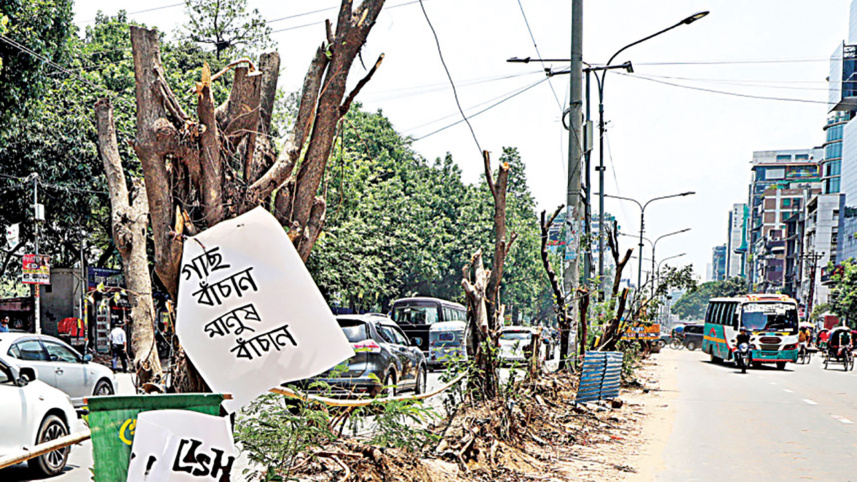
The government’s actions on the environment often seem contradictory. The Malnichhara tree-felling in Sylhet, CRB’s felling of century-old tree in Chattogram, and tree felling in Dhaka, including in Panthokunja Park, are examples where the city authorities have been accused of chopping off trees for beautification and development purposes. In Mohammadpur, where I live, we used to enjoy the canopy of trees and plants. In my neighbourhood, a mango tree sheltered birds and gave shade to rickshaw pullers, street vendors and passers-by. Authorities cut down thousands of trees for repeated utility works, yet waterlogging and service disruptions persist. With few replacement saplings surviving, green cover remains a fraction of what it once was.
The idea of cutting down trees for projects and planting more trees in their place is not realistic. A tree usually takes 10 to 20 years to mature. The replaced trees, if any, would take at least a decade to be of any use to people. Chopping trees triggers a chain reaction in the ecosystem, including loss of animal habitats and food sources. I often question the policies that allow the destruction of mature trees and their complex ecosystems, only to offer a few saplings as compensation. Isn’t this simply greenwashing disguised as environmental progress?
Another aspect of such environmental plans that strike me as peculiar is that they are often focused on areas like Gulshan, Banani, Baridhara and Dhanmondi, which already have better environmental indicators such as vast tree canopy, lakes, and more parks than most other areas, while densely populated areas like Mohammadpur and Old Dhaka remain neglected and continue to suffer from worsening pollution. Such disproportionate actions exhibit how environmental inequality remains unaddressed.
Our cities cannot wait anymore. The government must take steps to make them liveable, combining multiple approaches, including keeping the existing trees and their ecosystems intact while planting new trees on a regular basis. Urban policies must be designed and implemented to effectively balance a city’s practical needs with genuine environmental conservation.
The prime minister has been inspiring people to plant trees since the inauguration of the 25-crore tree plantation programme. It shows the leadership’s commitment to improving environmental quality and combating climate change. However, these efforts may be in vain if the existing challenges are not confronted promptly.
Nushrat Rahman Chowdhury is a development professional who has worked with various international NGOs, including Islamic Relief International, CARE International, and Save the Children International.
Views expressed in this article are the author's own.
Follow The Daily Star Opinion on Facebook for the latest opinions, commentaries, and analyses by experts and professionals. To contribute your article or letter to The Daily Star Opinion, see our guidelines for submission.
 For all latest news, follow The Daily Star's Google News channel.
Comments