


What the decline in hilsa production tells us about our changing rivers

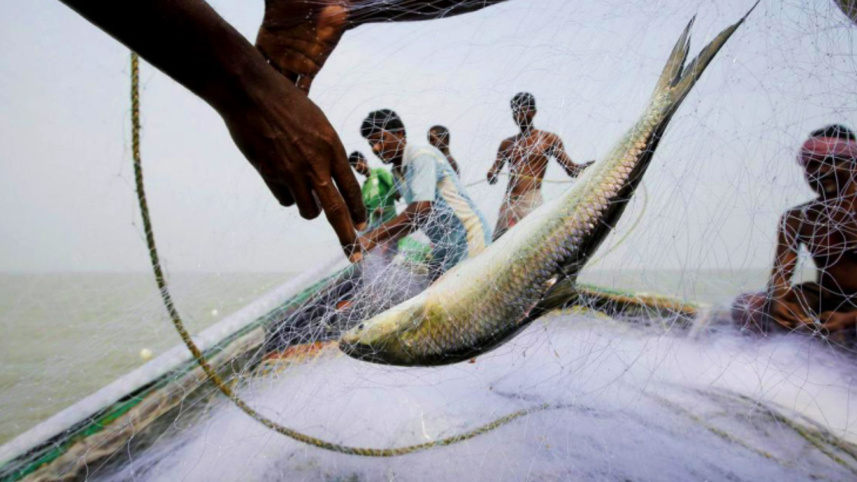
Hilsa was never just a fish. It is roughly 1 percent of Bangladesh’s GDP, a source of livelihood for nearly seven lakh fishermen, a Geographical Indication product recognised in 2017—the country’s second, after jamdani—and, since 1972, chosen to represent the nation itself. It is also, increasingly, something most Bangladeshis can no longer afford to eat. That combination should be a considerably larger topic of discussion than the embarrassment of Bangladesh importing hilsa from India. It matters as a symptom. The disease is what industrialisation, weak enforcement and a widening class divide have done over five decades to a fish that once fed the poorest households in the country and now barely reaches the tables of the middle class.
The ecological damage is already well-documented. Three coal-fired power plants—at Payra, Patuakhali on the Ramnabad channel, and Taltali on the Bishkhali river bank—discharge fly ash and heated wastewater from sites inside or close to the declared hilsa sanctuary in Patuakhali and Barguna. Studies have found that this has raised water temperatures in some areas by as much as 3.5 degrees celsius, coinciding with a 45 percent fall in the local hilsa catch over three years. More than a hundred obstructions, including many illegal nets, now block the coastal routes into the Meghna, Payra, Baleshwar, and Bishkhali systems. Researchers say the fish need roughly 10 metres of moving water, yet the Department of Fisheries has found depths of only five to six metres in several stretches. Jatka, the protected young hilsa, are still being caught because the decline in adult fish has made even the smaller ones too valuable for many fishers to leave alone. As a result, hilsa production fell to around 5 lakh tonnes in fiscal 2024-25, 5.5 percent lower than the previous year, with unofficial estimates suggesting a further decline in 2025-26.

What that decline means on the ground is much harder to capture in national production figures. For many fishers, a bad season can turn an already difficult livelihood into a debt problem. A fisherman can spend two weeks at sea during what should be the peak season and come back with fishes worth only a few thousand taka. The costs of ice, fishing gear, and food are usually taken out before the catch is divided between the boat owner and the crew, and for those who manage to bring in fish, much of the extra value is picked up along the way. The Bangladesh Trade and Tariff Commission has found that a hilsa can pass through four to six hands before reaching the final buyer, with the price rising by roughly 60 percent at each stage. There are also longstanding allegations of syndicates keeping prices high regardless of how much fish is actually being caught. Additionally, the government’s list of registered fishermen, which determines who receives conservation-period incentives, has reportedly gone without a proper update for 14 or 15 years.
The cultural cost is harder to price but no less real. Hilsa was declared the national fish soon after independence because it was abundant enough. Now the fish has drifted almost entirely out of poor households’ reach: production sagged through the 1980s and 1990s as pollution and the Farakka Barrage’s effect on the Padma took hold, then recovered sharply after 2010 thanks to sanctuary protections and a jatka-catching ban, briefly making hilsa affordable to the middle class. That recovery is now unwinding. The Department of Fisheries ran a five-year, Tk 229 croreconservation project from 2021 to June this year. The project did what it was designed to do, particularly in managing sanctuaries and protecting jatka. But its reach stopped short of the sea, where overfishing and trawling are among the biggest threats to hilsa. Additionally, power plants supplying the national grid were built inside a river system that the state had already declared worth protecting; however, enforcement has weakened since the political upheaval of 2024.
This domestic decline now has a cross-border dimension too. For much of the past decade, Bangladesh’s small annual hilsa export to Kolkata during Durga Puja became something of a ritual between the two countries. The interim government briefly stopped the Puja-season exports in 2024, only to reverse the decision soon afterwards. This year, however, the trade has taken an unusual turn. Around 3.5 lakh kg of Indian hilsa, much of it sea-caught in Gujarat, entered Bangladesh through Benapole in July and August. Some consignments declared at customs values so low that they raised questions about possible under-invoicing; one importer, for example, declared 7,723 kg at just Tk 57 per kg. Some of that fish was then sold in Jashore markets as Barishal hilsa. At the same time, 18 Bangladeshi exporters have applied to send hilsa to Kolkata again for this year’s Puja. The reason is fairly simple: however much Indian sea-caught hilsa comes into Bangladesh, it cannot quite stand in for the fish that buyers in West Bengal associate with the Padma. There is something deeply ironic about Bangladesh importing hilsa while trying to send its own fish back across the border. But that irony is really a consequence of everything that has gone wrong upstream.
None of this is irreversible. The recovery after 2010 showed that hilsa stocks can come back when the right measures are enforced. But seasonal fishing bans and the annual goodwill around Puja exports will not be enough. Power plants operating in or near protected waters need proper cooling and effluent standards. Dredging has to account for the routes hilsa take towards the sea, rather than stopping where the river becomes difficult to navigate. The list of fishermen eligible for government support needs to be updated and kept honest. And customs officials need to question declared import values that are so low they should immediately raise suspicion.
What is at stake is not simply whether Bangladesh can keep hilsa in its rivers. It is whether the country can protect a resource while continuing to make decisions that steadily undermine the conditions it needs to survive. If Bangladesh cannot reconcile its rivers, industries and fishing economy, importing hilsa may eventually become a permanent necessity.
Jannatul Naym Pieal is a writer, researcher, and journalist. He can be reached at jn.pieal@gmail.com.
Views expressed in this article are the author's own.
Follow The Daily Star Opinion on Facebook for the latest opinions, commentaries, and analyses by experts and professionals. To contribute your article or letter to The Daily Star Opinion, see our guidelines for submission.
 For all latest news, follow The Daily Star's Google News channel.
Comments