


Kodom always reminded me of her
It was raining when we met. Not the gentle rain where mothers worry about their cherished children catching a cold, nor the drizzle that encourages high school students to escape mundane classes to crowd the neighbourhood khichuri stalls.
Indeed, it was raining as if the sky had just lost its mother. The grief of the clouds had emptied the streets – no rickshaw-turned-half-coloured plastic carriage drifted by; no passerby rushed for sanctuary. There was only the pitch-black, uneven wet road.

Yet I sat, accompanied by a scrawny, scarred tomcat, nestled comfortably on the cold steel bench, under a bus stop, barely safe from the needles of water. I studied the dusty, oat-coloured furball. He bore a missing ear and two defining lacerations across his nose – an asymmetrical cross. If scars are the medals of the feline world, he was a decorated general, perhaps a veteran of the “Great Trash Bin Wars”, silently lecturing the youth on the art of survival. Maybe he nods with his whiskers and starts his sentence with “Back in my days…”
"BOOM!" A transformer nearby burst, showering orange-blue sparks. The veteran hissed, which sounded more like a curse, and bolted, leaving me alone with my thoughts.
That’s when she arrived under the bus stop, panting but not tired.
For a long time, I have wondered what she wore that day. Did she wear a short, block-printed kurti and flared jeans? Or was she draped in something more traditional? A vibrant salwar kameez or a navy-blue saree? The memory refuses to sharpen.
The only thing I remember is her vivacity – the way her face sparked with excitement and a hint of mischief, completely unbothered by the ruined kajal streaming down her cheeks like dark tears.
“Good heavens! What a treacherous downpour! And to think the weather report promised a gentle breeze and soft sun – perfect for an outing!”
With no one on the side, I came to the conclusion that, indeed, her rhetoric was directed towards me. Hence, I reluctantly replied, “Why not? You don’t like the rain?”
“Quite the contrary! I hate the Sun," she said, wiping the rain from her chin. "I hate how bright it is. I hate how it makes me feel like a drought, as if it is sucking the life essence out of me. Come now! Don’t laugh!"
I didn’t laugh. In fact, her words made perfect sense to me. I shifted on the bench to make room for her. She didn't hesitate. She took the spot where the scarred cat had been sitting moments ago.
The air around us shifted. The smell of ozone from the burnt transformer mingled with the scent of her – damp cotton, rain, and the faint, sweet trace of Arabian jasmine.
"I’m not laughing," I said. My voice was barely audible over the rain. "The sun can be... demanding."
She looked at me, surprised I agreed. She began to wring out water from the end of her orna.
"Exactly. It demands that you be happy. It demands that you be seen. The rain is different. It allows you to release emotions you’ve bottled up.”
"How so?" I asked.
"People like us," she said with a faint smile playing on her lips. "We can’t ever cry without scrutiny. But in the rain? In the rain, you can let the sky's tears mix with yours without judgment."
I had no reply to that.
"So, are you waiting for any bus? Or someone else?"
"I don't think either will arrive," I replied as I nodded toward the road, which had become a river of black oil. Truth is, I had forgotten why I was there. Perhaps I was merely a wanderer of my own thoughts, jumping from one lane of consciousness to another, waiting for the rain to wash away the solitude.
 For all latest news, follow The Daily Star's Google News channel.
 “And what brings you here?” I asked.
“I was supposed to meet two of my friends," she said, as I watched a droplet trace her jawline. “They cancelled at the last minute.”
“Do you know what their excuse was? Well, not that it matters anymore…” She paused before continuing again, “But I couldn't let my makeup go to waste. So, stubbornly, I came out, and gosh! What a rain!" She grinned, and for a heartbeat, the grey gloom of the shelter burned brighter than any noon sun.
However, something in her tone revealed that she was expecting her friends to leave her alone anyway, that she had prepared herself to be the only traveller in the rain, and that she was determined to find solace in solitude with a stranger.
That was when she proposed we go collect kodom. Having nothing to lose but the dull sanctuary we were perched under, I agreed.
Why kodom? I have revisited her reply a thousand times in the library of my memory.
“Because it represents the resilient soul that only reveals its true fragrance when the world is weeping.”
Her voice was the only competition against the roar of the wind.
We waded through the rising water, our footsteps heavy and rhythmic. We jumped over a widening puddle that had become a small lake, our laughter lost to the thunder. She slipped once, her hand clutching onto my arm for balance. And for a second, the world narrowed down to the scent of her glistening, wet hair and the shivering reality of another person.
We found a tree near the edge of a muddy park. Its branches were sagging under the weight of the monsoon.
When she reached for a low-hanging branch, her fingers trembled slightly from the cold. "Look at them," she whispered. They only bloom when the world is at its most violent, when the sky is breaking apart. They are the reward for enduring the storm."
I helped her steady the branch, my hand brushing against hers – a brief, electric contact that felt warmer than the July air. I pulled down a cluster of flowers. The rough, wet bark grazed my palm.
As we stood there, we were drenched to the bone, holding the heavy, spherical blooms.
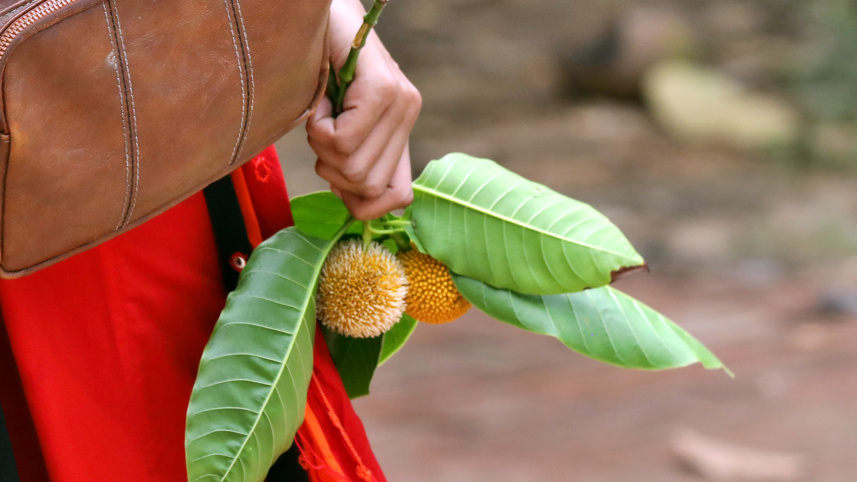
She handed me a kodom. The kodom flowers had a hue ranging from the spectrum of yellow to orange, almost like nature's ping-pong ball, armoured with white filaments.
“There is only one thing I hate about kodom, though. Can you guess?” She asked and handed me a second kodom.
“How quickly it wilts and turns from a sweet scent to a pungent, earthy decay?”
“Bingo!” She handed me the third one as the pour thinned to a drizzle. The hum of the city began to bleed back in. A lone rickshaw bell tinkled in the distance, such a metallic, lonely sound!
“One for me, one for you.” Suddenly, her voice dropped to a conspiratorial whisper. She paused and peered at my palm. Maybe she foresaw the decay of the kodoms.
“The third is for the distance. The space that grows when the rain stops and we go back to being people who don't know each other.”
The temporary sanctuary of the bus stop was dissolving; the "Great Trash Bin Veteran" would soon return to claim his bench, and the world would forget we had ever met.
“I should go,” she said. She didn't offer a name, and I didn't ask for a promise.
And then she vanished into the grey concrete urban crowd, where she blurred and became nothing but the flicker of a damp candle.
Nostalgia is a strange rot. It doesn’t smell of decay at first; it smells of July rain and wet earth. But as the years pass, the sweetness turns heavier. It ferments into something that sits at the back of the throat.
I realise now that she was right to leave.
Had we stayed, we would have become the sun to each other: demanding, bright, and exhausting. Instead, we remained the kodom: a brief, moody bloom that only the storm was allowed to remember.
Mueen Walee Maheer is an aspiring polymath who is currently a master of none but a fan of many. Send him a new obsession at mueenwaleemaheer@gmail.com.
Comments