The many worlds of Ghulam Murshid
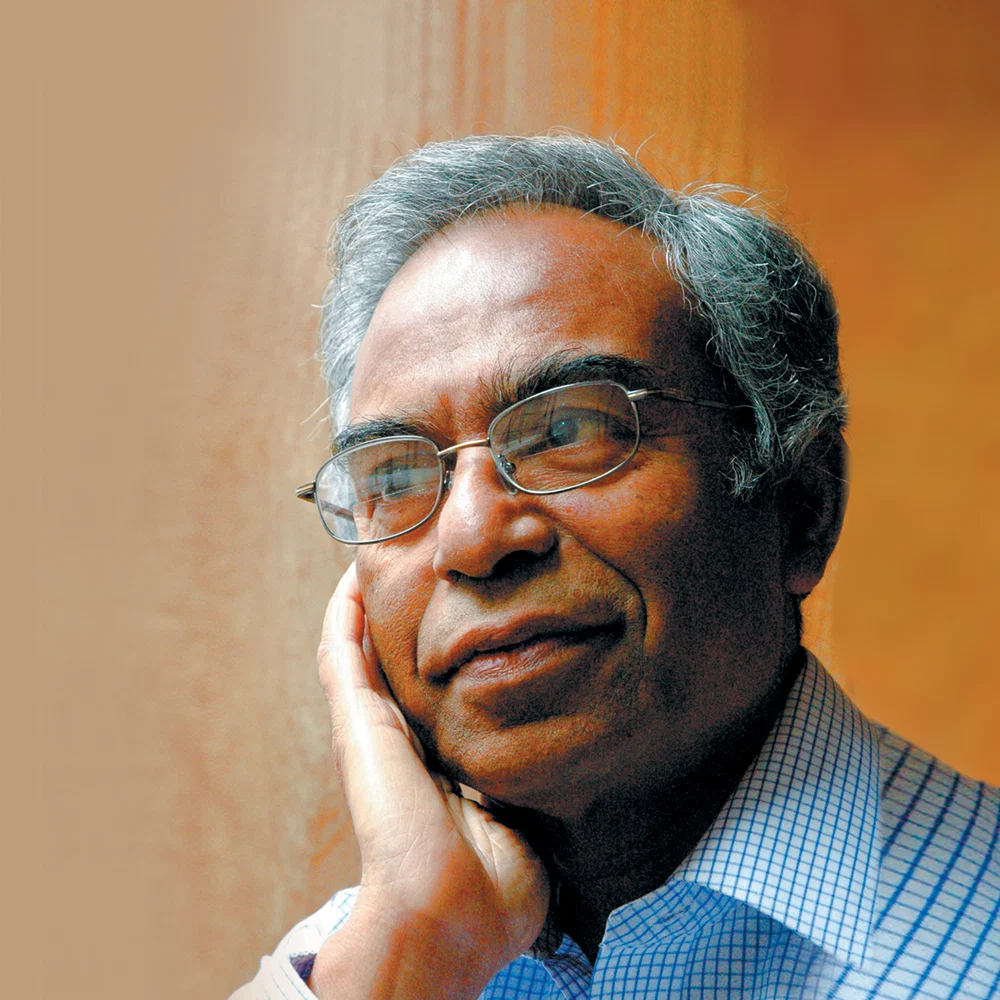
The Ghulam Murshid fan club can be said to comprise broadly three classes of people: first, close personal friends and family who shared his childhood days and, subsequently, his adult life as an author, researcher, teacher, journalist or broadcaster. Second, there are those individuals who knew him more by way of reading his copious writings than through any familiarity with his keen persona. There is, however, a third category, numerically much smaller, which has had a fruitful association with Murshid both as a scholar and as a person, and has been deeply familiar with both Murshid the person and Murshid the scholar. Of this category, some have meaningfully contributed towards exposing him and his works to the public gaze. In this category, I would place individuals like Swarochish Sarker, Maidul Karim, Gopa Majumdar, Sarbari Sinha and Bidhan Pal, each of whom has facilitated, in one way or another, my understanding of Murshid and of his authorial footprints. Some have been gracious enough to contribute to the Commemorative Volume on Ghulam Murshid that is now in the press. I shall return to this point later.
I first briefly caught sight of Murshid when, one summer morning in the year 1994, he and his wife, Elija, drove down to Oxford from their home in London. The groundwork for their arrival was laid by my economist friend from Rajshahi, Prof. Sanat Kumar Saha, whose stay at Oxford partly coincided with my own. We shared a common kitchen and at dinner time, as I recall, Prof. Saha would invariably complain about the very ‘tastelessness’ of locally produced GM vegetables. He also remained agitated during recurring debates that broke out over dinner about the propriety of the recently concluded liberalisation of the Indian economy. Bangladeshis too are ‘argumentative’ people, and my thoughts go to the interesting debate I once had with Prof. Anisuzzaman during a conference at Halle (Germany). At Oxford itself, Sanatda later made way for yet another Bangladeshi economist, Prof. Dilip Kumar Nath, with whom I still remain in correspondence.
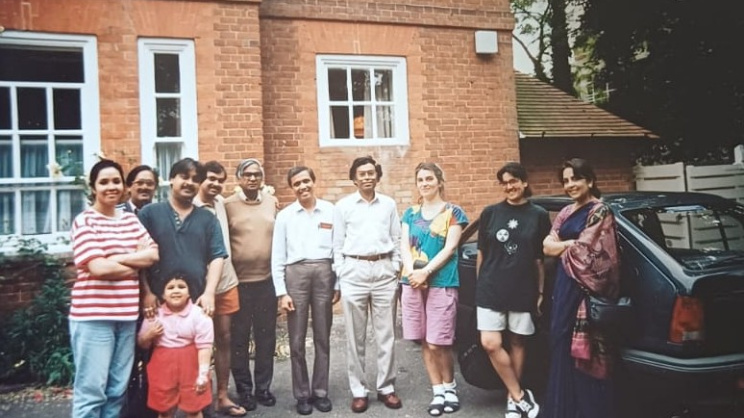
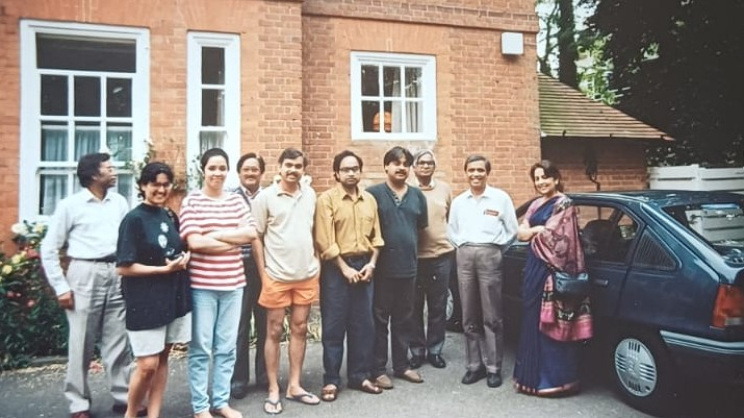
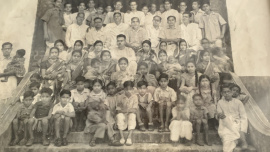
I have to say that Sanatda, although my elder by over ten years, proved to be a good campaign manager. On his initiative, a crowd of over a dozen people, all overseas scholars from India, Nepal, Spain, Poland and Iran and my co-residents at the North Oxford Overseas Centre, Banbury Road, readily gathered to pose for a photograph with the visiting couple. I don’t know if any of them kept up contact with our celebrated author, but the incident nevertheless suggested to me, first, that even in the 1990s, there was spontaneous respect for a fellow scholar and writer, regardless of the language he wrote in, and second, a sense of a world without borders. Both these features, unhappily, have considerably eroded since.
It was Sanatda who first alerted me to Murshid’s monumental biography of the Bengali poet from Jessore, Michael Madhusudan Dutt. In his reckoning, Murshid’s insights and competence as a biographer matched those of Prasanta Kumar Pal of Visva-Bharati and author of the majestic, multi-volume biography of Rabindranath Tagore. Ashar Cholone Bhuli caught much wider public attention once published as a book in 1995. At the time I was in England, it was being serialised in the popular Bengali weekly Desh, to which I had no access. It was only after my return to India that I could acquire a copy and read the work in print. Subsequently, I also had occasion to read the anthology of Madhusudan’s letters that Murshid edited, published by Oxford University Press, Delhi. Regrettably, I could not get the publishers to come out with a reprint of this valuable work, even after I volunteered to edit and annotate it.
What struck me most about these volumes was the enthusiasm and investigative diligence that permeated them. Murshid played the deductive role of the committed detective to perfection, keen to revive a trail gone cold. In this, he also consciously departed methodologically from previous biographers of Madhusudan, inasmuch as he anchored his work more firmly in empirically verifiable data rather than hearsay evidence and affectionate claims made by close contemporaries. The work demolished myths and platitudes and planted instead a truly complex figure tied to the vagaries of his historical context.
Ghulam Murshid was essentially a scholar of Renascent Bengal and, arguably, the two themes that enthused and excited him most were the history of modern Bengali language and literature and the Woman Question in historical perspective, both framed by the same colonial context. It is only apt that even his personal qualities and accomplishments carried the creativity, openness and versatility that characterised Renaissance figures of old. He was a lexicographer, historian, researcher, teacher, journalist, broadcaster and biographer, and was quite conversant with certain trends in modern Bengali music. I hear that his friends in Kolkata had elected him to the post of President of the Debabrata Smaran Committee. Unquestionably, he was a man who wore many hats.
As a biographer, Murshid reveals certain interesting traits. First, it can be no coincidence that the two biographies that he wrote (of Madhusudan and Nazrul respectively) are of men who were, by persuasion, poets and quite rebellious at that. Arguably, he had a penchant for evocative poetry, as can be gleaned from his early interest in medieval Vaishnava padavali. Second, there is the well-known fact of both Madhusudan and Nazrul deliberately breaking poetic, social and cultural conventions. It may be justly argued that Vaishnava padavali too was marked by some degree of social transgression. Third, they were both publicly critiqued for daring to differ or experiment. Not surprisingly, Murshid himself faced flak at least twice, initially on account of certain sentiments expressed about Nazrul and subsequently for exposing certain ‘uncomfortable’ social realities regarding the Bangladeshi diaspora settled in England.
Controversy also surrounds his remarks on religion and religious identity, both of which he personally found too pervasive, potentially hazardous and untrustworthy. Prima facie, this may appear somewhat incongruent. Neither Madhusudan nor Nazrul was an atheist or agnostic figure, nor, for that matter, was Tagore, on whom Murshid has written copiously. Here, I am hazarding the guess that what may have actually appealed to Murshid in these lives was, first, the freedom of conscience, as with Madhusudan, and the willingness to cross-fertilise the more dynamic and creative elements in seemingly contrary religious traditions, as with Nazrul and Tagore. Perhaps he believed that, in so doing, a man could rise above and shake off the sheer weight of narrow bigotry and hardened dogma. Murshid had once famously remarked that he was neither a Hindu nor a Muslim and that it was important to be a human being foremost. Interestingly, though, I have also heard him say that he was first a Bengali and only thereafter a human being or a global citizen. Could this be an admission of the fact that religion, at least on one level, was also culture? Bengal, in particular, has known far too much cross-religious and cross-cultural infusion for this possibility to be brushed aside.
The social and intellectual urge to stay clear of communal and overly idealised history writing led Murshid to critique both Ramesh Chandra Majumdar and Mohar Ali, who, allegedly, read history quite tendentiously. My own sense here is that such considerations, though quite apt in themselves, also led Murshid to somewhat ignore figures like Bankimchandra Chattopadhyay, commonly taken to be a spokesperson for Hindu nationalism. I have established elsewhere that, at least in the context of modern Bengal, he was the first to use the term ‘Hindutva’, even though his usage is very different from that of Savarkar. In some of his essays, Murshid does scant justice to Bankim, even though the man remains important to modern Bengal both in terms of literary creativity and critical thinking. A similar omission may be noticed in the case of Rammohun Roy, who rarely appears in Murshid’s writings. My surmise is that, though cloaked in reason, reform and modernism, Rammohun’s deep anchoring in religion somehow discouraged Murshid. For a man commenting on the course of the Bengal Renaissance, these are figures who had to be given greater space, however critically. It is noticeable, though, that he paid adequate attention to the agnostic Vidyasagar. As is well known, Murshid edited a sparkling collection of essays on this educationist and social reformer. What certainly aided this choice was Vidyasagar’s dedication to the cause of female education and women-related social reform.
Rabindranath Tagore, as I have earlier pointed out, proved to be a favourite with Murshid, notwithstanding his deep religiosity. I do believe that religion, albeit a reformed one, was quite consistently the site on which the major cultural creativity of the Bengal Renaissance rested. I have often wondered whether, when relating to Rabindrasangeet as deeply as he did, Murshid could somehow separate the innate spirituality and the sense of submission in these songs from a purely social or secular message that they may have also carried. For Tagore, the awakening in Bengal represented both the material advancement of man and the liberation of the human spirit. I am tempted to argue that Murshid acknowledged this.
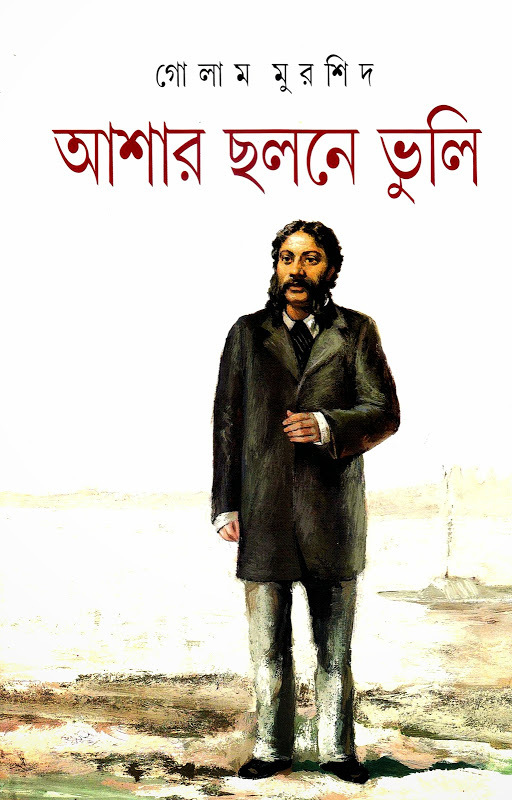
It is well known that Ghulam Murshid produced a series of pioneering works on the plight of Indian women and the securing of gender justice. Some scholars are inclined to think that, on this question, our author was occasionally guilty of overstating or somewhat romanticising feminist rebellion and its role in substantially challenging patriarchy. Even so, it is undeniable that through his writings Ghulam Murshid was able to blaze a trail for many interested scholars to follow, especially in the context of South Asia. Locating the new man and woman was very much a project of the rebel, modernist poet Madhusudan and of his foremost biographer.
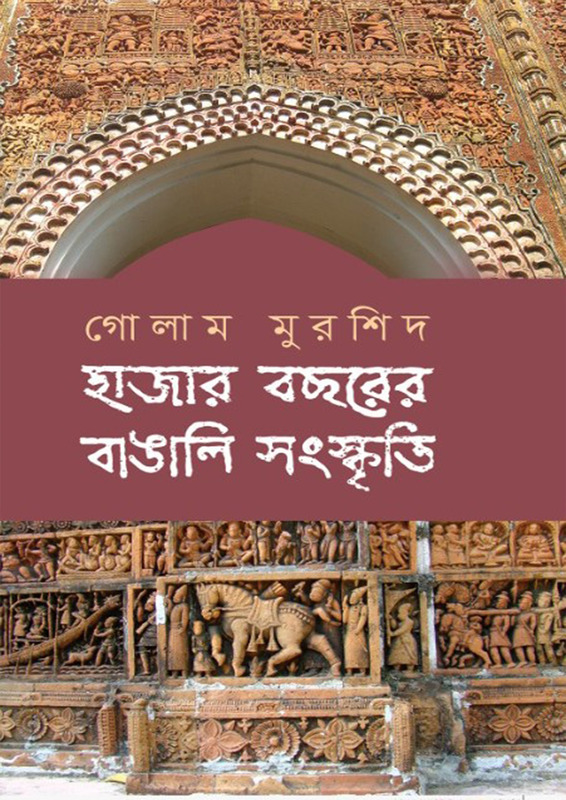
I have read Sarbari Sinha’s English translation of Hazar Bochorer Bangali Sanskriti. Several readers and critics have rated it as the singularly important ‘go-to book’ on the subject and, happily, I was fortunate enough to review it for Summerhill, the bi-annual journal of the Indian Institute of Advanced Study, Shimla. As a historian, though, I have to admit that I struggled with certain conceptual problems with this otherwise hugely popular book. For one, by ‘Bangali’, did Murshid mean the Bengali-speaking people or the people inhabiting the geo-cultural region generally known as Bengal? Going by the latter definition, one has to admit that Bengali culture had to be influenced, however marginally, by migrant communities originating both in India and outside. Kolkata still has the Armenian Church, Jewish bakeries and Chinese dentists, restaurant owners and shoemakers. This is not a problem with N. K. Sengupta’s title, A History of the Bengali-Speaking People. Where Sengupta errs is in leaning rather heavily on Hindu Bengal. In Murshid’s work, there are some factual errors too that careful editing would have done away with.
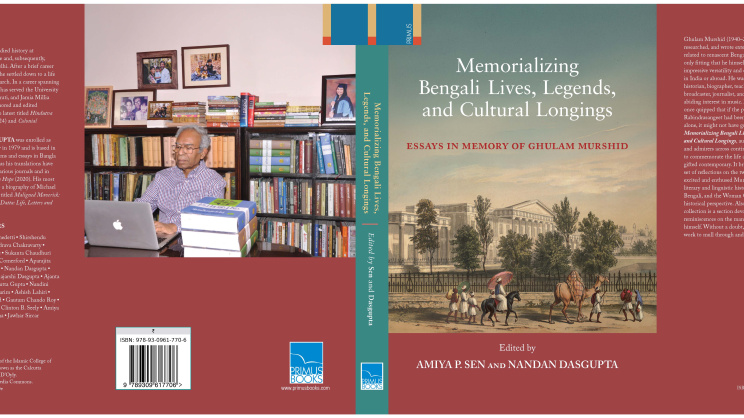
Ghulam Murshid once famously quipped that, as a musical genre, Rabindrasangeet might not have grown very much had the task of propagation been left to Tagore alone. In the poet’s lifetime and thereafter, this genre was actively promoted and made more sophisticated by contributions from a galaxy of eminent musicians and musicologists. On some subconscious level, this remark stayed with me and has been the main inspiration behind a Festschrift for Ghulam Murshid that a friend and I have edited. When published, this will perhaps be the only book of this nature to originate outside both West Bengal and Bangladesh. I take this occasion to personally thank each of our contributors located across continents. But for their enthusiasm and support, this work may not have been possible. Sadly, contributions from friends and colleagues in Bangladesh are fewer than we expected. At the time we approached them, even long-standing friends expressed restraint and reluctance, possibly in view of the political instability in Bangladesh during 2024–25. As an Indian, I would be remiss if I did not also bring up the matter concerning the difficulties of procuring copies of Murshid’s works, particularly those published in Bangladesh. I urge concerned people from the world of publishing and other concerned parties to seriously contemplate bringing out a Murshid Omnibus, possibly in multiple volumes, especially taking care to include his lesser-known works. This, I fancy, augurs well for closer cultural ties and cooperation between Bangladesh and India, reinforcing a shared culture and building more enduring bridges of understanding between peoples.
Even as I conclude this humble tribute to a gifted contemporary, I realise how little I know of Murshid the man and scholar. It is especially interesting, therefore, that I should still be so powerfully drawn to his memory. Perhaps, in some old-fashioned way, this is my way of repaying some unknown debt I owe him.
Amiya P. Sen retired as Professor of Modern Indian History at Jamia Millia Islamia, New Delhi.
Send your articles for Slow Reads to slowreads@thedailystar.net. Check out our submission guidelines for details.

Operation Jackpot: How Bangladesh’s naval commandos struck at Pakistan’s lifeline in 1971
The Yellow Butterfly: How Sheba shaped my world growing up

What Bangladesh’s historic Test victory in Australia means for Bangladeshi-Australians
Remembering Sumit Sarkar, a historian who questioned orthodoxy
The unfinished histories of Partition
In conversation with William Dalrymple / ‘Britain didn't conquer India’
Sheikh Mujib’s killing: What the newspapers told and what they omitted
Mirrors of Empire / The bureaucrats and intellectuals who shaped the Mughal Empire
To feel Bengali, to think beyond Bengal: Dipankar Gupta in conversation