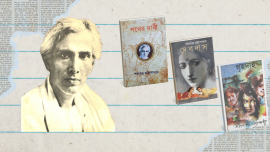
The Yellow Butterfly: How Sheba shaped my world growing up

It was probably towards the end of Solomoner Guptodhon (King Solomon’s Mines), one of the earliest editions in Sheba’s Kishore Classic series, that I happened upon these letters people wrote to one ‘Kajida’. I was still overwhelmed by how Allan Quatermain’s small party escaped certain death. First, they predicted a solar eclipse to impress the Kukuana. Then Henry Curtis, tall and strong like a Viking, slew Twala, the evil king, only to be led into a trap in the fabled mines by the devious witch Gagool, before finally escaping. They declined the Kukuana’s offer to stay and returned to Durban on their way to London, where they found fame and riches, thanks to the few diamonds they had carried in their pockets. Henry Rider Haggard introduced me to all the classic tropes—a secret world, a treacherous journey and hidden treasure—that I would encounter many more times.
Unwilling to let go of the heady adventure, I read on. These letters from readers to Kajida (who, I realised later, was Qazi Anwar Hossain, founder of Sheba Prokashoni and creator of Masud Rana) revealed a whole new world. People commented on books, discussed plots, asked questions about upcoming titles, inquired after a sequel they had been waiting for or perhaps asked about the next Masud Rana episode. It was like peeking into a room full of people completely absorbed in their conversations. And I listened in, standing at the door. It was hardly as enthralling as the story I had just read, but I read all the letters. And then there were a few previews of upcoming Kishore Classic editions. They were little blurbs. One was of Duhshahoshi Tom Sawyer by one Mark Twain. It was just a few lines…
নীরব, নিঝুম রাত। আকাশে তারার ঝিকিমিকি। সামনে বিছিয়ে আছে নদীর কালো পানি। কান খাড়া করে শুনল টম। কোনও সাড়া নেই কোথাও।
‘কে যায়?’
‘টম সয়্যার, স্প্যানিশ মেইনের কালো প্রতিহিংসা। তোমরা?’
‘লাল পাঞ্জা হাক ফিন আর সাগরের আতঙ্ক জো হারপার।’
‘সংকেত?’
‘রক্ত!’
(Nirob nijhum raat. Akashe tarar jhikimiki. Shamne bichhiye achhe nodir kalo pani. Kaan khara kore shunlo Tom. Kono shara shobdo nei kothao.
‘ke jai?’
‘Tom Sawyer, Spanish Main-er kalo protihingsha. Tomra?’
‘Laal Panja Huck Finn ar Shagorer Atonko Joe Harper.’
‘Shonket?’
‘Rokto!’)
The words were electrifying. I was fascinated and kept reading them over and over until I had them memorised. I could see myself standing in the still air under starlight. A quiet, shimmering river lay before me. I imagined these fantastical characters—the Black Avenger, the Terror of the Seas and the Red Handed—were about to make off on death-defying adventures on the high seas. And Spanish Main, I astutely deduced, must be the ship that the Black Avenger had commandeered and was now flying the Jolly Rogers.
Soon enough, I devised a ruse to visit New Market, but I had not yet contrived how to coax my strict disciplinarian father into buying me what must surely be a book full of blood and violence. I decided to go with the cold pitch when we got to the bookshop and found the title. Surprisingly, he turned out to be an admirer of this Mark Twain fellow and, to my relief, thought it was a good book. But just as I was about to turn away, I spotted another Sheba translation and took it out. It was another Kishore Classic.

The cover read Tin Musketeer and had an illustration of men in a swordfight against the silhouette of a battlement, promising murder and much mayhem. I could not leave it at the shop. The book begged to be read. Almost like Oliver Twist (which was another Sheba classic I would read in a few years) asking for a second helping, I mustered all my pluck and made the stupendous proposition of buying a second book.
Abbu’s frown relaxed as soon as he read the title. He readily agreed. I was aghast with admiration. My father’s tolerance for what I thought would be lurid tales of bloody bedlam established him as a man of refined literary taste in my 10-year-old mind. Apparently, Alexandre Dumas was a big deal too, and Abbu said that one day I would be old enough to read the unabridged translation of the full Three Musketeers series that Dadabhai guarded in his locked bookcase as if it indeed were Solomon’s treasure.
But I had no time to dwell on such trivialities. Breathtaking exploits awaited me in those newsprint pages still smelling of ink. I was all set to discover the world through Sheba Prokashoni’s paperbacks. It was 1984. Sheba was in its 25th year of operation. And I was still in my fifth grade.

Instead of the Black Avenger’s escapades, I read about a tranquil, almost idyllic life in the antebellum South of the 1840s United States. The book did not disappoint, though. Tom must have been just a little older than me, and together, we stole the ham and ran off to Jackson’s Island to become pirates. Tom’s small town along the Mississippi, which was also Twain’s, became mine too. Twain’s idyll is also where I left a sliver of my childhood.
Then came the swashbuckling musketeers with their swordfights in early 17th-century France. It was a tale of intrigue and conspiracy in the court of Louis XIII, where young D’Artagnan and his three comrades-in-arms took on the scheming Cardinal Richelieu. The plot unravelled through one action scene after another. D’Artagnan proved his worth, taking on Jussac, one of the best swordsmen in France. And soon it was a classic ‘race against time’ as the musketeers were sent on a mission to retrieve the queen’s diamonds from the Duke of Buckingham to save her honour.
It was also a tale of loyalty, friendship and camaraderie. I rode with the musketeers when they galloped from La Rochelle to the convent to save Constance, their horses kicking up dust in their wake. I despaired with D’Artagnan when Athos shook his head in resignation, saying there was no antidote. Constance had been poisoned. She died in D’Artagnan’s arms. And I lost my beloved even before I had loved. In the end, though, it did not turn out so badly. Even Richelieu acknowledged the young Gascon and recommended his promotion to lieutenant.

With the half-yearly exams coming up, there were no more books, and I must have felt how today’s children feel when their phones are taken away—an addict suffering from withdrawal. The exams passed in a blur, and soon there were more books and new adventures. The Sheba paperbacks, with their red-lined yellow butterfly logo that had infested so many of our households across Bangladesh, became a staple for me too.
The highlight of the day was invariably when I came back from school and swooped on the storybooks. I travelled across centuries and continents with Sheba. Translations of all these classics had made world literature readily accessible. There have been many times, as it was with Tom Sawyer, when I had sat down with the original version only to realise that I could not quite relish it as much as I did the lucid Sheba translation. Perhaps it was the ease of reading Bengali, perhaps the novelty had worn off, but some titles I only enjoyed as Sheba translations.
By the time the fifth-grade finals came along, I had mastered the art of hiding Sheba paperbacks behind textbooks, pretending to be engrossed in history or geography. But Robin Hood, which was a tome of a book (it cost a whopping Tk 20 when the regular titles used to be below Tk 10), was proving rather unwieldy. I did not relent and used my largest textbook as a cover, so nosy passers-by and suspicious parents would see that I was absorbed in science. I could not let trifling final exams get in the way of dispatching the Sheriff of Nottingham or pursuing Lady Marian. Only the drawing test was left when Little John and I tearfully buried Robin in Sherwood Forest.
In the meantime, I had made a ground-breaking discovery. Instead of trying to guess from the title and cover illustration whether the story might be interesting, I found out that it was wiser to stick with authors who had proven themselves. But being the discerning critic of fine literature that I was, it was a short list. Having read Kalo Teer (The Black Arrow) and The Sea-Wolf, I added two more names to Dumas and Twain. Fortunately, and as if on cue, Sheba kept pace with more from just the authors I approved of. The following year, there would be Huckleberry Finn and Kidnapped. There were also The Call of the Wild and White Fang. In one, the dog goes from a comfortable, pampered life in a large house to the cold, harsh north and eventually finds freedom in the wild. In the other, a wolf finds comfort as he retires to a peaceful life in warmer climes. I felt happy for Buck for raising his own pack, but ever since, I have also romanticised the idea of adopting a wolf pup and naming it White Fang.
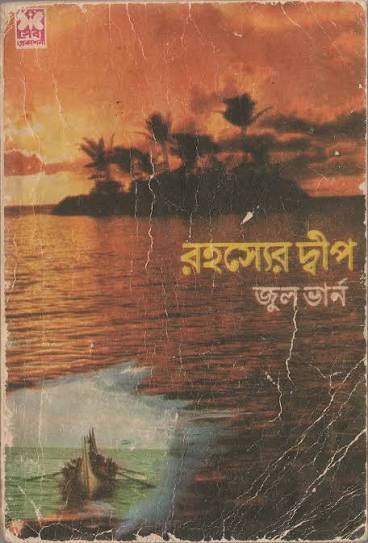
Then came The Count of Monte Cristo and Treasure Island, where I started to notice the supporting cast. It began with the immortal pirate archetype of Long John Silver. Even the name—Long John Silver—as it rolled off the tongue had an ever-so-subtle hint of foreboding, like the sudden glint of sharpened steel escaping from deep inside a scabbard. And yet there was a disarming pull. I could close my eyes and see the ship’s cook, with his green parrot repeating ‘pieces of eight’, moving about the Hispaniola’s galley on his crutch. I could see his tattoos, earrings and yellow teeth. He probably never brushed his teeth, I thought to myself. Endearing and yet crooked to the hilt, Long John Silver remains one of those villains I hate to despise.
And when Edmond Dantès met Abbé Faria in his cell in the Château d’If, I thought the abbé was the best tutor one could have—teaching sword fighting and languages, shrewdness and wisdom. It was under him that Dantès transformed into a man. He learnt to become a sophisticated man and manoeuvre through life, and most importantly, pursue his vendetta.
I wondered if my house tutor would have a similar appreciation for those dark arts as Faria. Overcome with curiosity, I broached the topic one afternoon. My tutor, a BUET student and decidedly a man of science, denounced them outright. With the uninhibited conviction typical of the ignorant, he proclaimed that fractions, not fencing, would lay the foundation for sixth-grade success. I had no doubts any more. I would have to look elsewhere for a proper education.
Towards the end of my sixth grade, Sheba published its first Tin Goyenda novel. It would go on to become arguably Bangladesh’s most popular series, spawning an entire generation, perhaps a couple of generations, of fans who adopted the characters into our lives. Their bywords became part of our lingo, every twist in their path became a topic of our conversations, and their quirks became our taunts and barbs. Boys wanted to be Kishore Pasha and girls envied Gina Parker.
I thought I had stumbled upon another treasure trove. Like thousands of fans, I would wolf down every edition and eagerly wait for the next adventure of the young sleuths. So, when I was off to cadet college, I wrote back home asking them to buy the ones that came out in the meantime so I could catch up during the holidays.
Here was a story, I thought, written by a Bangladeshi, taking me across the world. The protagonist was a deshi-born American living with his uncle and aunt, who owned the Pasha Salvage Yard somewhere in Rocky Beach, California. And it was in his uncle’s scrapyard, under a pile of rubble, that Kishore Pasha, the brain of the trio, set up his headquarters inside a trailer. I devoured every book thinking, finally, I was reading an original. Not an adapted or abridged version. I did not have to wait to grow older to read all the details in English. And it made me so very proud. But this would not last.
It must have been one of those times when the librarian was not around that I ventured deep into the bowels of the cadet college library. Most of the books looked austere and stern, quite like our librarian, leaving little doubt that they were for grown-ups. That is, until I noticed this one long row of colourful book spines. I took one out. The title read Skeleton Island, from Hitchcock’s famous Three Investigators series. I had read Konkal Dweep just a few months ago. I made out The Mystery of the Silver Spider and The Mystery of the Green Ghost, recalling Rupali Makorsha and Shobuj Bhuut. And it struck me that Rakib Hasan, who is still credited as the creator of Tin Goyenda, had merely altered the characters but lifted everything else right from Hitchcock, without so much as a mention or disclaimer. I felt betrayed and stopped reading Tin Goyenda from that day.
But my journey with Sheba continued. I had remained rather sceptical about Dickens, since Oliver Twist and David Copperfield sounded too tame. But that year, I finally decided to give them a chance and wished I had done so sooner. Jules Verne sneaked in with Captain Hatteras and Journey to the Moon. It was the same year that Challenger exploded, killing all of its passengers. Several more authors would follow, but soon I turned away from translations to settle on the originals. I never forgot about Tin Goyenda, though.
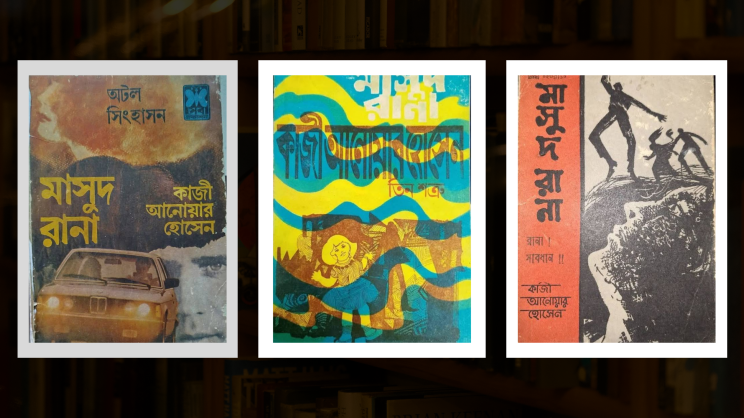
So, almost 20 years later, when I sat down to interview Qazi Anwar Hossain, that very Kajida I had first discovered at the back of Solomoner Guptodhon, I asked him why there was no disclaimer.
“But I believe we did mention it was based on The Three Investigators.”
“Not based,” I countered. “It was lifted from there, and I felt very betrayed. And no, it was not mentioned. I checked.”
“That was never the intention… we should have mentioned… I am sorry you felt that way.”
We quickly moved on. There was a lot of ground to cover. But I thought the most interesting part of the interview was over even before it had begun.
We, fellow Sheba reader Asjadul Kibria and I (we were at New Age then), first reported to a first-floor office of Sheba Prokashoni in Segun Bagicha. From there, we were ushered through a back door into a dark stairwell where burning torches would not have been out of place at all. It was old, musty and piled with Sheba paperbacks. A backroom storage area of sorts. Our minder guided us a couple of flights down and through a long corridor. It was a tunnel going from one building across an alley into the basement of another. The minder left us at the base of another flight of stairs and went back, advising us to climb up and knock when we came upon a locked grille. So, we did. Someone peeped from behind a curtain and inquired about my credentials, as if asking for the secret password. I reciprocated with a conspiratorial whisper that we were from a newspaper and had an appointment. She vanished as if it was the wrong password. Moments later, the woman reappeared and let us in. We went through another couple of doors to finally see Kajida standing up from his table to greet us with a smile.
I had prepped for several days for the interview. That was the first time I actually read Masud Rana, albeit only the first three because they had original plots. Having strict control over my reading list, Abbu had forbidden Masud Rana books for me. It appeared the man had indeed kept the lurid stuff away, bless his soul, until after my HSC exams. But I got into Forsyth and Le Carré before I got around to Kajida’s Masud Rana. And frankly, Rana did not have a chance after that.
Qazi Anwar Hossain recounted the story of how he began Sheba, right from the day he asked for money from his father, Qazi Motahar Hossain, as he sat hunched over a chessboard. Anwar Hossain recounted how Sheba spread its wings and, all of a sudden, he found himself stretched too thin, unable to devote time to research and writing himself. Thus, syndication it was, based on thrillers by Len Deighton, Alistair MacLean, Robert Ludlum, Ian Fleming and the like.
Having become a consummate espionage fan, I thought a six-foot dandy gallivanting around 1960s Dhaka in a Jaguar would blow his cover in an instant. Besides, why fashion Rana after the cartoonish James Bond at all, I asked?
The creator of Masud Rana said this character would have to be someone that every man wanted to be and who lived the life that every man envied. Hossain agreed there were similarities with Fleming’s Double-O Seven. But Masud Rana was also fashioned after himself and some of his fantasies. He did own a Walther PPK .32 and smoked Chesterfields, he said. So, the more unassuming George Smiley of John le Carré, as I had mentioned, might be more realistic but would never have the same pull with Bangladeshi readers, he thought. Sadly, though, there was no chance of original plots for his spy thrillers.
It did not matter, really. Not to Masud Rana fans. Just as it does not matter to Tin Goyenda fans. They eagerly waited for every Masud Rana or Tin Goyenda or Kuasha and devoured them as soon as they were out. I could not have known what Sheba did for me when I was reading those classics for the first time. Much later, I did. And I was glad Sheba was there as I grew up, feeding me tales and quenching a thirst that I might not have known I had. It gave me a taste of something that would probably have come much later in life. Indeed, some people have spent their lifetimes feeding on Sheba paperbacks. And thus it was that Sheba spawned generations of readers.
One book at a time, it gave us a glimpse of another part of the world. Each book was like a window. And in Sheba’s world, there were hundreds of windows. At a time when there was no internet or mobile phone, let alone social media or YouTube, and very limited television, Sheba’s books introduced us to the rest of the world. This was how we got a glimpse of faraway lands and learnt about the people there.
Just a few months before that interview with Kajida, I had stood on the Yucatán coast of Mexico—which actually used to be part of the Spanish Main—on a starlit evening, and I laughed to myself.
…not even Tom Sawyer could have done better with his wild imagination…
Tanim Ahmed is digital editor at The Daily Star.
Send your articles for Slow Reads to slowreads@thedailystar.net. Check out our submission guidelines for details.
Three revolutions that reshaped the world
Paradise lost and found: Rediscovering early modern Bengal
Unbound Mother: The making and remaking of Kaali in Bengal
Do great leaders make history, or does history make them?
Poison and cremation: A forensic history of colonial Bengal

Partition, Bor Porong and the Chakmas’ unfinished struggle for belonging
The young radicals who challenged 19th-century Bengal

More men are cooking. But is patriarchy leaving the kitchen?

Everyday secularism and the Bangladesh we rarely talk about