Unbound Mother: The making and remaking of Kaali in Bengal

Anecdote: An elegy for a fading plurality of the Dark Mother
Looking back, my childhood feels like a distant country, deeply rooted in the soil of a traditional Shakta household. We lived within a tapestry of Kali worship that felt endlessly varied, raw, and alive, a richness that I now fear is slipping away. My great-grandmother was a fierce, devout sadhika, a woman of intense spiritual solitude. Every year, on the anniversary of her passing, our home would swell with my grandfather’s music students. The haunting, melancholic strains of Shyama Sangeet would drift through the courtyard, introducing my young, impressionable heart to the Dark Mother. It was a world where devotion wasn’t sanitised; it was felt.
I carry a persistent ache for the old days at the Jhautala temple in Barisal. Year after year, I would watch the local artisans sculpt the goddess in her most primal, unvarnished form. There was an unsettling, yet liberating, honesty to her appearance back then: completely unclad, a grisly necklace of severed heads resting on her chest, and a girdle of human hands clasped around her waist. She held a gleaming scimitar in one hand and a freshly severed head in another, flanked by the grotesque, ghostly silhouettes of Petna, Petni, and the headless Kabandha. Animal sacrifice (pathabali) was an absolute, unquestioned certainty. To our childhood minds, a Kali Puja without the subsequent feast of sacrificial meat was an impossibility, a concept we could not even fathom.
My mother, trapped in the relentless, suffocating grind of our lower-middle-class existence, coped by constantly vowing a goat sacrifice to Kali Ma whenever hardship knocked on our door. Moreover, in our home, hardship was a constant guest. There was a tragic, anxious irony to it all: buying those goats for sacrifice became a financial burden of its own, a desperate cycle of faith that fuelled our poverty.
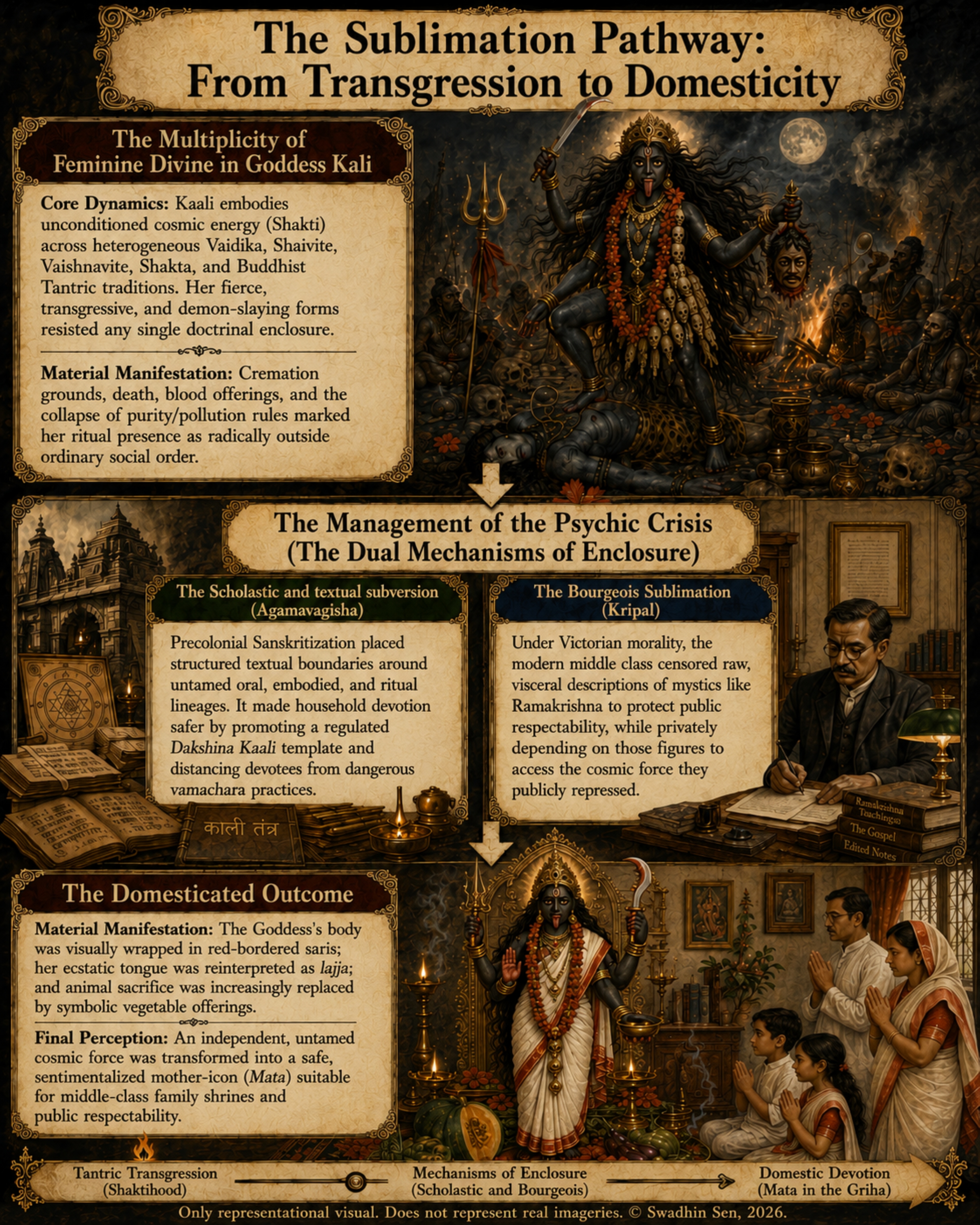
Amidst this, she would often guide my aunts and me to the Ramakrishna Mission. I remember being less drawn to the solemn prayers there and more comforted by the quiet sanctuary of their charitable homeopathic dispensary. I recall these fragmented vignettes now because they are the very ground upon which my consciousness was built; they show how deeply my own growing up was intertwined with these wild, contrasting rituals. However, as the years rolled on, a quiet, sanitising gentrification crept into our neighbourhood temple, a shift that now fills me with a strange anxiety. The fierce, untamed deity of my childhood began to fade, replaced by a version of her that felt safe, domesticated, and tailored for polite society. She started appearing dressed in a red-bordered white saree, her terrifying gaze replaced by a calm, sterile smile. The raw, visceral act of pathabali dwindled into near non-existence.
Recently, they installed a permanent, small stone idol in that very temple. There she sits, veiled in a saree, meditative, and polite.
As I travel across Bengal today and witness the dwindling remnants of her many indigenous forms and seasonal rituals, my devotion has not waned, but my heart has grown heavier. I have learned to cherish the vast plurality of the Dark Mother, but I am acutely aware of how rapidly we are losing it. We are trading a vibrant, messy, multifaceted spiritual ecosystem for a monolithic, comfortable uniformity.
This piece is born out of that bittersweet, anxious realisation, a mournful tribute to a fading diversity. If you read my words through the anxiety of this loss, perhaps you will hear the deeper, more troubled resonance beneath the text.
Kaali: Epistemic plurality and the politics of a singular narrative
Ramprashad Sen, one of the most popular and widely followed poets of Shyamasangeet (songs dedicated to Shyama or Kaali) and one of the most frequently cited padakartas of the genre of Saktapadavali, represents Kaali in sharply contrasting ways. In one poem, he writes: “Hey! Who is she, dark as clouds/ nubile, naked, shameless/ captivating hearts? Most improper for a family girl!/ Stomping like an elephant/ dizzy with drink, tongue/ distended, hair/ flying, crushing demons/ horrid shrieks —What a sight!” (Translated by Rachel McDermott).
In another poem, however, his contrasting narration is: “Kali, why are you naked again?”/ Good grief, have not you any shame? / Mother, don’t you have clothes?/ Where is the pride of a king’s daughter? / And, Mother, is this some family duty/ This standing on the chest of Your man? (Translated by Leonrard Nation and Clionton Seely).
We can interpret this contrast by invoking the affective inconsistency that is at the heart of bhakti/devotion. In another way, we may also be tempted to read the opposition between celebrating the demon-slaying warrior goddess with her dark nudity in one poem and wondering about her nudity as a family girl in another as an expression of anxiety and tension over multiple identities, perceptions, and expressions in late eighteenth-century Bengal, probably during the initial phase of British colonial transformation. We must not assume that the tensions between the sacred and the profane, domesticity and sovereignty, or pure and impure rituals in the traditions of Kali worship in Bengal began with colonial rule. These tensions had much earlier histories. Colonial modernity, however, transformed the conditions in which debates, discourses, and representations of Kali developed along divergent trajectories.
The complex, multivalent, and heterogeneous religious landscape, in concert with political and social complexities, is under pressure in contemporary India. These processes and realities have an intimate and multidimensional effect on the social, religious, and political fabric of South Asia as a whole. The overwhelming and tyrannical Hindutva project, propagated through various state institutions and populist mobilisations, has moved from the political margins to the commanding centre. It does not merely seek power. It seeks to reorganise the grammar of sacred practice. Regional, caste-differentiated, gendered, and subaltern traditions are being flattened into a single upper-caste, North Indian Brahminical template, which is then presented as the eternal, unchanging essence of Hinduism.
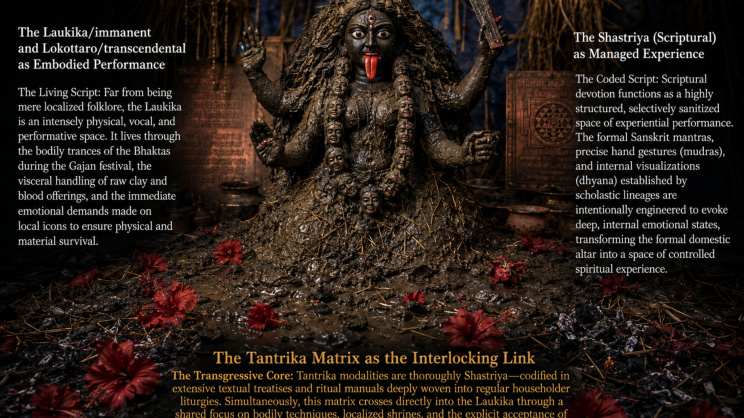
Scholarly history tells a different story. Religious traditions across the subcontinent are products of layered, contested, and dynamic negotiation, not of uniform continuity, as Brajadulal Chattopadhyaya has suggested. To understand these processes, however, we must resist one temptation: collapsing religion and ritual into a single domain. Talal Asad’s distinction is foundational here. Discursive traditions, comprising textual, theological, and normative formations, produce and contest religious authority. Embodied traditions, comprising practices, affects, sensory experiences, and corporeal disciplines, transmit and transform religious life. These two dimensions operate together. They are also in tension. In the case of Kaali, this distinction is not merely analytical. It is historically constitutive.
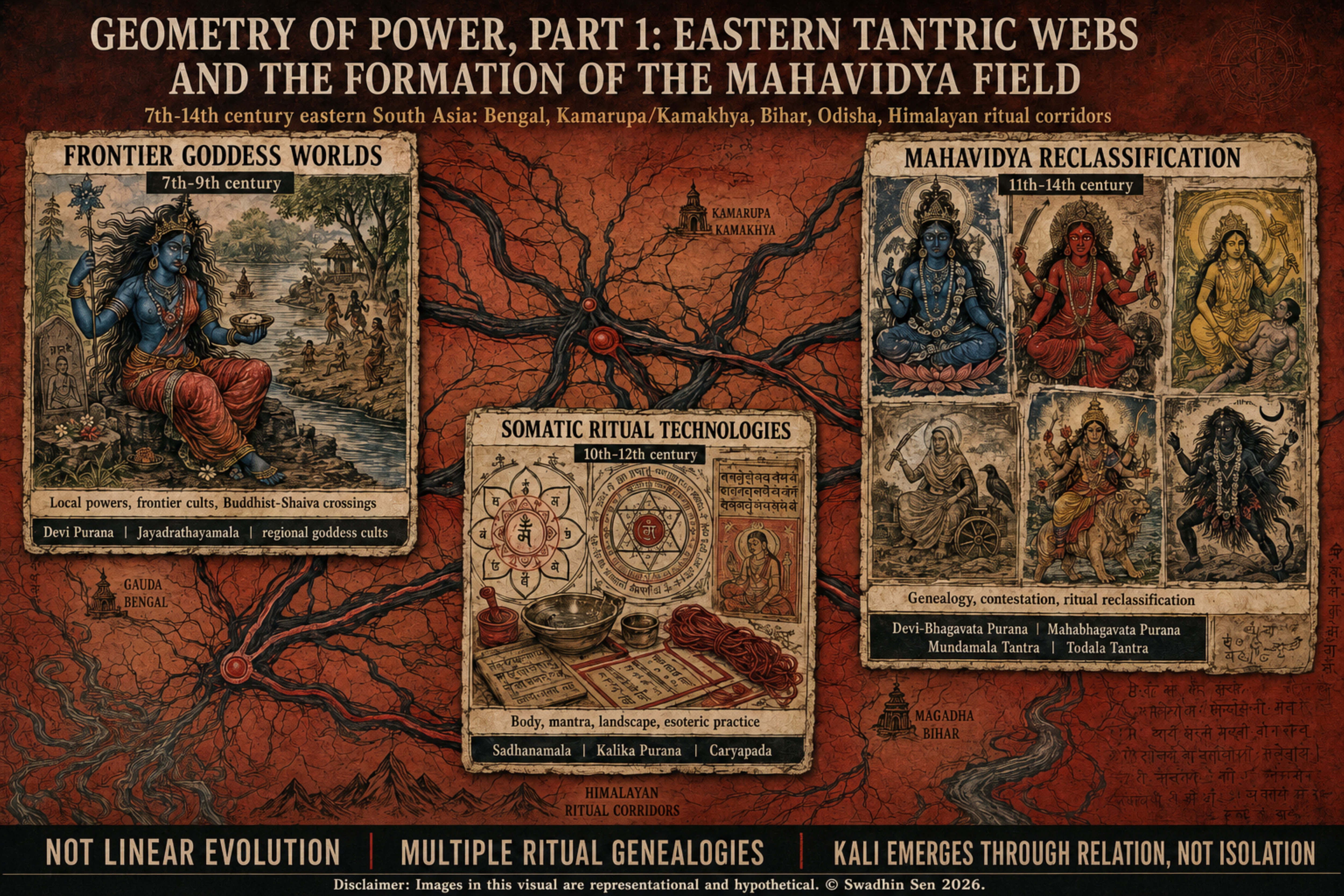
Bengal offers an especially instructive case. Its religious landscape has historically been plural, characterised by coexistence and contestation among Shakta, Vaishnava, Shaiva, Tantric, Buddhist, Jain, and indigenous traditions. This coexistence was not passive. It involved continuous, often contentious negotiation. The dominance of Shakta traditions, the depth of Tantric practice across caste lines, and the vitality of lokayata religious life gave Bengal a markedly different religious character from the Brahminical, Vaishnava-inflected mainstream of North India. This difference was not backwardness. It represented a distinct civilisational formation, the product of centuries of interaction, conflict, and synthesis.
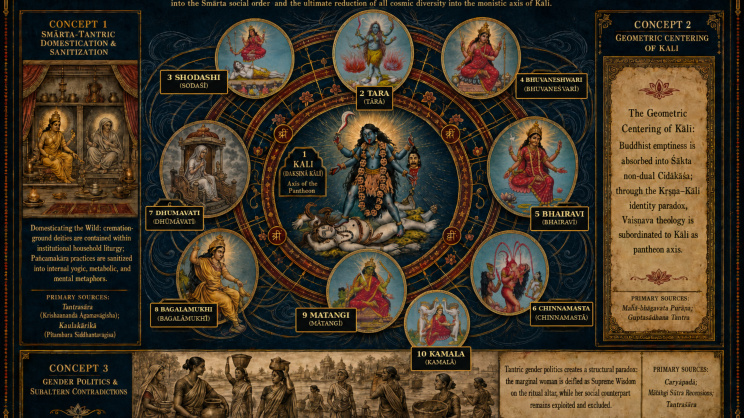
At the heart of this landscape stands Kaali. Few goddesses in the subcontinent carry such a weight of historical, thealogical, and affective complexity. Here, thealogy is used in contrast to the male/God-centric term theology: rooted in the concept of the goddess, the term was coined by Naomi Goldenberg. Kaali is a figure of terror and tenderness, cosmic sovereignty and intimate domesticity, transgression and devotion. She has never been a stable, unified figure. She has been a site of ongoing, contradictory reconfigurations in iconography, text, ritual, and the embodied lives of her devotees. Various studies by Elizabeth Harding, David Kinsley, Rachel McDermott, and Jeffrey Kripal have highlighted the seemingly heterogeneous reconstructions of the goddess Kali in Bengal. To impose a single identity upon her, whether as the domesticated consort of Brahminical orthodoxy, the nationalist symbol of colonial Bengal, or the vegetarian deity of Hindutva, is to commit epistemic violence against the irreducible plurality of her historical existence.
This paper pursues three objectives. First, it traces the pre-colonial processes through which goddess worship in Bengal was transformed through interactions among Shaiva, Shakta, Vaishnava, Tantric, Vajrayana Buddhist, and local traditions. Second, it examines how colonial modernity reshaped the sensibilities, affects, and embodied practices associated with Kaali. Third, it analyses the strategies through which the Hindutva project is working to homogenise, sanitise, and dissolve the plural, transgressive, and regionally specific traditions of her worship. An interrogative approach is essential throughout. Claims to religious authenticity, historical continuity, and cultural purity must be scrutinised, not accepted.
Deconstructing the origin myth: Scholastic codification and hagiographic invention
The dominant narrative of Kaali’s history is itself a product of particular historical interests. It presents the goddess as an ancient, unchanging figure whose worship has always taken the same essential form. This narrative is historically untenable. Goddess worship in Bengal underwent significant transformations over time, transformations that were neither natural nor inevitable but actively produced through specific textual, political, and social strategies. Studies by Narendranath Bhattacharyya, David Kinsley, Rachel McDermott, and Hugh Urban have explicitly demonstrated, from various perspectives, the reconfigurations of Kali and goddess worship in Bengal.
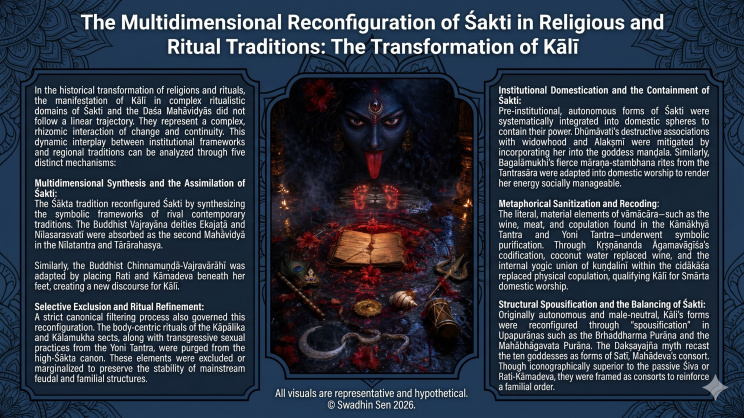
The sixteenth-century codification by Krishnananda Agamavagisha is a key example. His Tantrasara did not simply describe existing practice. It intervened in it. It provided a structural framework that allowed the goddess to enter domestic spaces while retaining certain transgressive attributes, but on terms that were now regulated, textually authorised, and socially managed. Its function was explicitly political: it brought the worship of Kaali within the orbit of Brahminical legitimacy without fully domesticating her. This was a negotiated settlement, not a natural evolution. It produced a particular form of the goddess, one that could be worshipped in the household, but whose more radical dimensions were simultaneously acknowledged and contained.
The hagiographic tradition surrounding figures such as Ramprasad Sen and Kamalakanta Bhattacharya further shaped this process. Their devotional poetry (Shakta Padavali) transformed Kaali from a figure of cosmic terror into an intimate, if demanding, mother. This was an affective reconfiguration, a shift in the emotional register of devotion. However, it was not a replacement for the older, more terrifying Kaali. It was a layering. The older forms persisted, especially in subaltern, Tantric, and non-bhadralok contexts.
The early medieval matrix: Discursive and embodied traditions in interaction
The pre-colonial religious landscape of Bengal was not a stable hierarchy with the goddess at its summit. It was a dynamic, contested field in which multiple traditions competed, negotiated, and sometimes merged. Between the twelfth and fifteenth centuries, the Bengal-Assam region was a site of intense religious activity: Shaiva, Shakta, Vaishnava, Vajrayana Buddhist, Sahajiya, Kalamukha, and Jain traditions all operated within this space. This vitality manifested itself at both the discursive and embodied levels. Textual production, iconographic innovation, and ritual practice were all sites of active contestation.
What distinguished this period was the absence of a single dominant orthodoxy capable of suppressing rival traditions. Brahminical authority was real, but it was not total. Royal patronage was distributed across traditions. Tantric lineages operated with significant autonomy. Subaltern and tribal communities maintained goddess-worship traditions that were only partially integrated into Brahminical frameworks. The goddess was not yet merely the domesticated consort of a male deity. She was a sovereign force whose worship cut across the social hierarchy. However, tensions, contestations, and assimilative processes were active across multiple registers. The state, kingship, and the sovereignty of rulers became connected to their subjugation of sacred places and incorporation of warrior goddesses, as Bihani Sarkar has shown.
Puranas, Upapuranas, and textual strategies of cosmic sovereignty
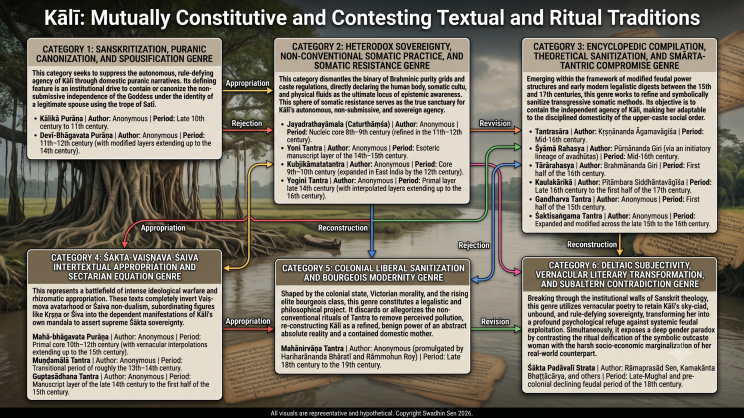
The Puranas and Upapuranas were not passive repositories of tradition. They were active interventions in ongoing religious contests. The Devi Bhagavata Purana, the Mahabhagavata Purana, and the Devi Purana placed the goddess at the cosmological centre, not as a consort, but as the supreme, self-sufficient source of all existence. These texts deployed specific narrative strategies: they assimilated rival deities into the goddess’s cosmological framework, subordinated male deities to her sovereignty, and established her as the ultimate ground of being.
The textual record is not uniform. Different manuscripts of the same Purana contain significant variations in iconography, in the goddess’s relationships with male deities, and in the scope of her authority. These variations are not merely scribal errors. They are evidence of ongoing negotiation. The Puranic tradition was a living, contested field. The assimilation of Tara from Vajrayana Buddhist traditions into the Shakta pantheon is one example of this process: a Buddhist goddess was reinscribed within a Brahminical cosmological framework, but the traces of her Buddhist origins, including her iconography and her association with transgressive practice, were never fully erased.
Shaiva–Shakta–Vaishnava negotiations and the politics of marginalised traditions
The negotiations among Shaiva, Shakta, and Vaishnava traditions in Bengal were not merely theological. They were political. Control over temple networks, royal patronage, and the authority to define legitimate religious practice were all at stake. The Kalamukha and Kapālika traditions offered modes of engagement with the goddess that were deliberately transgressive, existing outside the boundaries of Brahminical respectability. Their marginalisation was not a natural consequence of their theological position. It was the result of active suppression by competing traditions with greater access to political power.
Spousification, the strategy of making the goddess the consort of a male deity, was a key mechanism of this suppression. By inserting Kaali into a conjugal relationship with Shiva, Brahminical orthodoxy contained her sovereignty within a patriarchal framework. The goddess did not disappear. However, her independence was reframed as devotion. Her power was acknowledged, then subordinated. The Devi Mahatmya and later Shakta texts resisted this move, insisting on the goddess’s absolute primacy. However, the spousification strategy left lasting marks on Bengal’s iconographic and ritual traditions.
Vaishnava traditions introduced a further complication. The identification of Krishna as an incarnation of Kaali, or, in some textual traditions, as her devotee, was a strategy of assimilation that worked in both directions. It brought the goddess into the Vaishnava cosmological framework. It also brought Vaishnava affective registers, including intimacy, longing, and devotional surrender, into Shakta practice. The Sahajiya tradition, drawing on both Vaishnava and Tantric lineages, produced a synthesis that was neither fully orthodox nor fully transgressive.
The Mangalkavyas and the embodied grammar of sovereignty
The Mangalkavyas, vernacular narrative poems composed between the thirteenth and eighteenth centuries, are a crucial site for understanding how the goddess’s sovereignty was negotiated through embodied, popular practice. These texts are not theological treatises. They are performance texts, composed to be sung, enacted, and experienced in festival contexts. They narrate the goddess’s contests with male deities, her demands for recognition, her punishment of those who deny her sovereignty, and her ultimate triumph.
The Mangalkavyas did not simply reflect existing devotional practice. They shaped it. They provided a narrative grammar for the goddess’s relationship with her devotees, one that emphasised her power, her demands, and her capacity for both destruction and protection. This grammar was not confined to the elite. It circulated across caste and class lines, in village festivals, domestic rituals, and the performances of itinerant singers and storytellers. The embodied tradition of Kaali worship in Bengal was, in significant part, constituted through these texts and performances.
The Shakta Padavali: Intimacy, affect, and the devotional tradition
The Shakta Padavali, the body of devotional poetry associated with figures such as Ramprasad Sen, Kamalakanta Bhattacharya, and their successors, introduced a new affective register into the relationship between the goddess and her devotees. The terrifying, sovereign Kaali of the Tantric and Puranic traditions was not abandoned. She was encountered through a different emotional grammar: as a mother who was demanding, unpredictable, and sometimes cruel, but also intimately present and ultimately loving.
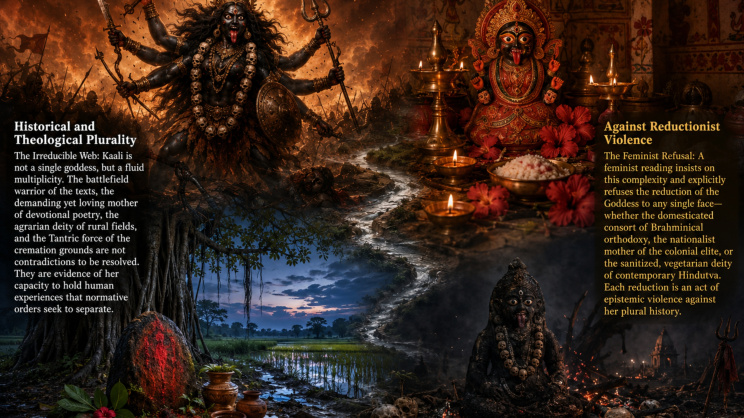
This affective reconfiguration was significant. It democratised devotion, making the goddess accessible to those who could not engage with the complex ritual requirements of Tantric practice. It also introduced a new form of embodied religious life: the devotional song as a mode of encounter with the divine. However, this democratisation had limits. The Shakta Padavali tradition was primarily, though not exclusively, a bhadralok phenomenon. It operated within a social context that was already shaped by caste privilege and gender hierarchy. The goddess’s intimacy was available, but on terms regulated by social norms.
Long-range genealogies: The core of tragic sovereignty
The pre-colonial history of Kaali in Bengal cannot be reduced to a single narrative of either progressive domestication or continuous resistance. The reality is more complex. The goddess was simultaneously subject to domesticating pressures, including spousification, Brahminical codification, and affective reconfiguration, and resistant to them. Her transgressive attributes survived not despite these pressures, but through a complex process of negotiation in which they were partially absorbed, partially contained, and partially preserved.
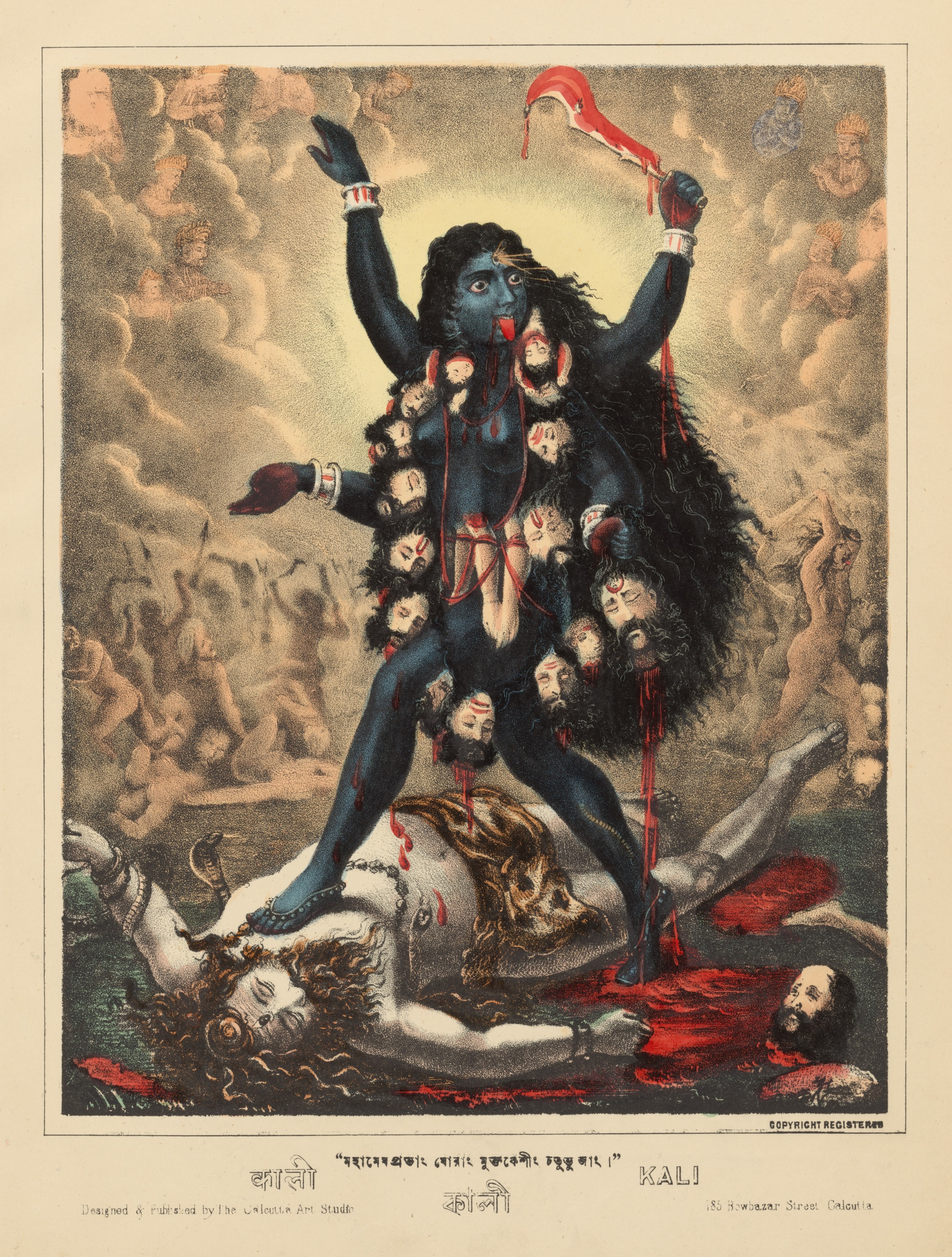
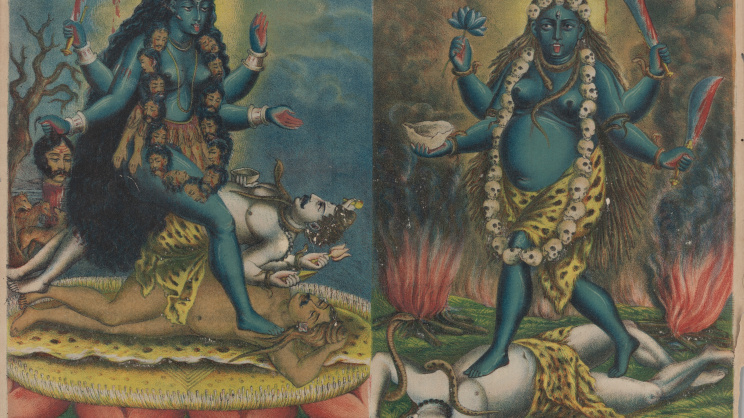
Why did the terrifying form of Kaali survive? The answer lies in what might be called her tragic sovereignty, the quality of her power that cannot be fully assimilated into any social or cosmological order. She stands on the body of Shiva, like the trampling goddesses, representing the strategic sublimation of one of the most powerful male deities. She wears a garland of severed heads. She demands blood. These attributes are not decorative. They are constitutive. They mark the limits of order, the necessity of destruction, and the irreducibility of the sacred to the socially manageable. Any tradition that sought to appropriate Kaali’s power had to engage with these attributes; it could not simply erase them.
This is why the history of Kaali is not a history of progressive taming. It is a history of ongoing, unresolved negotiation. Each attempt to domesticate the goddess generated new forms of resistance. Each codification produced new transgressive responses. The pre-colonial history of goddess worship in Bengal is, in this sense, a history of irreducible plurality, a plurality that colonial modernity would encounter, attempt to manage, and ultimately fail to suppress fully.
The contemporary reduction of the historical multiplicity of Kali and the imposition of an ahistorical singularity, along with vigilante Hindutva mobilisation to sanctify the Goddess, can largely be understood in the context of an increasingly widespread campaign across various religious traditions of South Asia. Interestingly, projects of purification and of returning to an imagined, original sacredness by rejecting perceived pollution represent a historical continuity with the symbiotic desires of colonial and nationalist imaginations.
Swadhin Sen is an archaeologist and professor in the Department of Archaeology at Jahangirnagar University. He engages with the intersections of fieldwork, texts, and the ethnographic present in various capacities. One of his key areas of interest is the reconfiguration of textual traditions within ordinary living traditions from transdisciplinary perspectives.
Send your articles for Slow Reads to slowreads@thedailystar.net. Check out our submission guidelines for details.

Do great leaders make history, or does history make them?
Poison and cremation: A forensic history of colonial Bengal

Partition, Bor Porong and the Chakmas’ unfinished struggle for belonging
The young radicals who challenged 19th-century Bengal
More men are cooking. But is patriarchy leaving the kitchen?
Everyday secularism and the Bangladesh we rarely talk about
Reading Sarat Chandra at 150, with empathy

Who really owned Britain’s royal jewels?
The 25,000-year history of betel nut chewing