Beyond equivalence: Translation and the politics of being understood

Linguistic diversity and language rights
Linguistic Diversity and Language Rights is the theme of International Translation Day, September 30, 2026, with “The Power of Being Understood” as its subtitle. The International Federation of Translators places translation, interpreting, and terminology at the centre of linguistic inclusion, emphasising their role in education, healthcare, justice, public services, and civic life.
The theme is timely because linguistic diversity exists under profoundly unequal conditions. Languages may be spoken by millions or by a small community; they may flourish in schools, government, publishing, media, and digital platforms, or remain marginalised, under-resourced, and increasingly vulnerable. Linguistic diversity is therefore not simply a celebration of the number of languages spoken in the world. It is a question of which languages have institutional recognition, technological resources, educational support, and the power to survive across generations.
This linguistic disparity is particularly evident in education. UNESCO notes that more than 7,000 languages are spoken or signed around the world today, yet only 351 are used as languages of instruction. It estimates that up to 1,500 languages may disappear by the end of this century, with the loss extending beyond vocabulary to cultural and historical knowledge.
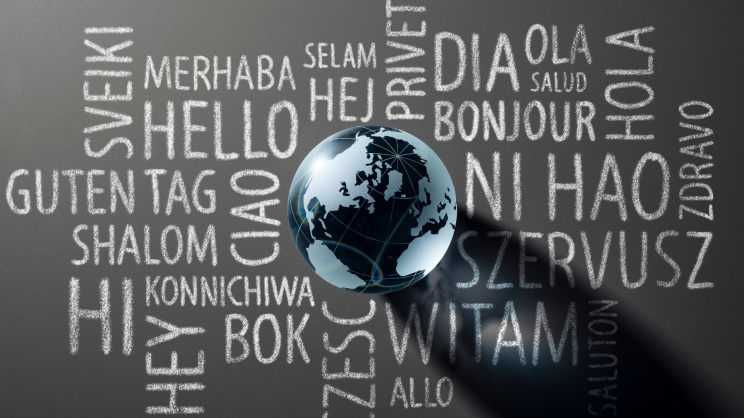
Language rights consequently mean more than the formal right to speak one's language. They include access to information, justice, education, healthcare, and public services in a language one understands, but also the right to preserve and transmit linguistic and cultural heritage. Fédération Internationale des Traducteurs (FIT) rightly emphasises translation and interpreting as practical mechanisms through which such rights can become meaningful.
Yet this creates an important paradox. Translation can make linguistic differences communicable. But can it preserve the linguistic difference itself? In other words, can we understand another language without reducing its distinctive ways of seeing, remembering, and expressing the world to our own?
When a language disappears, therefore, what disappears is not simply a collection of words. A way of wording, and thereby of worlding, the world may disappear with it.
The question matters because a language is not merely a container for information. It carries historical memory, cultural associations, social relationships, ecological knowledge, metaphors, conceptual distinctions, and particular ways of making experience intelligible. When a language disappears, therefore, what disappears is not simply a collection of words. A way of wording, and thereby of worlding, the world may disappear with it.
This is where the political significance of translation becomes more complicated. Translation can carry stories, knowledge, memories, and ideas across linguistic boundaries. But it cannot by itself preserve a language as a living medium. Translation can preserve communicability, but only linguistic survival can preserve the world from which that communicability arises.
The problem also has a transnational dimension. Languages do not remain neatly contained within nation-states. They cross borders through migration, displacement, colonialism, trade, education, and increasingly digital communication. A language carried by migrants may acquire new forms of life in another country; a diaspora can preserve a language while simultaneously exposing it to pressures of linguistic erosion. Linguistic rights, therefore, cannot be reduced to national language policy. They also concern the right of communities to sustain a living linguistic world within and beyond national boundaries.

The phrase The Power of Being Understood consequently invites a question more difficult than it initially appears: What does it mean to be understood?
To be understood is among the most fundamental of human needs. Yet understanding is never simply a matter of hearing words or converting them from one language into another. To understand another person is to encounter a world of meanings shaped by history, culture, memory, identity, experience, and circumstance. Translation begins where linguistic difference becomes an obstacle to that encounter, but it does not end with the substitution of one set of words for another.
This is where the conventional ideal of equivalence begins to falter.
The trouble with equivalence
Equivalence suggests that something said in one language can be matched by something that means essentially the same thing in another. At one level, this is indispensable. Without some correspondence between languages, translation would be impossible. Yet the closer we look, the more elusive equivalence becomes.
Words do not carry meanings as self-contained objects that can simply be removed from one linguistic container and deposited into another. They carry histories, associations, tonalities, cultural memories, social positions, and worlds of reference.
Equivalence concerns words. Understanding concerns worlds.
This distinction extends an argument I explored in my earlier essay, “Wording the word and worlding the world: Poetics and politics of translation,” published in The Daily Star on International Translation Day 2025. Language does not merely describe a world that exists independently of it; it participates in making experience intelligible—indeed, in worlding the world. The word is never entirely detached from the world it helps constitute.
Translation, therefore, cannot be understood simply as the transportation of words between already completed worlds. It is an encounter in which different ways of wording and worlding are brought into relation. Questions of representation, power, and intelligibility inevitably arise.
And that encounter is never politically innocent.
The dream of perfect equivalence has always been haunted by the irreducible differences between languages. A word may have a dictionary counterpart in another language and yet fail to carry the same emotional, historical, cultural, or philosophical resonance. An idiom may be translated literally and become unintelligible; translated freely, it may become intelligible at the cost of its strangeness. A metaphor may survive grammatically while losing the cultural memory that gave it force.
Translation, therefore, inhabits an uncomfortable space between sameness and difference. It must make something recognisable without pretending that the two languages are identical.
The paradox is that fidelity may sometimes require non-equivalence.
A translation that reproduces the words of an original with mechanical precision may betray its meaning, while a translation that departs from the original wording may preserve something more important: its irony, rhythm, emotional force, cultural implication, or pragmatic effect.
Translation, therefore, inhabits an uncomfortable space between sameness and difference. It must make something recognisable without pretending that the two languages are identical. It must cross a distance without claiming that the distance has disappeared.
The difficulty deepens when we move from translating words to translating human experience.

A culturally specific concept may have no exact counterpart in another language. A community's historical memory may resist reduction to the vocabulary available in the receiving culture. A speaker's identity may be inseparable from linguistic forms that cannot be reproduced elsewhere without modification. Even silence can carry meaning: what is left unsaid, what need not be explained to members of one linguistic community, may become invisible when translated into another.
I encountered the intricate interplay of such silence much earlier, as an undergraduate, when I attempted to translate Ernest Hemingway's “Hills Like White Elephants” into Bangla. The story's central conflict is never named: the word abortion does not appear, and its meaning emerges through euphemism, repetition, hesitation, and what the characters leave unsaid. I found myself listening not only to what the characters said but to what their words could not say. In trying to carry that silence across languages, all I could hear was Harold Pinter's paradoxical—and to me particularly daunting—formulation from The Homecoming: “You never heard such silence.”
Translation consequently confronts an enduring ambivalence that cannot be resolved merely by greater lexical accuracy:
How can the other be made intelligible without making the other identical to oneself?
That is the deeper problem of translation—and, ultimately, of being understood.
The politics of being understood
The politics of translation does not begin only when someone deliberately mistranslates, censors, distorts, or manipulates a text. It is already present in the act of interpretation itself.
Every translation involves choices. What should be retained? What can be omitted? What should be explained? Which cultural reference should be preserved in its foreignness, and which should be rendered through an approximate equivalent familiar to the target audience? When ambiguity exists, should the translator preserve the ambiguity or resolve it?
These are linguistic decisions, but they are also decisions about whose categories of meaning will govern the encounter.
Who is being translated?
Who is doing the translating?
For whom?
And according to whose understanding of what counts as intelligible?
The questions become especially consequential when languages meet under conditions of unequal power. Colonial histories provide stark examples. A colonised people could be rendered linguistically intelligible through the vocabulary of the coloniser while remaining profoundly misunderstood. Indigenous concepts could be translated into European categories that made them legible to colonial administration precisely by stripping away the conceptual systems from which those concepts emerged.
The problem also persists in less dramatic forms. A migrant's experience may be translated into bureaucratic language and thereby become administratively legible while losing the complexity of the life behind the documentation. A patient's words may be interpreted into the clinical vocabulary of medicine and become medically intelligible, while the cultural meaning of illness remains inadequately conveyed. A person's testimony may be translated into the formal language of law and thereby enter the institutional record, while something of the speaker's lived experience disappears in the process.
A person can be made linguistically intelligible without being fully understood, let alone authentically represented.
Here, a crucial distinction emerges:
A person can be made linguistically intelligible without being fully understood, let alone authentically represented.
Indeed, intelligibility itself can become a form of power. To render another person understandable is not always to encounter that person on their own terms. It can also mean fitting their experience into categories that the receiving culture already possesses. What appears to be successful translation may therefore sometimes become an act of assimilation: difference becomes intelligible because it has been reduced to what the listener already knows how to recognise.
The right to be understood, then, cannot mean the right to be made equivalent to the dominant language. It must include the right to remain different while still being heard. Yet inclusion alone does not dissolve hierarchy. Translation may bring a marginalised language into the field of recognition while leaving intact the terms by which recognition is granted. It can bridge linguistic distance while leaving linguistic hierarchy untouched. Linguistic justice, therefore, requires reciprocity over asymmetry: translation must become a two-way encounter in which neither language is simply the measure of the other, and each remains open to being altered by the encounter.

The impossible task
Translation is therefore a daunting, if not impossible, task—not because nothing can ever be translated, but because nothing can be translated without remainder.
Something always exceeds the translation: a connotation, a historical association, a rhythm, a cultural memory, a conceptual distinction, an ambiguity, an emotional register, or simply the fact that the original expression belongs to another linguistic world.
But the impossibility of translation is not an argument against translating. Quite the opposite.
Human beings translate precisely because complete equivalence is unavailable.
Translation is an activity of negotiating the distance that cannot finally be eliminated. Its achievement lies not in abolishing difference but in making communication possible without pretending that difference has ceased to exist.
The translator, therefore, works within a field of approximation, judgement, interpretation, and responsibility. Too little difference indicates that the translation has domesticated the other. Conversely, too much difference suggests that the target language may remain inaccessible.
The translator works within an unstable interval between intelligibility and alterity.
That is why translation has never been merely a technical activity. It is an interpretive practice in which the limits of understanding itself become visible, revealing an underlying incommensurability: some meanings cannot be fully rendered within the conceptual terms of another language without being altered in the process.
Being understood and the right to be heard
The political implications of translation become particularly clear when we consider language rights.
The right to speak one's language is not fully realised if no one is able—or willing—to listen to it. Likewise, access to healthcare, education, justice, government services, and civic participation cannot depend upon a person's ability to abandon their linguistic world at the institutional threshold.
But there is a difference between having one's words translated and having one's meaning recognised.
A person may receive an interpreter and still encounter an institution whose conceptual framework leaves little room for the experience being expressed. A language may be formally accommodated while the worldview embedded within that language remains marginalised.
Language rights consequently involve more than access to words. They involve recognition.
The deeper promise of translation is not simply that I can understand what you have said. It is that I might become capable of recognising that your way of saying it—and perhaps your way of seeing the world—is not reducible to mine.
Language death, translation, and transnational belonging
This distinction becomes even more urgent when a language itself is endangered.
Language death is sometimes described as the disappearance of vocabulary or grammar. But the loss is deeper. Languages encode relationships between people and place, memory and identity, generations and ancestors. They may preserve ecological knowledge, social distinctions, oral histories, metaphors, and concepts for which another language has no ready equivalent.
Translation can document and circulate some of these meanings. It can introduce a disappearing language's literature, stories, and knowledge to speakers of other languages. But translation cannot substitute for the continued life of the language itself.
This is where the translational and the transnational converge.
A language carried across borders can become a site of belonging for migrants and their descendants. It can survive in households, religious and cultural associations, literature, music, and digital communities, even when it occupies a marginal position in the surrounding society. Yet migration can also accelerate linguistic erosion as younger generations move towards the dominant language of education and public life.
The challenge, therefore, is not simply to translate minority languages into dominant ones. It is to ensure that linguistic inclusion does not become another name for linguistic assimilation.
A genuinely plural understanding of language rights must allow communities to participate in the dominant institutions of a society without requiring them to surrender the linguistic world through which they remember, relate, and imagine.
Translation can preserve communicability, but only linguistic survival can preserve the world from which that communicability arises.
Translation in the age of artificial intelligence
The problem becomes newly urgent in an age of machine translation and artificial intelligence.
AI can now translate enormous quantities of language at extraordinary speed. Large language models (LLMs) extend this capacity beyond conventional machine translation by generating translations that can account for context, idiom, tone, and stylistic variation with remarkable fluency. Such systems can significantly expand access, especially where professional translation is unavailable.
But contextual fluency should not be confused with situated understanding.
A model can infer patterns across vast multilingual corpora without inhabiting the historical, cultural, or experiential world from which an utterance emerges. It can produce a fluent rendering while missing the significance of what cannot be reduced to correspondence. It may translate an idiom smoothly while erasing the strangeness that matters, or resolve an ambiguity whose unresolved quality is part of the meaning.
The danger, then, is not simply that machines will mistranslate.
It is that fluency may be mistaken for understanding.
The problem is especially significant for languages with fewer digital resources. FIT notes that technological development has highlighted disparities between high-resource and low-resource languages and stresses the continuing importance of human language professionals in safeguarding quality, ethics, and inclusion.
The technological question is therefore not whether machines can translate more languages. They plainly can. The deeper question is what conception of language is being embedded in the systems that increasingly mediate communication.

If language is treated primarily as translatable data, what happens to the aspects of language that resist datafication: cultural memory, situated knowledge, ambiguity, irony, silence, embodied experience, and historical meanings carried by particular forms of expression?
The machine may translate the sentence.
But who—or what—translates the world behind the sentence?
The human remainder
This is where the continuing importance of the human translator becomes clearer.
The human translator does not simply possess information unavailable to the machine. More fundamentally, the translator occupies a position between worlds. Translation requires judgement precisely because languages are not closed systems of equivalent signs. The translator must decide what the text is doing, not merely what its words denote.
This does not make human translation infallible. Human translators can misunderstand, distort, impose assumptions, and reproduce cultural biases. Nor does it mean that machine translation has no interpretive value. Rather, it means that translation remains a domain in which judgement cannot be separated from meaning.
The translator's task is therefore not to eliminate uncertainty but to negotiate it responsibly.
Perhaps this is why translation remains an art even when it becomes increasingly technological. The ultimate challenge is not to make language perfectly transparent. It is to preserve enough opacity for differences to remain differences while making enough meaning available for communication to occur.
That balance can never be permanently achieved.
It must be negotiated again and again.
Beyond equivalence
The politics of being understood is thus perpetually fraught because understanding itself is never innocent. To understand another person is not simply to receive information from them. It is to interpret them through categories that are themselves historically and culturally situated.
Translation exposes this problem because it places two linguistic worlds in direct relation.
It reminds us that meaning is neither entirely inside words nor entirely outside them. Meaning emerges through relations among words, speakers, histories, contexts, and worlds. To translate is therefore to enter that relational space.
This is why translation cannot finally be reduced to equivalence.
Equivalence asks whether two expressions correspond. Translation asks what becomes possible when two worlds encounter one another.
The distinction matters. If we imagine translation as the perfect transfer of meaning, every difference becomes an error to be eliminated. If, instead, we understand translation as an encounter with difference, the inevitable remainder is not simply a failure. It is evidence that another linguistic world has not been completely absorbed into our own.
In this sense, the failure of perfect translation may be part of its achievement.
For what would it mean to understand another completely? Would complete understanding finally erase the distance between self and other—or would it erase the very otherness that made understanding necessary?
Perhaps the goal of translation is therefore not to arrive at a point where nothing remains untranslated. It is to create a space in which what cannot be fully translated can nevertheless be encountered.
The power of being understood lies not in the fantasy of perfect equivalence, but in the willingness to remain in conversation across irreducible difference.
Translation does not eliminate linguistic diversity. At its best, it makes diversity communicable without making it disappear.
And if language participates in worlding the world, translation participates in bringing worlds into relation. It does not simply move words across boundaries. It negotiates the boundaries through which human beings recognise one another.
That negotiation is necessarily incomplete. Perhaps even necessarily impossible. But it is an impossibility we cannot afford to abandon. For without translation, differences can become isolation.
Without difference, understanding becomes mere recognition of ourselves. Between the two lies the difficult, perpetually unfinished work of being understood.
Dr Faridul Alam, a former academic, writes from New York City.
Send your articles for Slow Reads to slowreads@thedailystar.net. Check out our submission guidelines for details.

Not love at first sight

How far can devotion take us? Radhe Jaggi’s BHAKTA explores the sacred

The moral hierarchy of pleasure: Who controls women’s bodies?

Inherited Memories / My grandmother’s world: Partition, Shia traditions and memories of Old Dhaka

The taste of childhood: Bengali food, family and memory

Along the Kapotaksha, in search of Madhusudan’s river

Where did gold come from?

Do we understand the children we try to teach?

AI is here. Can Bangladesh’s education system adapt?