


Our very own mango revolution

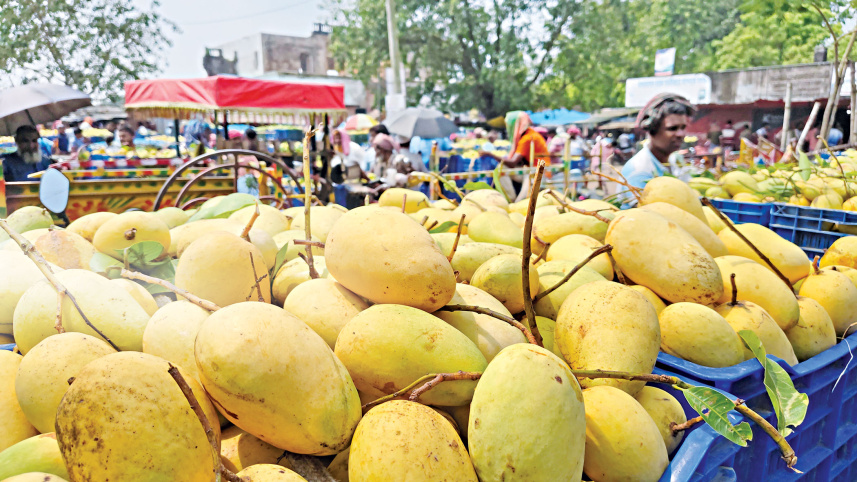
The mango harvest season in Bangladesh typically ends in August. But in Chapainawabganj, one of the country’s major mango-producing districts, markets were still bustling with golden-hued Katimon mangoes.
Selling for Tk 300-400 per kilogramme, Katimon mangoes now fetch nearly twice the Tk 150-180 per kg they commanded just a couple of years ago.

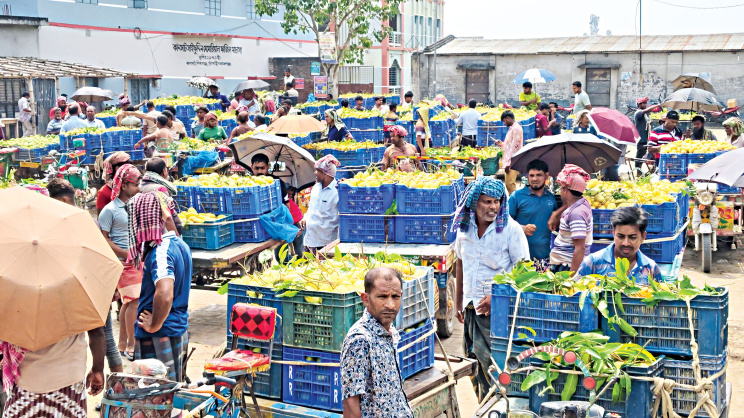
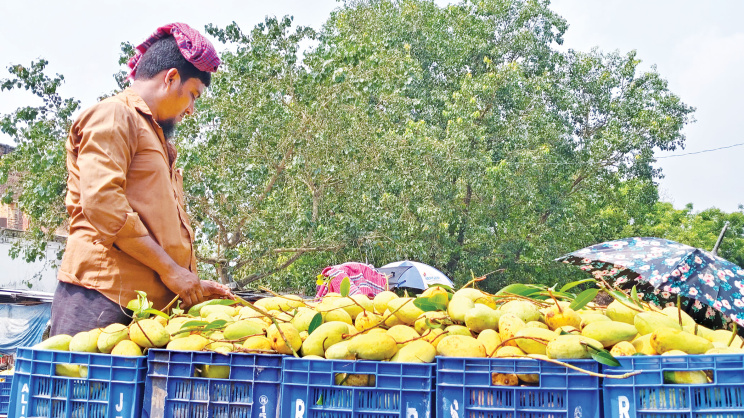
At Kansat Bazar in Shibganj upazila on September 19 morning, hundreds of mango-laden vans carrying growers and seasonal traders crowded the market, a sight that would have been difficult to imagine a few years ago.
Workers were busy transferring the fruit to wholesale warehouses for sorting and dispatch to Dhaka and other districts.
With persistent demand for off-season mangoes, growers often do not have to wait long to sell their produce, keeping the market as vibrant as it is during the peak season.
“Even a few years back, no mangoes were sold at this time of the year. Now, hundreds of vans loaded with ripe mangoes arrive daily,” said Rafiqul Islam, who owns a tea stall at Kansat Bazar.
At Kansat Bazar, Katimon mangoes sold for Tk 7,000-7,500, Banana mangoes Tk 17,000-18,000 and Ashwina Tk 5,000-6,000 per maund.
Growers and traders said Khirsapat mangoes had sold for nearly Tk 25,000-28,000 per maund a week earlier, while the year-round BARI-11 variety fetched Tk 6000-7000 per maund.
In comparison, seasonal mango varieties sold for Tk 1,200-3,000 per maund during the peak season.
Agriculture officers said the harvest of varieties such as Khirsapat, Banana and Ashwina usually ends around June-July, but farmers are using different techniques to bring them to market even in September.
Md Nayon Mia, upazila agriculture officer in Shibganj, said some 400-500 tonnes of Katimon mangoes, valued at an estimated Tk 6-7 crores, were being traded at Kansat Bazar daily.
“This trend is expected to continue for another month before Katimon supplies eventually dwindle. However, the variety remains available for rest of the year on a small scale,” he said.
Md Moniruzzaman, agriculture officer in Sapahar upazila of Naogaon, said 50-60 maunds of mangoes were being sold daily at the Sapahar market.
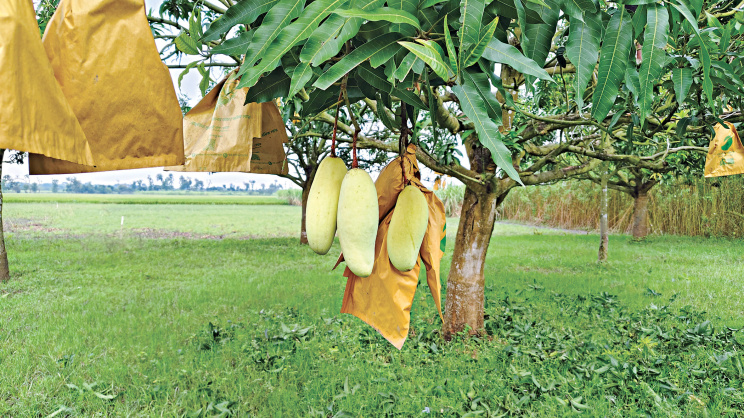
Abdul Wahed, president of the Chapainawabganj Chamber of Commerce and Industry and also the Bangladesh Mango Producers-Merchants Association, said the main mango season generates Tk 4,000-5,000 crores in sales for Chapainawabganj, while the off-season Katimon trade has brought in another Tk 400-500 crores annually over the last couple of years.
“Off-season yields are growing yearly by 15-20 percent. The total sales revenue is expected at Tk 500-700 crores by December this year,” he said.
According to the Department of Agricultural Extension, Katimon cultivation covered less than 1 hectare across Rajshahi, Natore, Naogaon and Chapainawabganj districts in 2014.
By the 2025-2026 season, it had expanded to 4,757 hectares across the four districts, including 4,462 hectares in Chapainawabganj alone.
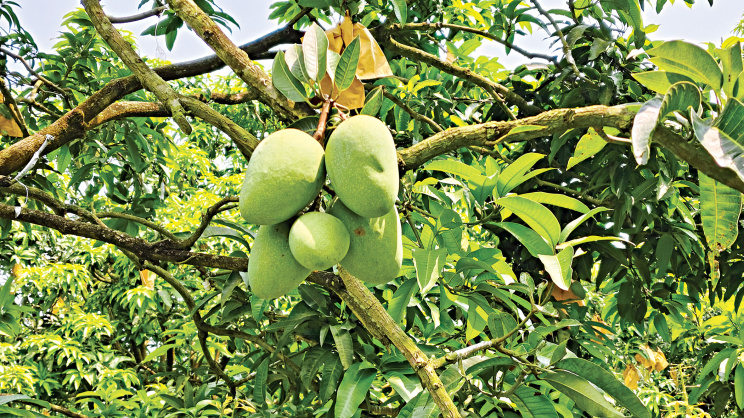
Cultivation of Katimon, a year-round variety from Thailand, began in Bangladesh in 2014 through a “Year-round Fruit Production and Nutrition Development Project”, led by Mehdi Masood, who now serves as a consultant for the DAE’s tissue culture laboratory and horticulture centre establishment project.
“In 2014, only 2,000 Katimon saplings were distributed nationwide through horticulture centres alongside promotional exhibitions. When visiting Shibganj, experts trained farmers on how to produce it year-round,” Masood recalled.
“Although critics initially dismissed the initiative and urged cutting down the trees, Katimon has since captured widespread popularity.”
 For all latest news, follow The Daily Star's Google News channel.
 Masood said growers were the true architects of its success, scaling up traditional grafting methods by applying 500-1,000 scions to medium-sized trees instead of just five or six.
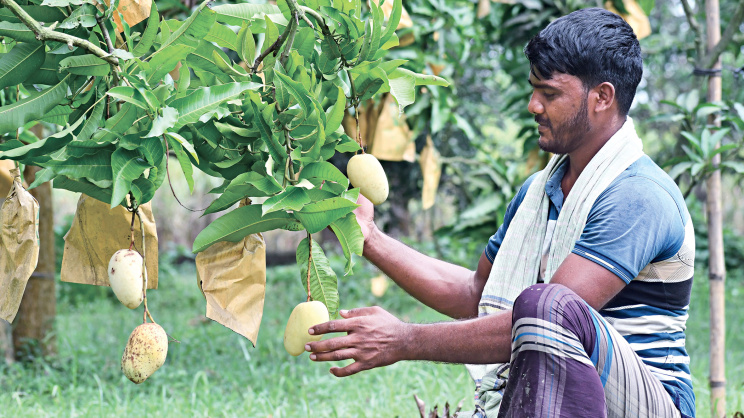
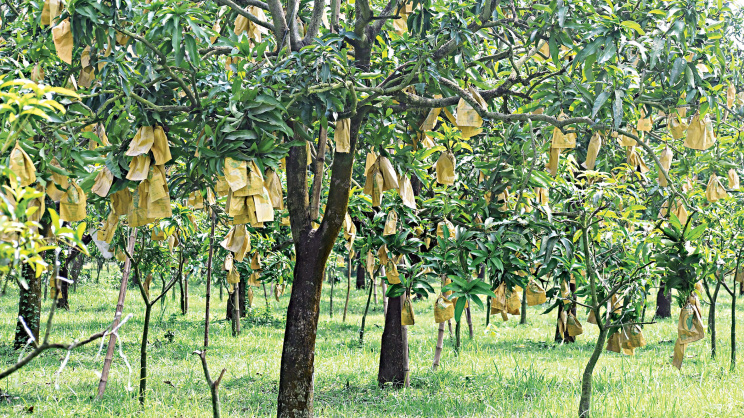
During visits to mango orchards across Shibganj, this correspondent found many trees bearing Katimon, alongside Banana, Ashwina and small amounts of Lakshmanbhog mangoes.
Many growers are grafting Katimon scions onto trees of traditional varieties such as Guti, Fazli, Ashwina and Lakshmanbhog.
Hasan Ali, who was harvesting Katimon mangoes in his 12-bigha orchard, said traditional varieties such as Fazli, Ashwina and Guti were no longer profitable, prompting growers to switch to Katimon through grafting.
The transition, he said, has been profitable.
Md Abdur Rakib, a grower from the Mobarakpur area of Shibganj, said, “Grafting Katimon scions onto Khirsapat trees and applying a specific hormone triggers simultaneous flowering on Khirsapat and Katimon branches, resulting in a mixed harvest of Katimon and Khirsapat mangoes which enhanced our profits.”
Hasem Ali, another grower from the Dorichok Beel area under the same upazila, said removing the initial flowers of Banana mango trees during the peak season prompts a second round of blooming two months later, producing high-value off-season fruit.
Md Sorof Uddin, chief scientific officer at the Regional Horticulture Research Centre in Chapainawabganj, previously known as Mango Research Centre, said growers had been experimenting with de-blossoming and hormone application.
“While some achieved success with varieties like Lakshmanbhog, Khirsapat, and Kalyanbhog, the resulting fruits often exhibit deformed shapes,” he said.
Sorof Uddin warned that disrupting regular bloom cycles does not guarantee better output and can sometimes suppress flowering in future. He recommended restricting such experimentation to genetically late varieties to reduce the risk.
Researchers, meanwhile, expect four new late varieties to be introduced within the next two to three years.
Two are being developed by the Regional Horticulture Research Centre in Chapainawabganj and the other two by the Chapainawabganj Horticulture Centre.
Shorof Uddin said BARI Mango-19, a hybrid derived from BARI Mango-3 and BARI Mango-4, was nearing release.
With favourable size, sweetness and strong stems that resist storm damage, the variety is suited for commercial production and typically matures from mid-July to mid-August, he said.
“Another promising hybrid variety, supposed to be released as BARI Mango-20, is a cross between Amrapali and Langra that mirrors the appearance and flavour of Langra while extending the harvest through August and September with high sweetness levels,” he said.
Both varieties are expected to be released within the coming year, Sorof informed.
The Chapainawabganj Horticulture Centre is also developing two late varieties known in India as Kananbhog and Late Amrapali, said its Deputy Director M Khaledur Rahman.
As growers increasingly turn to late varieties for higher returns, the centre will monitor the two selections over the next two to three years to assess their adaptability to local soil and weather conditions before wider promotion, he said.
Comments