


Unwanted Revenge: Breaking the fantasy of retribution
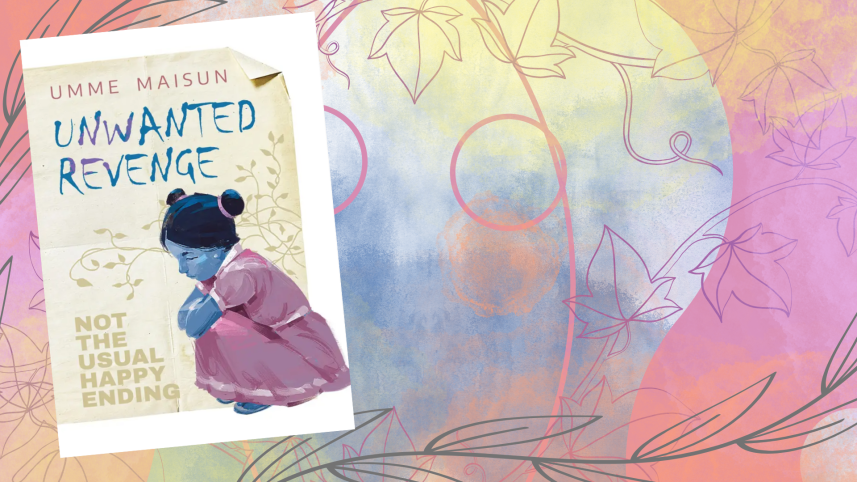
From Hamlet to The Count of Monte Cristo, revenge has always been a compelling phenomenon in literature. At first glance, it is cathartic, almost divine in the lost justice it promises to serve. A final act that restores balance, punishes the guilty and triumphs over the wronged. However, the anatomy of revenge thrives in duality. It can just as easily break free from its divinity, escaping simplistic moral binaries into something far more corrosive and tragic.
Umme Maisun’s Unwanted Revenge: Not the Usual Happy Ending delves into the devastating intersection of revenge, unresolved trauma, and the cycle of abuse. After debuting with the fantasy novel The Emerald Stone at just 11 years old, Maisun returns with a psychological thriller that is both a gripping mystery and a modern tragedy.

The novel follows Maya Sinclair, a young woman living in the shadow of a grievous childhood fire that took her family and left her with lasting scars that continue to define her life. Despite her bleak past, Maya remains determined to rebuild her life. A neon-yellow recruitment poster leads her to apply for a position at Norman Industries, and against countless odds, she secures the job. What initially appears to be an optimistic opportunity spirals downward after the sudden, suspicious death of a company executive.
She soon gets entangled in an investigation wrestling clandestine histories, fractured families, and unreliable alliances. The line between truth and deception begins to blur as Maya discovers that the mystery surrounding the company is inseparable from her own past. The novel morphs from a corporate thriller into a character-driven act of vengeance and cyclic violence. Every new piece of information distorts the narrative, forcing both Maya and the reader to reconsider what they believe to be true.
From a technical standpoint, Maisun demonstrates a clear understanding of suspense. Short chapters, careful cliffhangers, subtle foreshadowing and a steady stream of revelations maintain momentum throughout the novel. Moreover, the revelations succeed because they reframe earlier scenes that bring readers to the unsettling realisation that nothing previously accepted as truth can be trusted. Every conclusion is deemed uncertain, causing readers to continuously question their assumptions as familiar characters, motives and events are stripped of certainty.

However, the relentless pacing is sometimes seen to work against the novel's soulfulness. The major turning points come at a breakneck speed, leaving little room for characters or readers to fully process emotionally heavy moments before the narrative pivots to its next mystery. The prose is simple, favouring clarity over ornamentation. While the straightforward style is appropriate for the novel’s pace and tension, it sometimes explicitly spells out emotions that could have landed better through implication.
Though the driving fuel of Unwanted Revenge is its suspenseful mystery and manipulative narratives, the novel is most compelling in its introspection on suffering, accountability, and the hollowness of violent victories. The investigation primarily acts as a framework through which Maisun explores the perpetual nature of trauma across characters and how pain reshapes their identity and morality. This theme is mainly explored through the intertwined character arcs of Maya and Garett.
Rather than constructing the conventional hero-villain dichotomy, Maisun presents two individuals shaped profoundly by wounds who ultimately represent opposing responses to suffering. Maya’s trauma is internalised. She’s in a constant state of survival, with anxiety, recurring flashbacks, and withdrawal permeating her everyday existence.
Garett, the heir to Norman Industries and Maya’s closest ally, embodies intense childhood trauma turned outward. Deceptively introduced as charismatic and likeable, he gradually unravels into a morally ambiguous antagonist who suffers from dissociative identity disorder. Garett isn’t reduced to a caricature of evil but becomes an uncomfortable materialisation of how abuse and grief distort one’s perception of justice.
Both are survivors imprisoned by the past, yet the deliberate juxtaposition creates a creative yet unsettling thematic contrast. The moral ambiguity also becomes a defining characteristic. The novel repeatedly asks whether humanising a villain and understanding their suffering should alter our judgement of their actions. Characters resist easy boxes of heroes or villains, pure or evil. They are built in the uncomfortable space between perpetuating the same violent cycle, victimhood and accountability.
At its heart, Unwanted Revenge: Not the Usual Happy deconstructs the fantasy that violence restores balance. Every act of vengeance makes another victim, while every attempt to bury the past only makes it resurface more destructively. The greatest casualties of revenge often end up becoming the people who allow it to define their lives. Maisun diligently refuses easy absolution, with no satisfaction of revenge fulfilled, and instead shows how retribution can lead to nihilistic, poignant chaos.
Aleena is a struggling ninth grader who loves robots and revolutions. Send her your esoteric online archives at aleenayusra33@gmail.com.
 For all latest news, follow The Daily Star's Google News channel.
Comments