


High taxes and interest rates stifle investment

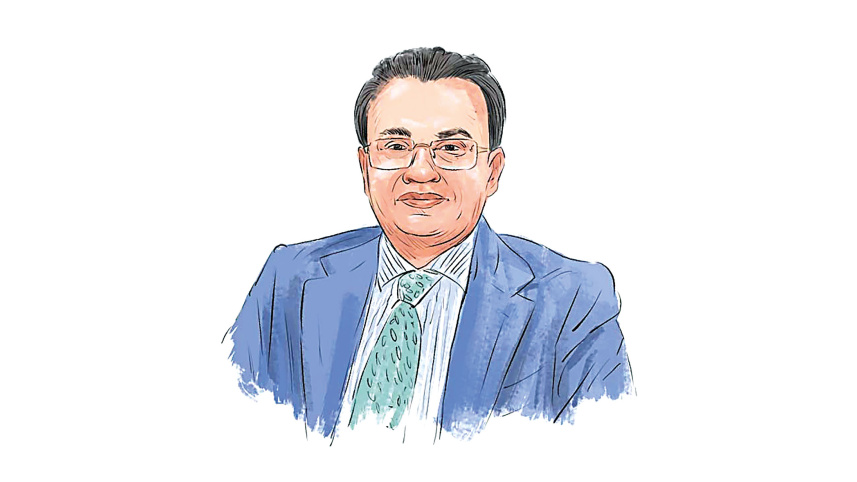
The National Board of Revenue (NBR) seeks at least 10 percent higher value-added tax (VAT) collection from businesses each year, regardless of whether their sales grow, according to Riad Mahmud, president of the Bangladesh Association of Publicly Listed Companies (BAPLC). He said the practice has created a “double whammy” for manufacturers already strained by years of overlapping economic shocks.
“It is common sense that revenue of many businesses dropped amid challenging situations,” he said. “Why would the government collect higher VAT even if the revenue of a company falls?

Speaking in an interview with The Daily Star ahead of the upcoming budget for fiscal year 2026-27, Mahmud traced the current stress to an unusual sequence of shocks, each arriving before companies had recovered from the last.
The Covid-19 pandemic disrupted production and demand worldwide. The Russia-Ukraine war then drove a dollar shortage and sharply raised import costs, particularly for energy and raw materials. Political upheaval surrounding the mass uprising in August 5, 2024 followed, and more recently, tensions between Iran and the United States have added a fresh layer of uncertainty.
“We have not seen four such shocks within such a short period in recent memory,” Mahmud said. “There is no set formula for dealing with a situation like this.”
The taka’s depreciation against the dollar has compounded the difficulty, making industrial raw materials and capital machinery significantly more expensive to import at a time when domestic demand remains weak.
Policymakers should not raise or impose any new tax on inputs or equipment, and should remove double taxation on dividends paid by listed companies. If this double taxation is addressed, it will be helpful to bring new investors to the market. The government is creating a fund for the companies that are already shut down. The same benefits should be ensured for restructured companies
Against that backdrop, Mahmud argues that policymakers should not raise or impose any new tax on inputs or equipment, and should remove what he describes as double taxation on dividends paid by listed companies — firms that have already paid corporate tax on their earnings.
“If this double taxation is addressed, it will be helpful to bring new investors to the market,” he said.
He also noted that the government is creating a fund for those companies which are already shut down. The same benefits should be ensured for restructured companies, he argued.
Mahmud is particularly critical of the divergence between the manufacturing and banking sectors. The removal of interest rate caps and the shift to market-based lending, he said, pushed borrowing costs to levels that many factories can no longer comfortably absorb. At the same time, banks have recorded some of their strongest profits in years.
“The overall pie has not grown,” he said. “Money has simply shifted from one pocket to another.”
The consequences, he warned, will eventually show up in employment and economic activity. Manufacturers under financial stress are already becoming more cautious about recruitment and expansion, even where they are not yet actively laying off workers.
“The manufacturing sector is directly linked to employment creation,” he said. “When factories become weak, they gradually reduce workers, stop hiring new employees and fail to increase salaries in line with inflation.”
“Come rain or shine, businesses must still repay banks,” he noted. “If companies fail to repay on time, they quickly become overdue or fall into special mention accounts.”
Mahmud said the current policy environment is creating a difficult situation where companies are paying increasingly high financing costs while demand conditions remain uncertain.
He referred to a recent government decision capping penal interest on overdue loans at 1.5 percent, saying it offered some relief. However, the BAPLC president considers it insufficient. He would prefer lending rates to be more directly tied to banks’ actual cost of funds.
“The central bank already has published data on banks’ cost of funds,” he said. If a bank’s cost of funds is 6 or 7 percent, he argues, a lending rate of 15 percent represents an unusually high spread that is difficult to justify in the current environment.
 For all latest news, follow The Daily Star's Google News channel.
 He acknowledged that capping lending spreads amounts to market intervention, something businesses do not ordinarily favour, but said the present circumstances warrant it.
“We are not usually supporters of intervention,” he said. “But this is an unprecedented situation.”
He said the policy support currently being provided resembles a temporary bandage designed to prevent a larger financial crisis.
“If businesses stop repaying loans, they become bad borrowers and the banking sector faces another problem,” he said. “So everyone is trying to manage the situation while it is still manageable.”
Mahmud also pushed back on the narrative that weak private investment reflects a crisis of confidence among entrepreneurs. Those who intend to stay and operate in Bangladesh still believe in the country’s long-term potential, he said.
“To me, it is not mainly a matter of confidence,” he said. “It is a matter of sources of funds and sources of investment.”
He argued that many businesses are avoiding fresh investment because borrowing costs have become too high to justify expansion. “If I go to a financial institution for borrowing and the interest rate is excessively high, then naturally I will not invest.”
He also criticised the lengthy process of raising capital from the stock market, saying new companies often need many months to secure funding through equity issuance.
“If a company starts the process now, it may take until next year to raise funds,” he said. “That delays investment decisions.”
Mahmud, however, remains hopeful. He said Bangladesh needs faster and more efficient capital market processes if policymakers want to encourage greenfield investment and industrial expansion.
He believes that if borrowing costs come down to reasonable levels, investment will follow. He says so from personal experience.
“If financing becomes reasonable again, investment will start,” he said. “At least I am ready to invest.”
Comments