


1.81cr Bangladeshis at risk of acute food insecurity: FAO
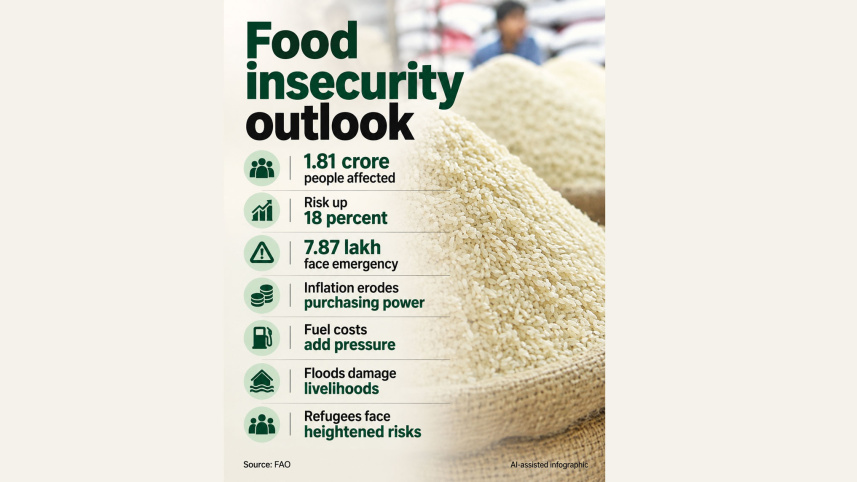
About 1.81 crore people in Bangladesh are projected to face high levels of acute food insecurity between September and December 2026, according to a report by the Food and Agriculture Organization (FAO) released this month.
The UN agency categorised the level of food insecurity in Bangladesh as IPC Phase 3 (crisis) and above -- under the Integrated Food Security Phase Classification (IPC), a standardised global scale used to measure the severity of food crises.

IPC Phase 3 is the threshold at which populations experience critical levels of acute food insecurity and malnutrition, requiring urgent intervention.
The FAO said the projected number of people facing acute food insecurity is 18 percent higher than the estimated 1.53 crore people during May-August this year.
The projection includes approximately 7.87 lakh people expected to experience IPC Phase 4, or emergency-level acute food insecurity, under the IPC framework.
“The deterioration in food security conditions is mainly due to constrained household purchasing power amid persistently high inflation, driven by elevated fuel and energy costs associated with disruptions in the Strait of Hormuz, while floods further affected livelihoods in some areas,” the FAO said in its Bangladesh country brief.
Bangladesh has been facing persistent inflation since fiscal year 2022-23. The 12-month average inflation rate rose to 10.13 percent in June 2025, the highest since FY12. In August 2026, consumer price inflation moderated to 8.26 percent, while the 12-month average inflation rate stood at 8.66 percent, according to the Bangladesh Bureau of Statistics (BBS).
According to the IPC, food security conditions are projected to worsen in Satkhira, Bagerhat, Barishal, Barguna, Bhola, Jhalokathi, Noakhali, Khagrachhari, Rangamati, Bandarban and Cox’s Bazar.
Gaibandha, Kurigram, Jamalpur, Sirajganj, Netrokona and Sunamganj are also identified as districts where people face acute food insecurity.
The FAO report said food security conditions remain of particular concern for approximately 12 lakh forcibly displaced Myanmar nationals residing in Cox’s Bazar and Bhasan Char.
Thirty-five percent of this refugee population is projected to face acute food insecurity between September and December, including 10 percent facing emergency-level acute food insecurity amid anticipated funding shortfalls for food assistance and limited livelihood opportunities.
Despite the increased risk of food insecurity, the UN agency forecast Bangladesh’s aggregate paddy output for 2026 at 6.19 crore tonnes, roughly 5 percent above the four-year average of 5.95 crore tonnes.
The FAO said the 2026 Boro paddy crop, which accounts for about 55 percent of annual output, yielded an estimated 3.19 crore tonnes, close to the previous year’s record level, supported by improved seed varieties.
The Aus harvest concluded in July at 41 lakh tonnes despite crop losses caused by flooding from May to July in Chattogram, Cox’s Bazar, Moulvibazar and Habiganj. The vegetative Aman crop is preliminarily forecast at 2.59 crore tonnes, it said.
As domestic production is forecast to rise, the FAO expects Bangladesh’s rice imports to decline sharply. Rice imports for calendar year 2026 are forecast to fall to 8 lakh tonnes from 19 lakh tonnes in 2025, it said.
 For all latest news, follow The Daily Star's Google News channel.
Comments