


Is Bangladesh’s budget really too big?

For more than a decade, the unveiling of the national budget has triggered a familiar chorus of reactions. Headlines routinely describe it as a “big budget”, a “massive budget” or a “debt-driven budget”, as if its size alone determines its significance.
Politicians, business leaders and ordinary citizens have all weighed in with sharp quips. Some dismiss it as nothing more than a “numbers game”. Others argue that the headline figure looks “impressive” but says “little” about the government’s actual spending capacity.
 For all latest news, follow The Daily Star's Google News channel.
 Yet a comparison with neighbouring countries tells a different story.
In terms of government expenditure as a share of gross domestic product (GDP), which is the value of all goods and services the country produces in a year, Bangladesh has one of the lowest ratios in South Asia and among countries scheduled to graduate from the least developed country club.
In simple terms, Bangladesh’s budget is like a small water tank serving a rapidly growing city.
The culprit? Mainly weak revenue collection. Relative to the size of its economy, Bangladesh’s tax take is among the lowest in the world.
But why does budget size matter in the first place?
Basically, government expenditure finances essential public services such as healthcare, education, law enforcement and public administration. Higher spending on healthcare and education generally benefits ordinary and marginalised people the most.
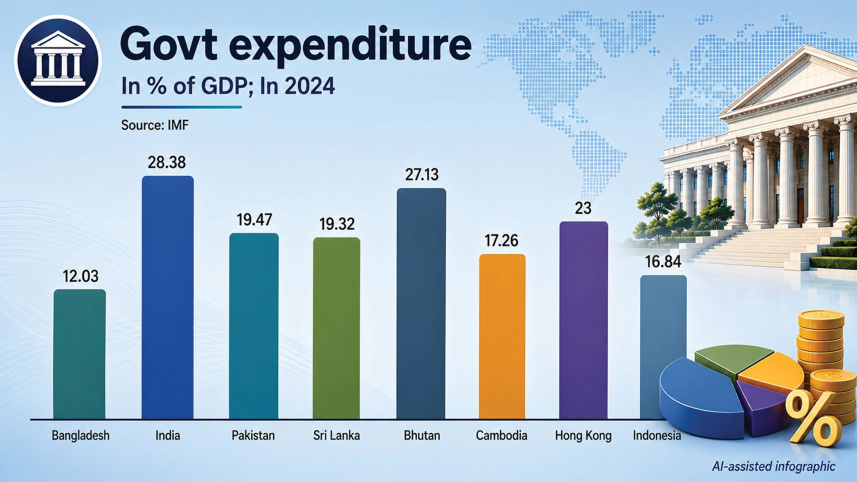
In 2024, Bangladesh’s government expenditure stood at just 12.03 percent of GDP, according to International Monetary Fund (IMF) data.
In the same year, government expenditure accounted for 28.38 percent of GDP in India, 19.47 percent in Pakistan and 19.32 percent in Sri Lanka. The ratio was 27.13 percent in Bhutan, 17.26 percent in Cambodia, 23 percent in Hong Kong and 16.84 percent in Indonesia.
In neighbouring Myanmar, government expenditure in 2024 amounted to 23.4 percent of GDP. Among countries graduating from the LDC category, the ratio in that year stood at 33.55 percent in Senegal and 35.81 percent in the Solomon Islands.
Globally, only a small number of fragile economies, including Ethiopia, Haiti, Sudan and Yemen, recorded lower government expenditure-to-GDP ratios than Bangladesh.
According to Fahmida Khatun, executive director of local think tank Centre for Policy Dialogue (CPD), the country’s limited public spending reflects weak revenue mobilisation rather than fiscal restraint. It is also linked to longstanding weaknesses in project implementation.
“But the main reason behind low government expenditure is low revenue collection,” she said.
The National Board of Revenue (NBR) collected Tk 370,874 crore in fiscal year 2024-25, falling Tk 92,626 crore short of its revised target. The original target had been Tk 480,000 crore before being reduced by Tk 18,500 crore.
As a result, the tax-to-GDP ratio dropped to just 6.8 percent, one of the lowest among countries at a similar stage of development.
Fahmida attributed the poor revenue performance to institutional weaknesses, limited administrative capacity within the revenue board and governance shortcomings.
She also pointed out that even the resources collected are not always used efficiently. Delays, cost overruns and implementation bottlenecks often prevent public spending from delivering the expected economic benefits.
The problem extends to foreign financing as well. Bangladesh has access to substantial external funding. But many foreign-assisted projects suffer from implementation delays, reducing the country’s ability to utilise those foreign resources.
The consequences are far-reaching.
Government spending supports essential services, builds infrastructure and strengthens social protection programmes. These investments improve living standards, reduce inequality and create conditions for stronger economic growth.
Infrastructure spending is particularly important because it encourages private investment and job creation.
“If physical infrastructure does not improve, private-sector investment will not be encouraged, and economic growth may fall short of its potential,” said Fahmida.
She said higher and more efficient public spending could therefore make a substantial contribution to both economic development and social welfare.
However, increasing expenditure alone is not enough. The quality and timeliness of spending matter just as much, added the economist.
The country’s development spending has long been hampered by implementation weaknesses.
According to the Implementation Monitoring and Evaluation Division (IMED), only 41.41 percent of the revised Annual Development Programme (ADP) allocation was utilised during the first 10 months of fiscal year 2025-26.
That means the challenge is not simply the size of the budget. It is also the state’s ability to execute projects efficiently.
Comments